
I hear from a lot of people that are filled with bilious fury about the tech industry, but few companies have pissed off the world more than Adobe.
As the foremost monopolist in software, web and graphic design, Adobe has created one of the single-most abusive, usurious freakshows in capitalist history, trapping users in endless, punishing subscriptions to software they need that only ever seems to get worse.
In the Department of Justice’s recently-settled case against Adobe, it was revealed that early termination fees for its annual subscriptions amounted to 50% of the remaining balance on the customer’s subscription, with one unnamed Adobe executives referring to these fees as “a bit like heroin for Adobe,” adding that there [was] “...absolutely no way to kill off ETF or talk about it more obviously [without] taking a big business hit.”
Let me explain how loathsome Adobe’s business model truly is.
The below is a screenshot from Adobe’s website from Wednesday March 18 2026.
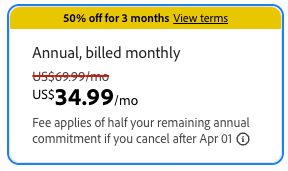
One might read this and think “wow, $34.99 a month, what a deal!” and immediately sign up without clicking on “view terms,” which reveals that after three months the subscription cost becomes $69.99 a month, and that this “monthly” subscription is a year-long contract.
Adobe deliberately hid (and I’d argue still hides!) its early termination fees behind “inconspicuous hyperlinks and fine print.” Want to cancel? Adobe charges you 50% of the remaining balance on your contract — so, in this case, over $300, and it justifies this by saying (and I quote) “...your purchase of a yearly subscription comes with a significant discount. Therefore, a cancellation fee applies if you cancel before the year ends.”
The DOJ did a great job in its complaint explaining how much Adobe sucks, just before doing nothing to impede them doing so:
Adobe utilizes other onerous cancellation procedures to trap consumers in subscriptions they no longer want. Consumers attempting to cancel online are forced to navigate numerous hurdles, including hidden cancellation buttons and multiple, unnecessary steps such as pages devoted to password reentry, retention offers, surveys, and warnings. Consumers attempting to cancel via phone or chat experience dropped calls and chats, significant wait times, and repeated transfers. Adobe uses a dedicated “Retention” team to discourage subscribers who try to cancel. Adobe relies on such obstacles to thwart cancellations and retain subscription revenues, depriving consumers of a simple mechanism to cancel as required by law.
An exhibit from the DOJ’s lawsuit shows the MC Escher painting of canceling an Adobe subscription and the six different screens that it takes to do so. The DOJ also added that Adobe’s subscription revenue had nearly doubled between 2019 ($7.71 billion) and 2023 ($14.22 billion), and since then, Adobe’s subscription revenue hit $20.5 billion in 2024 and $22.9 billion in 2025.
To be clear, Adobe is utilizing many very, very common tricks that the software industry has used to keep people from quitting, and basically every software service I use makes you jump through three to five different screens (fuck you, Canva!) to cancel. These tricks are commonly referred to as “dark patterns.”
Adobe’s Early Termination Fees are, however, uniquely awful, both in that they employ the evil sorcery of enterprise software contracts and deploy them against creatives that are, in many cases, barely keeping their heads above water in an era defined by people trying to destroy them.
I will say, however, that I’ve never seen anyone else bill monthly for an annual contract outside of the grotesque SaaS monstrosities I wrote about last week. These are egregious, deceptive and manipulative techniques that shouldn’t be deployed against anyone, let alone creatives and consumers.
And because this is the tech industry under a regulatory environment that fails to hold them accountable, the $150 million settlement with the DOJ doesn’t appear to have changed a damn thing about how this company does business, other than offering “$75 million worth of services for free to customers that qualify.” The judgment does not appear to require any changes to how Adobe does business, and $150 million amounts to roughly 0.345% of the $43.4 billion that Adobe made in 2024 and 2025.
Adobe is a business that runs on rent-seeking, deception, and a monopoly over modern design software mostly built by people that no longer work there, such as John and Thomas Knoll, who won an Oscar in 2019 for scientific and engineering achievements for creating Photoshop along with Mark Hamburg, who left Adobe the same year.
Adobe does not create things but extract from those that do, exhibiting the most egregious and horrifying elements of the Rot Economy’s growth-at-all-costs avarice. While you may or may not like Photoshop, or Lightroom, or any other Adobe property, that’s mostly irrelevant to the glorified holding corporation that shoves different bits around every few months in the hopes that they can scrape another dollar from their captured audience.
Much of this comes from Adobe’s abominable subscription products, most notably (and I’ll get into it in more detail after the premium break) its Creative Cloud subscription, a rat king of different services like Photoshop and InDesign and services like “Adobe Creative Community” and “generative credits” for AI services that are used to justify constant price increases and confusing product suite tweaks, all in the service of revenue growth.
All the while, Adobe’s net income has, for the most part, flattened out for the best part of two years at a seasonal range from $1.5 billion to $1.8 billion a quarter, all as the company debases its products, customers and brand in the filth of generative AI features that range from kind of useful to actively harmful to the creative process and have generated, at best, a couple hundred million dollars of revenue in the last two years.
I should also be clear that Adobe has an indeterminately-large enterprise division that includes marketing automation software like Marketo, which it acquired in 2018 for $4.75 billion along with Magento, a different company that develops a software platform to run corporate eCommerce pages, all so it can do battle with Salesforce. CNBC’s Jim Cramer once called Salesforce and Adobe’s competition “one of the great rivalries in tech,” and he’s correct, in the sense that both companies love to buy other companies to prop up their revenues. Adobe has bought 61 of them since the 90s, but Salesforce has it beat at 75.
They’re also both devious, underhanded SaaSholes that make their money through rent-seeking and micro-monopolies. The business known as “Adobe” is a design platform, a photo editor, a PDF creation platform, an eCommerce platform, a marketing automation platform, a content management system, a marketing project management system, an analytics platform, and a content collaboration platform.
You do business with Adobe not because you want to, but because doing business at some point requires you to do so. Use PDFs regularly? You’re gonna use Acrobat. Need to edit an image? Photoshop. Run a design studio? You’re gonna pay for Creative Suite, and you’re gonna get a price increase at some point because you don’t really have any other options. Doing a lot of email marketing campaigns? You’re gonna use Marketo, whether you like it or not. Adobe’s “Digital Experience” vertical is effectively a holding corporation for Adobe’s acquisitions to help boost revenue, an ungainly enterprise limb that grabs companies and puts it in a big bag that says “money me money now” every year or two.
Put another way, one does not do business with Adobe. It has business done to it.
There’s also the “publishing and advertising” division that has made somewhere between $146 million and $300 million a year since 2019, most of which comes from abandoned products and, ironically, the product that originally made Adobe famous — PostScript, the language that underpins most of modern printing, whether directly or by inspiring the various other alternatives that emerged in the following decades.
Adobe Is The Best Example of the Worthlessness Of The Modern Public Software Company That I Can Find
Adobe is a company that bathes in the scent of mediocrity, constantly doing an impression of an ever-growing business through a combination of acquisitions and price increases that are only possible in a global regulatory torpor and a market that doesn’t know when it’s being conned.
It’s also emblematic of how the modern software company grows — not through an honest exchange of value built on a bedrock of innovation and customer happiness, but the eternal death march of enshittification of its products and monopolization of whatever fields it can barge its way into.
In many ways, Adobe is one of the greater tragedies of the Rot Economy. Beneath the endless layers of subscriptions and weird upsells and horrible Business Idiots lay beloved products like Photoshop, Illustrator and InDesign that are slowly decaying as Adobe searches to boost engagement and revenue.
A great example is a story from Digital Camera World from 2025, where writer Adam Juniper talked about features he loved that were disappearing for no reason:
…in this case it was the Shape tool which, I admit, isn't an essential for most photographers. I wanted to put a speech bubble onto an image which is something I've done in the past (and like I have done for this article) to illustrate stories and it was dead simple because one of the built-in shapes in Photoshop's shape tool was a speech bubble.
Sure, it's not super elegant but, hey, we live in a world where an entire generation or two communicates using crudely drawn faces and representing emoji and that's apparently fine, so why can't I make a two word joke in a bubble like I used to be able to?All I wanted is for a robot with a camera to be saying "Smile, Human!" to illustrate a piece I'd commissioned for this very site about, well, how A.I. might not be the best at getting pictures of people. That makes sense, right? As an editor, it's more fun, I think, than the plain image of the robot with the camera.
But when I went to add the speech bubble to a layer, with the aim to put the text atop that, I found that the speech bubble that was there two decades ago had gone. There was still a shape tool and there were shapes to be found. As well as the predictable geometric ones, there were Folders of Wild Animals, Leaf Trees, Boats, and Flowers (and, oddly, not actually the explosion bubble depicted) by default.
I searched for a solution and, of course, paid for stock bubbles was one of the solutions. There is always a spend-more solution.
Juniper found that Adobe had intentionally moved the speech bubble to an optional “legacy shapes and more” feature, all with the intent of pushing users to pay for (per Juniper) Adobe’s add-on Stocks subscription.
In fact, a simple web search brings up user after user after user after user after user after user after user saying the same thing: that Adobe only ever seems to make its products worse, with the solution often being “find a way to revert to how things were done before the update” or “find another company to work with,” except Adobe’s scale and market presence make it near-impossible to compete.
Sidenote: I’ll also add that Adobe once told users of older versions of Lightroom Classic, Photoshop, Premiere, and Animate in 2019 that they were “no longer licensed to use [these apps],” and that “continued use may [put them] at risk of potential claims of infringement from third parties.”
Adobe even has the temerity to bug you with ads within its own products, nagging you with annoying pop-ups about new features or attempting to con you into a two-month-long trial of another piece of software using “in-product messaging” that’s turned on by default.
These are all the actions of a desperate, greedy company run by people that don’t give a shit about their customers or the things they sell.
A few weeks ago, CEO Shantanu Narayen said that he was stepping down after 18 years in which he took Adobe from a company that built things that people loved and turned it into a sleazy sales operation built on rent-seeking and other people’s innovation.
Those who don’t bother to read or know anything about software will tell you that the “threat of AI” or “the SaaSpocalypse” is killing Adobe — a convenient (and incorrect!) way to ignore that Adobe is only able to grow through acquisitions or price-hikes.
The sickly irony is that acquisitions were always in Adobe’s blood from the very early days of Photoshop. It just used to be run by people who gave a fuck about whether software was good and customers were happy.
Reporters and Analysts: Stop Blaming Software Companies Being Run Like Shit On AI
In fact, I’m going to have a little rant about this.
I’m sick and tired of journalists from reputable outlets talking about “the threat of AI” to software companies without ever explaining what they mean or any of the economic effects involved. Adobe isn’t being killed by “AI.” We’re at the end of the hypergrowth era of software, and the only thing that grows forever is cancer. It also gives executives Narayen cover for running operations built on deceit, exploitation, extraction and capital deployment. Years of evaluating these companies entirely based on their revenues and imagined things like “the threat of AI” without any connection to actual fucking software makes the majority of the analysis of software entirely useless.
Nothing even really has to change about reporting. Just use the product! Use it and tell me how you feel. Talk to some customers. Spend more than 20 minutes on Facebook. Use Photoshop and tell me how many popups you get, or whether it inexplicably slows down or starts eating up RAM. You’ll quickly see that we’re in a crisis that’s less about AI and more about creating a tech industry powered by creating mediocre software and putting far more effort into making a business impossible to avoid.
Decades of this psuedo-journalism mean that a great many business reporters are simply unprepared to discuss what’s actually happening, evaluating software companies based on 10-Ks and shadows on the wall of a fucking cave.
The tech industry has done a great job of scaring reporters into thinking that having a negative opinion is somehow “not supporting innovation,” and I want to be clear that refusing to criticize the tech industry is what’s actually stopping innovation. Letting these companies get away with ruining either the products they build or the products they buy is creating a climate in which the most-successful companies are the ones that crowd out the competition and raise prices.
Adobe’s growth has come from being a fucking asshole. Its decline has come from the limitations of one’s ability to buy other companies and claim their revenues as your own and constantly increasing the price of your services. If there were a “threat from AI,” you’d actually be able to name it and point to it rather than referring to it like the Baba Fucking Yaga.
I’m going to put it very, very bluntly: the last 15 years or so of tech earnings have been earned predominantly by fucking over the customer through either reducing the value of the product or increasing its price. The tech and business media’s lack of attention to the actual state of technology is partially to blame, because Number Has Always Gone Up, and thus the assumption was that the underlying product quality was raising that number versus screwing over the customer.
Wake up! Look at every tech product you’ve used and tell me if it’s improved in the last decade! Facebook’s worse, email’s worse, browsers are either the same or worse, Google Search is worse, Adobe Creative Suite is worse, iPhones might seem better but the software is bloated with endless options and dropdowns and ads and nags, pretty much the only thing that’s improved is physical hardware because shipping bullshit, useless hardware is much, much harder.
This total lack of awareness of the actual state of the world is why these companies have gotten away with so much shit over the years, and why so many of you are incapable of actually capturing this moment. You are not actually looking for what’s happening, just for what might comfortably fit your analysis of the world.
Vaguely blaming things on “the threat of AI” allows you to continue pretending everything will grow forever, and rationalize bad behavior by framing every problem through the lens of disruption and innovation. A company that’s on the decline “being disrupted by AI” allows you to believe that another company will grow and take its place. Saying that a company is growing revenue “because their AI bets are paying off” allows you to ignore price increases and deteriorating software, and think the world is a better place, even if you can only do so by living in a fantasy.
Gun to your head, what is the threat to software from AI? How is it manifesting, and who is the threat? Is it OpenAI? Anthropic? Are their products actually replacing anything? Can you prove that, or is this just something you heard enough people say that you’re now comfortable believing it?
The actual threat to software companies is their hatred of innovation and their customers, and what's happening to Adobe will eventually happen to them all.
Products that provide value are enshittified, and the products they acquire have been (or came pre-) enshittified. The prices have gone up. The nags to consumers have increased. Revenues have gone up because these companies have been allowed to buy effectively anyone they want — though Adobe was, thankfully, stopped from acquiring Figma — and increase prices whenever they want, and when it’s come time to evaluate the health or strength or actual value of these companies, all that anybody ever looks at is revenues.
Perhaps your argument might be that the markets don’t care about how good something is, except the markets are influenced by journalism and financial analysts. The markets celebrate dogshit companies like Meta that make broken, harmful products because their disgusting monopolies allow them to brutalize businesses and consumers alike.
What we’re seeing in the software industry are the limits of how much one can abuse a customer, a business model that SaaS enabled and both the tech media and analysts celebrated because it worked, in the sense that it worked at making the software companies rich. And because the people at the top have chased out anybody who knows what “good” looks like and empowered vacuous growth-perverts at every level, these companies have no idea what to do to stop the tide from coming in.
Your argument might be that these companies couldn’t grow so fast without fucking customers over or making their products worse — and at that point you should ask yourself what you want the world to look like, and how willingly you’ve participated in making it look how it does today.
The decline has yet to fully begin, but a CEO doesn’t suddenly decide to quit their company after 18 years during record results because the future looks bright.
The real SaaSpocalypse is the comeuppance for decades of focusing businesses on growth by any means possible, and the hysterical non-analysis of blaming it on AI is a sign that those responsible can’t be bothered to live in anything other than the dreamworld of venture capital and Ivy League business schools.
Adobe’s story is a tragedy — the tale of the great things that can be done with software for the betterment of humanity, and how usurious Business Idiots can hijack it as a means of expressing eternal growth to the markets.
This is The Hater’s Guide To Adobe, or The Adobe Enshittification Suite.