
If you liked this piece, you should subscribe to my premium newsletter.
It's $70 a year, $18 a quarter, or $7 a month, and in return you get a weekly newsletter that’s usually anywhere from 10,000 to 18,000 words, including vast, detailed analyses of NVIDIA, Anthropic and OpenAI’s finances, and the AI bubble writ large.
My Hater's Guides To the SaaSpocalypse, Private Credit and Private Equity are essential to understanding our current financial system, and my guide to how OpenAI Kills Oracle pairs nicely with my Hater's Guide To Oracle, as well as the Hater’s Guide To Oracle (Part 2). I've even done a two part Hater's Guide to NVIDIA.
Subscribing to premium is both great value and makes it possible to write these large, deeply-researched free pieces every week. To subscribe, use one of the following links: $70 a year, $18 a quarter, or $7 a month.
Soundtrack: Queens of the Stone Age — Infinity
Two years ago, NVIDIA CEO Jensen Huang said that “the more you buy, the more you save,” referring to its new (at the time) Blackwell GPUs that would “reduce LLM inference operating cost and energy by up to 25x.” Two years later, those supposed gains have been pared back to 10x, based on case studies with private inference providers that do not share their margins and are most-decidedly not profitable, and absolutely nobody seems to mind that NVIDIA overstated the gains on Blackwell (in a vacuum, in specific circumstances) by 150%, partly because these numbers are utterly meaningless, and partly because the media in most cases ardently refuses to criticize this company.
Blackwell being “10x better” than Hopper does not appear to have made any AI startups profitable (or even more profitable), it does not appear to have lowered anyone’s costs in a way that we can measure using dollars and cents, and as a result, I feel very little when I’m told that Vera Rubin provides “up to 10x more tokens per megawatt,” especially as that was with DeepSeek R-1, a year-and-a-half-old open source model.
Nevertheless, all of this is immaterial to the larger problem that none of this appears to have resulted in anything tangible other than horrendously-overstuffed balance sheets and spuriously-puffed stock prices.
Hyperscalers will have sunk over $1.3 trillion dollars into generative AI by the end of 2026, and have plans to spend a trillion dollars more next year. On a very rational level, nothing that large language models (LLMs) have done, do or will do in the future can or will ever bring in the more than $2 trillion (or more) in brand new revenue that will be required to make any of this worth it.
To be more specific, between March 2022 and July 2026, Meta, Google, Amazon, and Microsoft added over $850 billion in property, plant, and equipment (PP&E), nearly tripling their PP&E from $498 billion or so, and in a period where they spent over $1 trillion in capital expenditures.
In that same four year period, none of them have disclosed their actual revenues from AI or AI-related services, and, as of their latest quarters, capital expenditures now represent 24.4% of Amazon’s, 33.7% of Meta’s, 37.3% of Microsoft’s, and an astonishing 43.4% of Google’s revenue, a number that’s steadily increased over the last three years.
They’ve also added over $307 billion in on-balance sheet debt, leaving them with a total of $557 billion, doubled from $250 billion or so in March 2022. I mention on-balance sheet because Nikkei reports that Meta, Google, Amazon and Microsoft have over $1.35 trillion in off-balance sheet debt — either data centers/GPUs yet to be delivered, or debt raised via SPVs that shift the actual “ownership” of them over to another party as a means of making them look less-indebted than they really are.
To be clear, it’s totally fine accountancy-wise to not include leases or commitments yet-to-commence, but it’s very important to know how big an anvil hyperscalers are conjuring above their heads. Google, for example, has $811 billion in contracted future spending commitments as of its latest quarter, increasing by a dramatic $661 billion ($478 billion or so in the latest quarter) in the last 6 months, and Meta has over $237 billion in non-cancellable contractual commitments.
Over $167 billion of that on-balance sheet debt has been raised in bonds across Google, Meta, and Amazon, with its $25 billion bond sale from July receiving (per Bloomberg) a cool reception, with “demand [settling] at 1.6 times the deal’s size…[and to] put that in perspective, US high-grade corporate deals have seen orders average around four times their size this year.”
For some further perspective, per Freedom Broker’s Saken Ismailov, there was around $100 billion of demand for $20bn of Google’s three to fourty-year-long bonds (5x) and around £9.5 billion of demand for its £1 billion 100-year bond sale (9.5x).
As of last week, Google’s century bond has already lost 10% of its value.
This is a problem, as all four are certain to become repeat visitors to the bond markets. Herman Chan of Bloomberg Intelligence estimates that hyperscalers will need to raise $1.5 trillion in investment-grade debt in the next five years just to keep up with their trillions in estimated capital expenditures.
To make matters worse, hyperscaler bonds are, to quote Bloomberg, “...underperforming on almost every metric,” and are “in the red on average,” though that includes Oracle, whose credit just got downgraded to a single rung above junk by S&P Global.
Sidenote: As an aside, whenever you hear bonds are measured in something called “spreads,” it’s how much more an investor would expect to get paid above the current US treasury bond rate in “basis points,” with 100bps referring to 1%.
The thing is, when treasury rates go up, bond prices go down, even though you’re still getting paid on the coupon (the yield, IE: the money it pays regularly) and the payoff at the end of the bond’s life. As a result, spreads exist to tell you how much more or less it pays than an equivalent US treasury bond, or a similar ultra-low-risk government bond.
Bonds are also generally raised in tranches, in different currencies, at different lengths, which makes their prices less useful than you’d think. Furthermore, bonds can be resold to third-parties, and often for cheaper than the original purchase price — which is something that would happen if people started to get worried about the company not being able to pay back its debts.
Let’s give you a (hypothetical) example. US Treasuries are 5%, and a hyperscaler raises $10 billion in bonds at 6.5%.
The “spread” here would be 150bps — which suggests that investors think they’re mostly safe. In general, 150-300bps is worth keeping an eye on, 300bps+ is worrying, and 700bps+ is a company that the market is concerned about repayment. For example, a high-credit company's bonds would have an average OAS of 20-80bps, or an investment grade (like Amazon at 118bps) would have between 80-150bps.
And, well, then there's the rest.
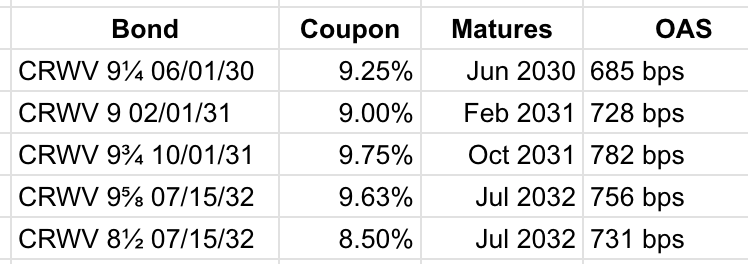
For example, CoreWeave’s $1.25 billion in bonds raised in June 2026 currently sit at an option-adjusted spread of 756bps, despite being issued somewhere around 540bps on the day of issuance. Put another way, bondholders have dumped the shit out of them in the last month and have material concerns that CoreWeave won’t pay. To make matters worse, the average for its bond/credit rating (Ba3) is 200-400bps, meaning the market is really, really concerned about whether CoreWeave pays its bondholders.
All of this is a way of telling, in realtime, how much riskier a bond might be than the rock-solid guarantee of the US government (or whatever currency it was raised in). When I say “option-adjusted spread,” that’s a forward-looking model that strips out things like if a company can recall (IE: buy back a bond early) a bond to give you a generalized spread that tells you how the market feels about a particular bond.
Things can muddle a little bit depending on the company, or should I say one company in particular.
EDITOR'S NOTE: To be clear, this is an edit to the piece, because I wanted to clarify some stuff and the article I previously linked got things wrong.
Also, thank you to eagle-eyed premium subscriber Clayton for noticing!
So, SpaceX's "investment-grade" bonds (issued in late June) are rated BBB - the lowest level possible - and have an average OAS of around 270bps, with the widest spread sitting at 346 (for its 30-year dated bond). I previously linked to a piece that said it was "trading like junk," and I was completely right in that assessment, but didn't give you, the reader, the juice to understand why.
As of writing, the average spread of Bloomberg's Corporate High Yield Index - which, to be clear, is made up of junk bonds in most cases many rating levels lower than SpaceX - is around 282bps. In other words, Musk's "investment-grade" bonds are trading like junk!
As complex as all of this sounds, it’s all pretty simple: hyperscalers have borrowed a bunch of money to fund AI, to the point that it’s pushing them into cash-flow negative territory, and every time they raise more money, bondholders become more worried about them paying it back, especially given that both Amazon and Google have now gone cash-flow negative as of their latest quarters.
Or, put more-simply, the more they raise, the more it costs.
Then there’s the other, more-obvious problem — the more they buy, the more they spend.
As I wrote in the Hater’s Guide To The Memory Crisis, the sheer scale of Microsoft, Google, Meta and Amazon’s spend on AI data centers has led to a massive supply chain crisis and price-gouging from the triopoly of Micron, SK Hynix and Samsung, with Micron alone bumping prices for DRAM by 60% in its last quarter, shooting up the price of every single kind of RAM possible, at a rate increased by the amount of GPUs and servers that hyperscalers buy.
To give you a sense of how memory hungry AI is, single 72-GPU GB300 NVL72 AI server has over 20 terabytes of high-bandwidth memory (used almost exclusively in GPUs and other AI chips), and 17 terabytes of the LPDDR5X RAM used in mobile devices, and a gigawatt data center has thousands of those NVL72 servers (or something similar). Moreover, that high-bandwidth memory that AI GPUs use requires more wafer space during manufacturing — further reducing the amount of manufacturing capacity for other kinds of memory.
This naturally creates a vicious cycle. The more AI servers that hyperscalers buy, the more demand they create for RAM and high-bandwidth memory, which increases the price of RAM and HBM, which makes the AI servers more expensive, which means hyperscalers need more money, and because AI has yet to provide meaningful improvements in revenue or cashflow, they’re forced to raise more debt.
The more they raise that debt, the more expensive that debt becomes, and the more of that debt they use, the more of it they need, because the more they spend, the more the stuff they’re buying costs, which means they need more debt.
And, to be clear, I’m talking about some of the best-capitalized companies in the world with some of the best credit in the world. Things get magnitudes harder and more expensive for a neocloud like CoreWeave (or a counterparty), or a data center SPV, or anyone that isn’t backstopped by a hyperscaler, like Google’s backstop of Cipher Mining’s data center for Anthropic.
Are you beginning to see the problem yet?
The Further It Goes, The Worse It Gets
You can dance around making whatever noises you want about future GPUs or cadres of data centers magically giving somebody the margins you crave, but it appears that using AI only seems to be getting more expensive for hyperscalers, the companies that rent the GPUs, and basically anyone running a business using AI models.
Spare me your anecdata! Every AI startup is unprofitable, and every time somebody describes an AI company “getting profitable” it’s during some mythology-adjacent rain dance about mythical 90% gross margins on inference, or, in the case of the data center providers, after they’ve amortized billions (or tens of billions) of dollars’ worth of GPUs.
The problem is that the longer this goes on, the more expensive it gets, and the more extreme the payoff has to be. A trillion dollars of capex and the near-entire capitulation of the media and finance class cannot be justified by “some incremental improvements somewhere that nobody can really understand and an incredibly unprofitable way to let people write software that sometimes is faster but never in a way anyone can capture.”
Every wibbly-wobbly, fan fiction-adjacent analyst note or Twitter screed claiming that we’re in some sort of CPU or GPU supercycle never seems to reconcile with the reality that money doesn’t really seem to come out the other end when you buy something from NVIDIA unless you’re Anthropic or OpenAI. Data center operators have yet to show substantive proof of a sustainable business model renting out GPUs, let alone profits that would justify taking on billions in debt, and the payoff date seems to exist somewhere between “fuck knows” and “never.”
Take CoreWeave, the perennially debt-raising no IT loads refused neocloud, which has raised over $23 billion in the past two years with bond spreads that communicate a near-existential anxiety about the future of the company. Their previously-mentioned $1.25 billion bond raise — raised a little over a month ago — is now trading over 200bps higher than issuance when it was already at a 9.625% yield, which genuinely brings into question how future debt raises will go considering it’s guiding $31 billion to $35 billion in capex for a year and still has yet to build most of the capacity it needs to fulfil its massive backlog.
In fact, CoreWeave’s bond spreads look like a dog’s arsehole after eating a Thanksgiving turkey:
And because it hasn’t built it yet, that means it hasn’t bought all the stuff, and the longer it takes to buy the stuff, the more expensive it’ll get.
That’s also before you consider talent shortages, transformer shortages, electrical grade steel shortages, and generator shortages, which means you’re paying more money for the same thing (or less), likely having to accept whatever quality of material or talent you can get, all while battling to secure power as local authorities begin forcing data center builders to pay their fair share. This just happened in the Midwest, with local regulators in Port Washington, Wisconsin demanding Oracle puts up a $7 billion guarantee (costing it $100 million a year) to protect taxpayers if the power behind its Stargate data center doesn’t get built, largely due to that S&P credit downgrade…associated with it building so many data centers for OpenAI.
Nobody seems to want to discuss that every data center we’re describing is 2 to 3 years in the future, and the market is becoming increasingly impatient and showing signs of non-compliance with the greater AI narrative. The theoretical payoff for anyone buying a GPU in the last 12 months is that sometime in the year 2030 you will, in theory, make somewhere between 30% and 40% gross margins, assuming that you have had near-constant utilization of your GPU infrastructure from an industry where effectively every customer is either an unprofitable AI lab or a hyperscaler trying to keep their theoretical future compute off their balance sheet.
How does any of this work? Has anyone worked that out yet? Because it isn’t working right now, the only reason that any of you think it’s working is because CoreWeave (which lost $740 million last quarter) and Nebius ($399 million in revenue, $8.45 billion in debt) haven’t had trouble raising debt.
Be real with me: do any of you seriously believe CoreWeave exists in 2030?
Remember: its largest customer is OpenAI, either through Microsoft (70% of its revenue), Google (for OpenAI), or its own payments that are paid net 360.
In fact, why stop there — do you think OpenAI will be around in 2030?
The Final Boss of Circular Financing
I’m not asking these questions to be a dick or because I’m a hater, but more out of a genuine sense of curiosity. Over the weekend, the Wall Street Journal reported that NVIDIA was in talks with OpenAI to guarantee $250 billion in financing for a 10GW data center (allegedly) being built by SoftBank affiliate SB Energy, by which I mean NVIDIA would guarantee the compute payments (as it has with CoreWeave and Lambda but at a much bigger scale) so that SB Energy can raise debt to buy the chips from NVIDIA to rent to OpenAI:
Nvidia’s backing would allow the data-center developer, which is owned by Japanese billionaire Masayoshi Son’s investment firm SoftBank, to raise debt at more favorable terms than it could if OpenAI had no financial backer, since OpenAI has no investment-grade credit rating as an unprofitable private company. The AI company has been in advanced talks to lease the site for several weeks, people familiar with the matter said.
What’s even crazier is that the $250 billion guarantee would only cover lease payments and construction costs, and, per The Journal, NVIDIA is also discussing a deal to finance the $350 billion in GPUs to go inside it. It is unclear how that would happen, who would fund it, how it would get funded, or really anything about the deal.
This is the final boss of circular financing. SoftBank, which owns over $100 billion (on paper) in OpenAI stock, is using its affiliate SB Energy (which OpenAI and SoftBank invested in in May) to raise debt to build a 10GW data center — likely costing more than $500 billion in chips and construction — by getting a backstop from NVIDIA (which invested $30 billion in OpenAI and cited it as a material indirect customer in its 10K), which will also make upwards of $350 billion in revenue from the deal.
If/when this deal closes, SoftBank (which owns more than 15% of SB Energy) will use the contract signed with OpenAI as a way to take SB Energy public, giving both it and OpenAI a massive equity gain, all while feeding revenue from one investment to another investment, at least in theory.
Will any of this happen? God no. SB Energy is a confusing and murky business. SoftBank sold 85% of its shares to Toyota to form a company called Terras Energy in 2023, and it’s unclear if the new SB Energy has anything to do with the old one. Even if it did, neither company named SB Energy has ever actually built a data center, and to my knowledge, nobody has gotten close to building a 10GW data center.
Then there’s the problem of the debt itself. It’s unlikely that SB Energy raises all this money at once, which means that it’s going to fall into the same problem as hyperscalers are facing — that the more debt that AI data centers raise, the more expensive it becomes to raise debt for AI data centers.
That, and the debt markets are already showing their distaste. Back in May, SB Energy (via an SPV called SE Cosmos LLC) raised $999 million in 144A bonds (private debt sold exclusively to qualified institutional buyers) rated BB- (junk) by Fitch and BB+ by S&P Global to buy a former 3M campus and turn it into a 70MW data center, and it only got that with a guaranty from SoftBank Group.
Since issuance, its (option-adjusted) spread has grown from 351bps to 536bps, and that’s for a relatively low amount of debt for a relatively-straightforward data center.
Sidenote: It’s also unclear how that project gets built. Based on TD Cowen estimates, a 70MW data center would cost about $3 billion including chips and construction. The data center, per S&P Global, will be leased to “Silver Bands 3,” a company that, based on the existence of two SoftBank subsidiaries called Silver Bands 4 and 6, appears to be a subsidiary of SoftBank that is renting a data center from a subsidiary of SoftBank.
None of this appears to matter to ratings agencies.
Even with the cast-iron guarantee of mag7 findom NVIDIA, it’s hard to see how SB Energy pulls together what will likely be a succession of different $10 billion debt deals of the course of several years, especially given the above-discussed curdling of the AI data center debt markets.
I also think it’s fairly likely somewhere between nothing and very little happens as a result here, even if NVIDIA offers its backstop.
Per The Journal, phase one of the project is due to be finished sometime in 2028 and have around 800MW of power — and I must be clear that while this doesn’t seem like very much in the grand scheme of things, OpenAI’s Stargate Abilene, a 1.2GW data center that broke ground in July 2024, has energized and monetized no more than three out of eight buildings for a total of 309MW of critical IT load, or about 401MW of active power. Even if the data center has broken ground (which I don’t believe it has), it’ll be extremely difficult to meet that timeline, and at a rate of 800MW every two years, it’ll be more than a decade before it opens.
Sidenote: Hey, this kinda reminds me of something! Back in 1998, Lucent Technologies signed its largest deal ever — a $2 billion “equipment and finance agreement” — with telecommunications company Winstar, which promised to bring in “$100 million in new business over the next five years” and build a giant wireless broadband network, along with expanding Winstar’s optical networking. In practical terms, Lucent would lend money to Winstar to hand back to Lucent to buy stuff from Lucent.
In 2001, Winstar would file for bankruptcy and sue Lucent for $10 billion in damages after it failed to give it $90 million in promised funding so it could keep up with debt that was, at least in part, also owed to Lucent. Lucent was eventually forced to pay back $188 million in loans and later pay $300 million in restitution.
NVIDIA has been smart enough to not be the actual bank of last resort, choosing instead to do equity investments and give backstops. Nevertheless, the consequences might be the same. When Winstar collapsed, losses and impairments totalled 15 cents per share in Q2 2001, per The Register.
Forgive me if I feel a little dismissive, but it’s a little hard to take any of this seriously! This theoretical data center with theoretical funding built by a SoftBank affiliate to rent GPU capacity to a SoftBank investment with the backstop of an OpenAI investor that stands to make hundreds of billions of dollars is equal parts ridiculous and fantastical.
Oracle is burning its company to the ground to build data centers for OpenAI in pursuit of a $300 billion, five-year-long compute deal that was meant to begin in June 2026 and currently has 5.6% of the 7.1GW of capacity it needs to make that revenue, even with Larry Ellison throwing every dollar he has (in addition to tens of billions of debt and laying off 21,000 people) and pulling every favor imaginable.
Though it’s kind of a straggler in the cloud space, Oracle still has a ton of experience in building data centers, and if it can’t get these done within a reasonable timeframe, I struggle to see how SB Energy — a company that has, as a reminder, never built a data center before — is meant to build the largest data center campus in history, assuming it can raise the money, which it will have a great deal of trouble doing.
In any case, I won’t be surprised if a “deal” is signed, and if some sort of debt financing takes place, but it’s going to be tough for SoftBank and its various tendrils to raise the $30 billion or more for Vera Rubin chips, let alone the $14 billion for construction.
To be clear, I also don’t think this deal has very much to do with OpenAI or generative AI. SoftBank wants SB Energy to lock up the deal so that it can push it to go public and unlock some much-needed liquidity. NVIDIA wants to lock up (theoretical) hundreds of billions of dollars of revenue, and doesn’t really care if the data center gets built as long as CFO Colette Kress can find a way to book the GPU sales as revenue.
This is all a very, very bad sign for the AI industry at large. If there were real, diverse, meaningful and consistent long-term demand for generative AI or NVIDIA GPUs, NVIDIA wouldn’t have to create the world’s first circular financing within a circular financing, or need to take money from one of two different massive companies with either junk or junk-adjacent credit putting their futures in jeopardy to pay it.
Oh, right, there’s also the other problem: how the fuck will OpenAI pay for this capacity? If we, based on my estimate of $75 billion a year across the 7.1GW of Stargate data centers, assume that OpenAI would pay around $10.5 billion a gigawatt of capacity, that’s $105 billion a year in compute costs just for SoftBank, or a little less than half of the $122 billion OpenAI will have raised this year, with $60 billion of that coming from NVIDIA and SoftBank.
Nobody has an answer here! Every time one of these insane theoretical deals is announced it’s discussed like building gigawatts or raising hundreds of billions of dollars is both easy and effectively already done. It doesn’t matter that NVIDIA claimed it was investing $100 billion in OpenAI last year to build 10GW of data centers in a deal that never happened (despite CNBC claiming the first $10 billion would close within a month of the announcement!), or that OpenAI can’t afford it, or that OpenAI has been part of no less than three different announced-then-never-completed deals. The media has been fully trained to simply accept whatever slop NVIDIA shovels down their throats, and to avoid discussing messy things like “how this happens” because that wouldn’t be considered objective.
Allow me to be subjective for a second: this deal is bullshit. AI data centers are taking 18-to-36 months to build, and capacity is clearly coming online at such a slow rate that it’s hard to understand why people are still buying more GPUs, other than the fact that once they stop everybody has to admit that it was all kind of a huge waste of money. The media remains ill-prepared for this moment, because of (to quote Ed Elson) a cult-like worship of the wealthy, where the assumption is always that they’ll work it out, and anything they say that doesn’t work out is just a result of the complexity of businesses.
Yet this is actually a very, very simple situation. NVIDIA needs to keep sustained and ever-growing demand for its GPUs, and the only way that it can keep doing that is either by creating and constantly funding neoclouds (who, to quote CEO Jensen Huang, would not exist if NVIDIA didn’t support them), creating massive circular deals focused on OpenAI, or relying on hyperscalers that have run out of hypergrowth ideas and thus must keep building data centers to avoid admitting that to the markets.
You’ll notice that nobody other than hyperscalers, Anthropic, and OpenAI seem to be demanding gigawatts’ worth of compute, and that’s because outside of the AI labs and those supporting them there’s less than a fifteenth of the demand necessary to support the 190GW of planned data center capacity.
As a result, the only way that NVIDIA can continue beating and raising each earnings season is to manufacture these massive deals, all to avoid discussing the blatantly obvious truth that diverse demand does not exist. Why else would it have over $30 billion in commitments to rent back its own GPUs?
Sidenote: While Thinking Machines theoretically might “deploy” a gigawatt of Vera Rubin-powered capacity at some point, it only appears to be doing so because NVIDIA invested in it, and as ever, nobody has ever asked questions like “how?” or “where?” or “with what money?” because, at 360KW of IT load per NVL72 rack, assuming a PUE of 1.3, that’s 2136 VR200 NVL72s at $7.8 million a piece, or $16.66 billion in chips alone for a company that’s only raised $2 billion. Nothing is happening here. No data centers announced, no plans to do anything, just put the story in the bag and pump the stock! Don’t think! Only growth matters!
While NVIDIA continues to sell remarkable amounts of GPUs, it does so to an increasingly less-diverse customer base — 54% of its revenue and 64% of its accounts receivable (IE: orders shipped, revenues booked, but money not received) come from three customers. While its new (as of its latest quarter) “ACIE” (AI clouds, industrial & enterprise) segment might feign a little variety, this includes basically any SPV or VIE or neocloud that NVIDIA itself has helped prop up.
NVIDIA’s revenues are, for the most part, propped up by FOMO rather than any real relationship to revenues, productivity, or reality, much like the rest of the semiconductor companies profiting off of AI. Every move it makes is to further propagate the sense that if you don’t buy GPUs and build AI data centers that you’ll be permanently left behind — which is why it plans to invest $5 billion in mysterious AI startup Safe Superintelligence, a company with no products or plans other than to rent NVIDIA GPUs from someone at some point.
Outside of those building the infrastructure, the only people making a profit (or really much money at all) are the bankers and private credit funds underwriting data center debt, the ratings agencies getting paid to rate that debt, and any VC that’s been lucky enough to get paid out across the (very) few acquisitions of the AI bubble so far.
Otherwise, basically every layer of the AI industry exists to be exploited by the layer above it. AI startups and enterprise customers pay Anthropic and OpenAI on a per-million token rate (losing money in the process) so that Anthropic and OpenAI can rent GPUs from hyperscalers (losing tens of billions of dollars a year) so that hyperscalers can buy a trillion or more dollars’ worth of GPUs (putting them in such a hole that they’ll never, ever be able to make the money back).
It’s all deeply unsustainable, vile and wasteful, and only made possible in a lax regulatory environment, a captured tech and business ecosystem, and an economy dominated by growth-at-all-costs thinking.
The More You Buy, The More You Need
As I’ve hinted at previously, AI needs to become something altogether more successful, powerful and financially viable than it is today, and that “something” grows ever-larger with every new massive data center deal and funding round and egregious statement from Clammy Sam Altman.
Hyperscalers will, by the end of the year, have sunk over $1.5 trillion in capital expenditures and equity investments into Large Language Models that have yet to provide good enough revenues to actually disclose.
Their actual AI products — outside of providing compute to Anthropic and OpenAI — are mediocre also-rans that range from embarrassing to actively harmful, deeply unremarkable simulacrums of whatever OpenAI or Anthropic’s product du jour might be, the latest of which are the (deeply embarrassing) attempts by Microsoft and Meta to make their own OpenClaw products. While people might use Google AI overviews by accident or accidentally click the Gemini icon when they’re using Google Docs, the actual outcomes of Google’s various LLMs are unexceptional, much like every hyperscaler product.
The only really successful product — GitHub Copilot — only grew to a few million paying users because it subsidized their usage, allowing them to burn more than 25 times their monthly subscription fee, leading to user revolts when they were inevitably switched to token-based billing.
Do not confuse “some revenue coming out of these products” with any kind of success. Microsoft, Google, and Amazon have tens of thousands of salespeople whose job is to harass their customers into buying AI add-ons, on top of simply changing their product categories to force AI services into regular subscriptions as an attempt to claim that they have “AI revenue.” The fact that none of these companies are willing to disclose their actual quarterly revenues for AI is a sign that they’re bad, and the fact that effectively no journalist bothers to include this in their writeups of their earnings from the last few years is a disgrace to the profession that fails the general public.
The problem that hyperscalers face is that they can’t really stop spending on AI, because once they do so, they’ll suddenly start getting graded on their AI investments. As long as we’re in a “capex buildout phase” of indeterminate length with data centers that take two to three years to come online, Microsoft, Google, Microsoft, and Meta can perpetually kick the can by spending tens of billions of dollars on capex, or at least they’ve been allowed to because their current businesses have kept growing.
There’re a few problems with this approach:
- As mentioned, the more they buy, the more they lose.
- The longer it takes to pay off, the larger the payoff will have to be.
- At any given time, the market could simply refuse to wait any longer.
As mentioned previously, the payoff here would have to be in the trillions of dollars of new revenue, in a way that was virtually impossible to deny. Incremental revenue growth or improvement of current profit lines are insufficient justification of the current spend, let alone the future trillion-plus (and yet-to-be-unannounced) in capex or the trillion-plus in ongoing commitments.
What could possibly make any of this worth it? None of the hyperscalers have created a single new product line or service that actually matters, nor do they have any unique IP or technology that could turn into one.
AI boosters and paint-eaters continue to claim that the growth we’re seeing now is from investments in AI, but if that’s the case, that means that the current hyperscaler business lines are in such severe decline that they basically stopped growing in 2022, which is most assuredly not the case.
Sidenote: That being said, I do have one revelation for you: based on my reporting on OpenAI’s audited financials, we know that OpenAI spent $17.2 billion on Microsoft Azure in a calendar year where Microsoft had $120.4 billion in revenue in the Intelligent Cloud segment, growing 26% year-over-year (from $95.5 billion in CY2024).
This means that OpenAI’s revenue represents 69% of Microsoft’s year-over-year cloud growth for calendar year 2025, and without it, Intelligent Cloud would’ve only grown 8% year-over-year.
That’s pretty fucking bad!
And please, spare me your warbling about whatever “ad growth” you think Meta is getting from AI. This is the metaverse all over again, except larger, more annoying, and more dangerous to its balance sheet. The fact that we are even debating whether AI is helping these companies and that nobody can just show me the actual numbers to prove me wrong are the signs that something is very, very wrong in a way that’s unlikely to change.
It’s also unlikely to change with another trillion dollars’ worth of capital expenditures.
More capex means more space for Anthropic and OpenAI to spend their venture capital funds on Azure, AWS, and Google Cloud. Even if margins were to remain stable and both AI labs stay alive for the next five years, the revenue growth would still be overshadowed by capital expenditures that represent 100%, 118% and 181% of cloud revenues as of their last quarters.
It don’t take no math genius to say that this does not seem to be working out in a way that makes more dollars than it costs, and I can find no compelling evidence that another three years of data center construction magically turns this all on its head.
Yet the moment they stop spending capex (by which I mean dropping it significantly — below $15 billion, I’d say), the AI bubble pops. Any capital expenditure pullback will be an impossible-to-ignore sign that what they’ve built is sufficient, which will get hyperscalers a short-term stock bump before facing three much-uglier questions:
- Why did you spend all that money?
- Is AI not the next big thing?
- What is your next big thing, then?
And there’re really no compelling answers, because, as I discussed in the Rot-Com Bubble, we haven’t had a new Google Search, iPhone, or Microsoft 365 in decades, and without one, hyperscalers don’t have a hypergrowth future.
Their only hope would be if AI itself becomes far more than it currently is, and yes, that includes Anthropic and OpenAI.
AI Is Running Out Of Time To Actually Matter
People are going to be very mad at me for saying this, but when you strip away the media hype and the investment rounds, the actual things that generative AI can do are, at best, kind of cool and for the most part awkward and mediocre.
The ability to generate code in a mindless and expensive way that sometimes works and may or may not make developers an indeterminate level of more-productive is not a business model, a point made more obvious by the fact that Anthropic and OpenAI allow users to burn $8000 to $14,000 a month for $200.
I know somebody is going to read this and oink that “they have 70% gross margins” or some such bullshit, but none of you have any proof other than something your dad’s friend’s dog’s aunt’s proctologist’s friend heard in a Discord chatroom. However “useful” AI coding tools may be — and it’s genuinely hard to tell! — is immaterial to the larger point that they’re very, very, very expensive to use, that most of those costs are either hidden from the user or subsidized by employers, and that despite all the fucking noise, they are yet to substantively replace or even enhance human beings outside of the loudest and most annoying people on Twitter.
And I think people genuinely underestimate how harmful the vacuousness of AI’s benefits has become.
Per Nik Suresh’s excellent “AI Mania Is Eviscerating Global Decision-Making”:
Unfortunately, we live in a dark timeline. All of the AI projects we have observed as a team are failing. Every single one – we have seen 0% success in a year and a half, not only amongst projects we have been asked to participate in, but even within projects that we have observed in passing while doing totally unrelated work. Even if you grant that AI tooling accelerates specific workloads, the method and scale of the current investments is senseless. Frequently the failure is not related to AI itself, but rather that companies are terminally bad at running software projects effectively, and as I have remarked previously, AI projects are subject to all the failure modes of normal projects plus you can get everything right and then still fail because of the method's novelty. Very few companies are so good at shipping software that they can afford the extra risk profile.
Suresh, a decorated consultant and software engineer who wrote one of the best pieces on AI of all time, tells the story of an economy dominated by people buying and selling AI for symbolic reasons entirely disconnected from actual productivity, with in some cases one’s sufficient devotion to using or supporting AI’s (imaginary) productivity benefits being essential to surviving in many modern businesses.
In every sufficiently large business we have observed (say, with 500+ employees), we have noted that continued advancement, and increasingly continued employment, has started to require repeated professions of belief in the transformative power of AI for said business. I am not talking about providing ideas about how to use AI in the business – I mean religious profession, declarations of faith. Overwhelmingly these statements are made by non-technicians, though it is not uncommon for technicians to emit deranged statements to curry favour.
There have been several occasions where I have seen someone, apropos of nothing, blurt out almost word-for-word “AI is changing everything”, only to concede moments later that their organisation does not currently use LLMs for anything, and indeed, that they cannot name a single thing that has changed other than they get some use out of ChatGPT (frequently the free-tier). In one extreme case, I have seen an executive confess that they had never even used ChatGPT or any AI tool in their life, immediately after producing a technical strategy for an organisation with $2B+ in revenue which was entirely centered around AI.
This is an alarming situation caused by a few things:
- Business software is often bought by and sold to highly-suggestible c-suite executives that will never actually be the ones to use it.
- A captured business and tech media that has repeated effectively every (imaginary) promise of AI as if it had already happened.
- Many businesses are run by people who do not do any real work or have a hand in actually making the company successful, and hire people who are similarly-vacuous as a means of ingratiating themselves. These Business Idiots are everywhere.
Suresh’s piece is both fantastic and vile, telling the story of people “AI-washing” their work, “...meaning that even when they can perfectly competently execute on their jobs to the satisfaction of their management teams, said managers are unhappy if [they didn’t use AI],” of organizations firing top performers because they achieved said performance without using AI, of a global intelligence crisis where executives lie and say they love AI and are 100x more productive with AI because if they don’t, their customers and their customers’ customers will be offended.
LLMs are capable of doing a convincing-enough demo of functional-adjacent software that they can convince basically any CEO that they can do basically anything. As I wrote in Revenge of the Business Idiot, the media and the markets are so used to coddling and celebrating the dull, brainless and mediocre executive class that it was inevitable a technology would grow not based on its actual efficacies but what it represented to the managerial sect, and what it could represent to their stupid friends.
The problem is that there’s only so far you can take something based on everybody pretending it’s magical or its convenience as a symbol of executive power. Outside of coding, AI really has no fundamental use cases beyond being slightly better at interpreting search queries, brainstorming, and searching documents.
Sidenote: The only truly useful use case I’ve found is on the Bloomberg Terminal’s ASKB feature, which takes natural language and turns it into BQL code to make requests of Bloomberg’s datasets. It’s genuinely useful! It’s also something I imagine that could be done with any number of different LLMs.
No amount of anecdotal “I used it for this one thing and it was useful” changes the amount of money that AI requires to exist, plugs the gaping holes in Anthropic and OpenAI’s cashflows, or fixes any of the economic problems with data centers I’ve already discussed.
LLMs are economically and practically unsuited to the tasks they’ve promised to solve, and no amount of extra capital expenditures or venture capital dollars will magically fix that.
If you think that’s an outlandish take, one that only a “hater” or “AI doomer” could make, allow me to refer you to this note from ratings agency Fitch, which warned that a lot of debt is going to AI capex, and the usefulness of AI (and, by extension, that capex) remains a big hanging question mark, which presents a massive risk to lenders, and by extension, the global economy:
The scale of the AI investment boom and the accelerated global technology cycle has been a significant driver of US equity market valuations and corporate bond issuance over the past year. The effects on real economic indicators are profound. The 18% yoy rise in IT capital investment directly added 1.4pp to 1Q26 GDP growth. The wealth effect from AI-related investor optimism and equity market gains has also been a meaningful support for US consumer spending growth, which has been broadly slowing.
That said, the medium- and long-term potential of the underlying technology is highly uncertain, as with previous tech cycles. The combination of revenue uncertainty and the extent to which capital markets and economies have become intertwined with AI have created a vulnerability for credit in the event of a re-evaluation of long-run returns potential. Very short-term spikes in market volatility for individual equities and tech-heavy stock indices have already occurred, but a larger, more protracted correction could have wider market, macro and credit effects depending on its scale, duration and contagion.
Anyway, I want you to imagine you wake up tomorrow, and nobody is talking about AI in the news. AI-related stocks aren’t dominating the market. Nobody on Twitter is discussing AI. Nobody you know or talk to is talking about AI. Nobody you know is using it, nobody you know has even heard of it.
Would you still be as excited? Would you feel the pressure to use it? Would any of this make any sense if there wasn’t someone threatening your job or scaring you in the media every day? Would any of this seem rational?
AI, as it stands, is an exercise in kayfabe — a thing people are taking seriously because the rich and powerful are saying they have to and a media ecosystem built to celebrate them says that you need to.
And the fundamental issue, to paraphrase Roger McNamee on CNBC, is that they’re trying to make a niche tool a general-purpose technology.
The trillion-plus dollars in capex and venture investment is an attempt to turn Large Language Models that generate and summarize things into something that can do anything, because the people at the top of both the organizations building and buying AI services don’t actually do real jobs and thus can’t understand that the vast majority of tasks are neither generative nor replaceable with a median version of their outputs.
Every layer of GPU (and CPU) intensive agentic bullshit is a tacit admission that LLMs are not a tool with any of the features of “artificial intelligence” anyone has dreamed of. Their greatest innovation is their symbolic ability to scare and compel people to change who they are or how they treat others as a patronage to the tech industry, or a general fealty to the powerful.
And I fear everything will end in tears, all because those with the responsibility to tell the truth or stand in the way of grifters both opened the doors and sung their praises, attacking and othering skeptics who wanted to avoid what I fear is now an inevitably painful future.
If you liked this piece, you should subscribe to my premium newsletter. It’s $70 a year, or $7 a month, and in return you get a weekly newsletter that’s usually anywhere from 10,000 to 18,000 words, including vast, detailed analyses of the biggest events and companies in the AI bubble.
