
If you liked this piece, you should subscribe to my premium newsletter. It’s $70 a year, $18 a quarter, or $7 a month, and in return you get a weekly newsletter that’s usually anywhere from 10,000 to 18,000 words, including vast, detailed analyses of NVIDIA, Anthropic and OpenAI’s finances, and the AI bubble writ large.
My Hater's Guides To the SaaSpocalypse, Private Credit and Private Equity are essential to understanding our current financial system, and my guide to how OpenAI Kills Oracle pairs nicely with my Hater's Guide To Oracle, as well as the Hater’s Guide To Oracle (Part 2).
Subscribing to premium is both great value and makes it possible to write these large, deeply-researched free pieces every week. This week's premium will be the finale to The Hater's Guide To Circular Financing, where I’ll talk about the history of this particular flavor of financial shenanigans, and the current users outside of NVIDIA.
If you want to get in touch — and especially if you have any juicy information about Anthropic, OpenAI, or any other companies in the AI bubble — hit me up on Signal at ezitron.76. I’m also on IB on The Terminal.
Soundtrack: Ben Zimmerman — Dyers Eve
We’re going to take a strange trip to get back to the AI bubble, but trust me, it’s worth it.
In Adam Curtis’ documentary Hypernormalization, he describes, and I quote, a world where “...over the past 40 years, politicians, financiers and technological utopians, rather than face up to the real complexities of the world, retreated,” constructing what he calls “a simpler version of the world in order to hang on to power,” with the world going along with it because “the simplicity was reassuring.”
Hypernormalization heavily focuses on post-cold war Russia, the means used to justify the Iraq war, and the rise of Donald Trump, but its lessons ring through everything I’ve been discussing for the last few years — that the tech industry and the markets themselves have moved beyond innovation or value creation into the realm of “managing” situations rather than addressing them, creating whatever reality is necessary to keep “things” going, no matter how ridiculous or unstable.
A lot of this comes from a lack of accountability. Nobody faced any real consequences for lying about evidence of WMDs in Iraq or the Great Financial Crisis. In fact, most of the people in question, even those who lost a lot of money, came roaring back years later. The amount of times I’ve read some bio of some guy who was working at Lehman, or Bear Stearns, or even Enron who eventually returned to their pre-crash status quo is enough to make one doubt the existence of consequences, or to convince oneself of the fact that they’re unevenly distributed.
Even outside of outright financial or war crimes, outright failures like Adam Neumann can raise another $350 million after pumping WeWork to a $47 billion valuation by outright lying about its gruesome finances, and a venture capital industry that can barely return a dollar per invested dollar continues to be able to raise billions of dollars.
Editor’s Note: Even actually committing war crimes — or being closely linked to them — isn’t enough to diminish a person’s standing. Take Erik Prince, the founder of private military company (PMC) Blackwater, which, in 2007, committed the Nisour Square Massacre, where seventeen civilians died and a further twenty were injured.
While those who actually pulled the trigger faced consequences ranging from life imprisonment without parole to one year and a day in prison (with four of the participants later receiving full pardons from Donald Trump), neither Prince nor Blackwater were actually held to account in any meaningful sense.
In 2011, Blackwater would license its name for an Xbox 360 game (called, unsurprisingly, Blackwater) that put the player in the boots of a gun-for-hire, which they controlled through the Kinect motion capture system. It received poor-to-middling reviews, with the most damning being from GamesRadar’s Matt Hughes (not me, a different one), which described the title as “an insult to gamers and a step backward for the Kinect.”
Blackwater would later rebrand (first to Blackwater Consulting, then to XE, then to Academi), and eventually would be bought by private investors. It later merged with two other private military firms to become the Constellis Group, which would later serve as guns for hire in the Yemeni Civil War, which had, at that point, become a regional proxy conflict.
Last year, Constellis — which, I remind you, is a direct descendent of the same Blackwater that perpetrated the Nisour Square Massacre — won a $10.3bn US Army contract.
Erik Prince, the founder of Blackwater, and the CEO at the time of the Nisour Square Massacre remains fabulously wealthy. His sister is the former Secretary of Education, Betsy De Vos, and Prince himself has close ties to the Trump Administration. He remains active in the PMC space, and reportedly has dealings in Ecuador, Haiti, and the Congo.
As for financial crimes, I’ll refer you to the Wolf of Wall Street himself, Jordan Belfort, who today earns a mint from delivering motivational speeches and selling self-help books.
In other words, we’re in a society of management rather than progress. While Dodd-Frank and the (now-weakened) Volcker Rule theoretically helped curb some of the excesses of the Great Financial Crisis, most of the people involved remain both wealthy and employed, blissfully un-blackballed from the world of finance or by the media.
While financial institutions and companies saw over $14 trillion in bailouts, only $46 billion (about 10%) focused on trying to save homeowners from foreclosure, and in the end, to quote a congressional panel from 2009, “...[there was] no evidence that [the] Treasury has used TARP funds to support the housing market by avoiding preventable foreclosures.”
Government funds were used to manage a systemic crisis by making sure the system survived rather than building a better society, because doing so — feeding it money, cleaning up its messes, explaining away its excesses — is easier than having any kind of vision or ideal to aspire to.
Doing so strips out (as I’ll quote again shortly) the “intractable complexities of the real world” by creating a simpler one — that the system works, that “progress” always flows through following the course of (often poorly-remembered) history. Per Curtis:
The Soviet Union became a society where everyone knew that what their leaders said was not real because they could see with their own eyes that the economy was falling apart.
But everybody had to play along and pretend that it WAS real because no-one could imagine any alternative.
One Soviet writer called it "hypernormalisation".
You were so much a part of the system that it was impossible to see beyond it.
The fakeness was hypernormal.
Everything ultimately returns to a point where you say “the system has worked this long and always works out in the end,” even if it hasn’t actually done so, because thinking of an alternative — even as you see proof point after proof point — is near-impossible due to the prominence of the dogma and confidence from those in power.
The flaws of simplistic, systemic thinking are that it “always works out,” as if time is simply repetitions of the same story again and again, versus a series of events that each feed into each other, each compounding the next one’s sins. Instead of building a robust social safety net after the Great Financial Crisis, America chose instead to drop interest rates to near zero, only choosing to slowly raise them in December 2015, then drop them again in the wake of COVID, giving trillions of dollars to businesses on top of near-unrestricted lending standards that helped corporations and banks swell with profits, all as regular people got a single stimulus check and unemployment insurance that varied dramatically state-to-state.
Editor’s Note: To be fair, it wasn’t just America that chose this path. In 2010, after the meltdown of the global financial system, the UK voted to elect a coalition government that actively set about dismantling the social safety net, with austerity leading to an estimated 330,000 excess deaths.
Private enterprise played a role here, with the UK government tasking French IT firm ATOS and US consulting firm Maximus with determining whether people should receive disability benefits. These firms were incentivized to refuse even the most dire of cases, including people with terminal cancer, and a significant chunk of their decisions were later overturned at tribunal — but not before the person had endured months of grueling poverty. Many died before, or shortly after, winning their appeal.
The backdrop to this savaging of the social safety net was a strengthening of corporations (who saw their tax burden shrink) and a weakening of consumers (who lost out on many of the employment protections they enjoyed previously, and saw their tax burden grow in the form of fiscal drag and increased sales taxes).
The point I’m trying to make is that everyone involved in this should be dragged before the Hague, and George Osborne shouldn’t be hosting a podcast, but rather defending himself and his fucked record at trial.
Nevertheless, the advent of remote work gave workers remarkable flexibility, leading to what was called The Great Resignation, as 50 million people quit their jobs in 2022, and, rather than celebrate an era of worker flexibility of power, the system sprung into action to drag us back to the status quo, predominantly through the media.
It — by which I mean those most-interested in bringing things “back to normal” — had already started aggressively attacking remote work, but added a new attack in the form of “quiet quitting,” an ecosystem-wide attempt to reframe “doing your job” as “not doing enough” as thinkpiece after thinkpiece suggested that no, actually, we needed to be back in the office immediately.
For the most part, people really liked remote work, and while there are downsides of never seeing anyone, it was mostly an incredibly positive way in which workers could spend more time with their families, save money on gas, and generally have more flexibility with their jobs. The media, again, worked its ass off to push that “quiet quitting” was leading to an epidemic of “coasting on the job.”
Meanwhile, corporations had been using supply chain crises and the specter of “inflation” to raise prices, though it became obvious that the real reason was sheer, unabated greed, posting record profits to soak up the cash from a frothy society excited to be back in the real world. By the end of 2022, the federal reserve would raise interest rates by a dramatic 4.25%, leading to tens of thousands of people losing their jobs.
Prices would never, ever come down.
Editor’s Note: On the subject of prices never coming down and unabated greed, in 2020, Amazon and the publishing industry successfully lobbied the UK government to remove its 20% sales tax on ebooks, which would put them on par with traditional paper books. Amazon promised that ebooks would become cheaper as a result.
And they did! Until they didn’t, with prices of digital titles returning to their usual high shortly after, as noted by Tax Policy Associate’s Dan Neidle, allowing the publishing industry (and Amazon, which controls 95% of the UK ebook market, and takes a 30% cut of sales) to benefit handsomely as a result.
The same thing happened when the UK government cut the sales tax due on tampons and other feminine hygiene products from 5% to 0%. Retailers were supposed to pass the reduction on to consumers. They didn’t.
No matter how greedy you think these fuckers are, the reality is always far, far worse.
The system — by which I mean the conjoined forces of the media, the markets and the American government — focused on aggressively forcing everything back to where it used to be. When things were rough, it pumped money into the system. When things seemed too frothy, it made that money harder to come by.
For the most part, regular people were punished for the excesses of the system itself — when they took advantage of remote work, job flexibility and purchasing power, they were told they were lazy, that they were wrong, that this was temporary, and that in fact they were too greedy with what they were generously given.
The culture war around remote work framed itself as pro-worker, but really existed to help bosses avoid having to create things like “measurable productivity” or “ways of knowing what their workers do,” even as the actual people working knew they were working harder than ever, and were happy to do so.
Regular people’s reality went from exciting to grim within the space of two years. It was now much harder to get a job, all as everything seemed to only get more expensive, to quote myself:
Case in point: Regular people have spent years watching the price of goods increase "due to inflation," despite the fact that the increase in pricing was mostly driven by — get this — corporations raising prices. Yet some parts of the legacy media spent an alarming amount of time chiding their readers for thinking otherwise, even going against their own reporting as a means of providing "balanced" coverage, insisting again and again that the economy is good, contorting to prove that prices aren't higher even as companies boasted about literally raising their prices. In fact, the media spent years debating with itself whether price gouging was happening, despite years of proof that it was.
The continued perpetuation of “the system is always right” ultimately led to the media near-completely detaching from reality. A regular person experiencing aggressively-worsening standards in their own lives would open the news only to be sneered at for feeling bad, mocked for questioning the numbers, told to sit down and shut up because the media and those that inform it knew better. After two years of hope and abundance, the world — and the system itself — attempted to revert everyone back to the beforetimes, all without the veneer of “prosperity” or “progress.”
In other words, a regular person’s form of “reality” was a confusing mess of social media, alternative media, mainstream media, and governments that seemed intent on saying that either everything was fine or that there was a specific thing to blame, usually either a foreigner of some sort or the listener or reader themselves. No attempts are levied at the system itself or the choices made by it or the way in which the media chooses to cover systemic movements, because to do so is considered either stupid (because it always works, right?) or hopeless (because it’s all so powerful).
Editor’s Note: This redirection was depressingly effective, as demonstrated by the rise of political forces once considered marginal across the developed world.
America had Trump. And then it had Trump again. Germany’s far-right AFD increased its share of the national vote by ten times in just twelve years. In 2022, Marine Le Pen came uncomfortably close to winning the French presidency, despite hailing from a political dynasty whose patriarch was convicted for holocaust denial.
In the UK, we had Brexit, an act of national self-harm that was spearheaded by Admiral Ackbar lookalike Nigel Farage — a man who, once upon a time, was a regular feature on Alex Jones’ Infowars, where he dabbled in antisemitic dogwhistles, and who starred in a spectacularly batshit commercial where a giant octopus depicting the EU caused millions of pounds worth of improvements to Central London.
Farage was, until Keir Starmer’s ouster, the bookies’ favorite to be the next UK Prime Minister.
Meanwhile, in 2022, the largest tech companies in the world (Microsoft, Google, Meta, Amazon and NVIDIA) had hit a rough patch of flat-to-low growth after desperate measures had failed to help.
While both the media and world governments were adept at making moves to sustain systemic thinking — that the system or systems know best and must be protected (we must prop up banks, we must make sure we’re all in offices, etc.), big tech tried and failed twice to force society to back their concepts, the first being a VC-led attempt to make Clubhouse the next Facebook (with the media attention to match it), the second being the doomed attempt to make the Metaverse the next internet, with the media dutifully covering it as if it were real along with consultancies like McKinsey and Deloitte.
To be clear, there was never proof that the Metaverse was a real thing that anyone wanted, but because Facebook changed its name to Meta, the assumption was that the rich and powerful would not simply “do something for no reason.” It petered out because despite all the hype, there was very little to actually use, or invest in, or really do with it.
Yet the most important detail is how everybody went on with their lives and ignored that Meta burned $77 billion on nothing, or that Microsoft (which bought Activision Blizzard under the auspices of the Metaverse) CEO Satya Nadella said he “could not overstate the breakthrough of the metaverse” in 2021 and then effectively shut it all down by 2023. Nobody was fired for the fuckup. Nobody got in trouble. No media outlet apologized for being wrong. As regular people were fired thousands at a time, tech executives like Satya Nadella and Sundar Pichai received tens of millions of dollars a year. Everybody acted like nothing happened.
Put another way, when regular people fuck up, they see themselves restricted and punished, fired, their credit ratings dropped, evicted from their houses, embarrassed in front of their friends and peers, and when corporations fuck up, the system accelerates to isolate them from damage, explain away their faults, congratulate them for trying, and then forcefully return “reality” to a point where everything they say is perfect.
To quote John Ralston Saul’s Voltaire’s Bastards:
Worse still, tinkering with these instruments has become a substitute for addressing the problem itself. Thus financial deregulation is used to simulate growth through paper speculation. When this produces inflation, controls are applied to the real economy, producing unemployment. When this job problem becomes so bad that it must be attacked, the result is the lowering of employment standards.
When this unstable job creation leads to new inflation, the result is high interest rates. And on around again, guided by the professional economists, who are in effect pursuing, step by step, an internal argument without any reference to historic reality.
Each time this happens, the systemic forces become more confident in their position, the media becomes more entrenched in the status quo, and both morality and success are increasingly redefined as ways of manipulating systems rather than being better or even good at anything. Everything becomes less about “doing the right thing” or “being correct,” and more a case of “moving within the system you live in so that you don’t get destroyed.”
People desperately want to see the AI bubble as either a systemic victory where venture capital has successfully ushered in a new status quo to worship or a systemic failure where the regular systemic factors — like bailouts and inevitable technological boom cycles — will immediately come into play.
As a result, they are willing supplicants for anything that signifies either version of the status quo — the signifiers of boom cycles (IE: “fast growth rates,” multi-billion dollar deals “from the biggest companies in the world) or post-collapse systemic recoveries (IE: “the underlying technology is good, all that dark fiber got used after the dot-com bubble, or there will be a government bailout).
You know. It’ll work out fine. It’s just like the Dot Com Bubble, even if it isn’t. These companies are so big that they’re Too Big To Fail, even though we’re in a very different situation. OpenAI and Anthropic will grow to become the largest, most-profitable companies on Earth, even though they lose tens of billions of dollars a year, and can only “reach profitability” through financial engineering.
Repeating Cycles
The reason we repeat these cycles is that we never actually learn anything at the end of them. Nobody gets in trouble, nothing really changes about the system, and each following cycle is more horrifying and egregious than the last. Despite all of our discussions of the Dot Com Bubble, most people forget that it was a website bubble and a telecom bubble, followed a few months later in December 2001 (nine months after Bethany McLean of Fortune pointed out many underlying issues) by the collapse of Enron, the seventh-largest company in America, losing investors $75 billion and destroying the lives of thousands of employees unaware of the fraud.
A BBC report would talk about how “Enron played the media,” noting how it was called “a model for the new American workplace” for the New York Times, and named “America’s Most Innovative Company” by Fortune six years running as well as one of the 100 best companies to work for in America. While investment analyst John Olson said that Enron was “great at gaming the system…Wall Street…[and] the media,” the problem was far more obvious: nobody could explain how Enron makes money, and both analysts and the media were fine with it.
But for all the attention that’s lavished on Enron, the company remains largely impenetrable to outsiders, as even some of its admirers are quick to admit. Start with a pretty straightforward question: How exactly does Enron make its money? Details are hard to come by because Enron keeps many of the specifics confidential for what it terms “competitive reasons.” And the numbers that Enron does present are often extremely complicated. Even quantitatively minded Wall Streeters who scrutinize the company for a living think so. “If you figure it out, let me know,” laughs credit analyst Todd Shipman at S&P. “Do you have a year?” asks Ralph Pellecchia, Fitch’s credit analyst, in response to the same question.
Hilarious stuff Todd! I’m so glad your stupid ass was the credit analyst for Enron at S&P Global. This man is a fucking CPA, and when he couldn’t answer how Enron made money, he mostly shrugged his shoulders. Here’s another great story from Todd Shipman:
The same day S&P's primary Enron analyst Todd Shipman went on CNN, even though S&P's had placed Enron on credit watch negative, Shipman said, “Enron's ability to retain something like the rating they are at today, investment grade, is excellent in the long term.''
When asked about the off-balance sheet partnerships, Shipman remarked that S&P's was “confident that there is not any long-term implications to that situation, that that's something that's really in the past.''
It was, in the end, not something that was “really in the past.”
The collapse of Enron eventually led to the Sarbanes-Oxley Act in 2002, which made (necessary, positive) changes to financial regulations, including executive sign-off on financial reports and severe financial penalties for faking or changing financial records, along with prohibiting auditing firms from doing business with their clients.
The problem, however, was that Sarbanes-Oxley only sought to limit outright lies and direct, impossible-to-argue accounting fraud rather than attempts to manipulate stocks through altering public perception. It did not see a systemic issue with how companies used the media (and analysts) as a means of muddying the truth, because as long as companies don’t outright lie — half-truths are fine, by the way — nobody is doing anything wrong, and nothing needs to truly change.
You see, the actual problem with Enron was far beyond simply “lying about its financials.” The media ecosystem had not only failed to see the danger coming, but actively helped exacerbate the damage it caused, all without a moment of introspection at the end. Their excitement about Enron was entirely based on how big its numbers were, even if there was little plausible explanation of how it made money, let alone how the numbers got that big.
In a New York Times piece on Enron from June 1999 — around two and a half years before its collapse — reporter Agis Salpukas accidentally proved my point:
Mr. Skilling says he does not care how people dress when they come to work, or whether expense accounts are filed on time. Or even if, after an all-out effort, a venture fails – like Enron's heavily publicized push two years ago to become the nation's leading retail marketer of electricity, as states like California opened the power business to competition. The executive who led that effort is now in charge of spending perhaps eight times as much to sell long-term power contracts to big companies.
Pobody’s Nerfect!
In any case, there was no retraction, no apology, no “we fucked up,” no acknowledgment of anyone’s mistakes around Enron, much as there haven’t been around the Metaverse, or NFTs, or “inflation” that was actually just price-gouging. Modern journalism sees itself as truth-tellers, all as it operates within a self-fulfilling prophecy of helping inflate financial bubbles, only to simply forget they had any part of it, because, as I’ve discussed, the complexities of the real world — how people are misled, how companies will willingly lie and get away with it, how corporate America is based on growth-at-all-costs thinking, and how business and tech journalism increasingly exists, even in its most-critical state, to elevate systemically-approved ideas — are too difficult to reconcile with.
Sidenote: NVIDIA deploying capital at random to help counterparties raise debt, despite being legal, should immediately trigger memories of Enron, if only because their actions have the same intention of artificially inflating revenues. Real businesses do not need financial wizardry.
Regular people are well-aware of the problem, which is why the growth of alternative media (and the ascent of demagoguery-fueled right wing media) has mostly taken the mainstream by surprise. Journalism does not see itself as part of the system (or systems) that maintain the status quo, nor does it see itself as a willing participant, or as a weapon used to twist the truth.
Yet journalism reports what’s put in front of it by the powerful, and finds whatever rationale it needs to. Enron technically had $100 billion in revenue in its final year. It didn’t really matter that nobody could explain what it did to make it, much like it didn’t really matter that Anthropic never defined what “$65 billion run rate” actually meant, because the number itself was only necessary to make everybody feel like it was all going to plan, and that the system worked.
In the end, the thing that the systems we rely upon seem best at is winding themselves up into a frenzy at the behest of the richest people in the world, usually burning anywhere between tens of thousands and millions of people with the consequences.
The system moves to make sure it doesn’t “break,” which is a nice way to say that the powerful are insulated against the fallout, even if it means simply acting as if nothing actually happened.
The problem — as we’re going to find out at the end of this era — is that everybody assumes that the system “returns to normal” at the end of each cycle, rather than those suffering from the consequences of its excesses accumulating scars and the system itself becoming increasingly burdened with obligations.
For example, the combined might of the Great Financial Crisis and COVID, along with an aging population and endless military budget, have let the US national debt grow to $40 trillion, both creating the problems we face today and leaving it with few options to fix them. This is not the same government that could once afford to pump trillions of dollars into any kind of bailout without running the very real risk of destabilizing the US dollar. Those who immediately jump to “too big to fail” are, once again, thinking of the system in simplistic, ahistorical terms, rather than as an accumulation of different times when the solution to problems was not systemic change but giving it more money to burn.
The AI bubble is a direct result of a lack of financial regulation or accountability in the business or tech media for directly enriching and empowering financial bubbles and outright scam artists. Doing so is justified by saying that they’re “excited about innovation” or “cautiously optimistic,” or suggesting that blindly reporting whatever big number just got invested with little or no pushback is “being objective,” believing that a single paragraph showing some skepticism is anything other than covering your ass as you blow smoke up somebody else’s.
Sidenote: I want to be very clear about what I mean here. There are plenty of reporters who seem to think “objectively” (read: emotionlessly) reporting some massive, impossible deal with a single paragraph saying “critics have suggested…” is being a skeptic. It isn’t! Being skeptical actually requires you to scrutinize what’s being said throughout the entire article. You think you’re being “balanced” when you’re really just helping the company by creating the appearance of agitation in a world built for the powerful.
This chaotic world of deteriorating products and a vacuum of responsibility means that regular people that rely on the media for reality receive a manufactured, distorted and outright harmful version of events, most of which are mediated by an editorial class that is desperate to impress the powerful and seem intelligent.
The problem is that real life and mediated life are becoming increasingly-distanced from each other, and every major financial crisis — the 2008 Crisis, Enron, the Dot-Com Bubble, the AI Bubble, and so on — flows from a place where systems and their associated narratives attempting to simplify the world grow too large to control, and flow into real-life consequences.
Each time one happens, the system itself moves to absorb the damage, never letting it get too bad — by which I mean leading to social unrest — and making sure as few people are held responsible.
To again quote Voltaire’s Bastards:
In a single decade, the idea of using public debt as an economic tool has moved from the heroic to the villainous. In the same period, private debt went in the opposite direction, from the villainous to the heroic. This was possible only because economists kept their noses as close to each specific argument as possible and thus avoided invoking any serious comparisons and any reference to the real lessons of the preceding period.
There are actually some pretty easy lessons to learn from every crisis: the media does not see itself as having a responsibility toward its readers nor any need to police itself, every financial crisis involves massive amounts of speculation that are both encouraged and applauded by the media, and both the financial system and the media work in concert to coerce and pressure the public into moving with the status quo. In the aftermath of a bubble, the media works to explain “what happened” in as vague or grandiose a way as possible, or to blame a very small handful of people, making the problem either way too big to fully comprehend or so specific that it can be handled with a few tweaks.
At no point does anybody actually have an idea of what a “better” or even “different” future looks like. Even the most devout AI boosters still describe the industry in the terms of the status quo. Even if OpenAI or Anthropic (in their minds) were to “destroy” an industry, that industry would still be one that was venture-funded and predominantly controlled by the hyperscalers. Critics must be framed as deranged or untrustworthy, because this is the only way that “progress” can look — growth-at-all-costs capitalism.
What makes the AI bubble so remarkable is how precisely it targets the weaknesses in systemic thinking, which is oftentimes propped up not by real experiences or actual proof but signifiers of growth that relate in some way to eras of prosperity, all as a means of kicking the can of “when will anybody make any money?” or “how do these companies become profitable?”
You see, the system is built to reinforce itself. The media is built to find things to pump and propagate narratives to reinforce eras of growth, and knows the right numbers that it needs to justify said propagation, much like it knows what shred of a product it needs to consider something “real.” Financial institutions crave ways to invest their capital, and know that their customers crave ways to exponentially increase their investments, ideally with a stable (yet high yield). Analysts are ready and waiting for a narrative to sell, and know that the easiest one is based on growth.
I must also be clear that none of this thinking changes that actual money is changing hands — the entire semiconductor industry and venture capital world has had to effectively reconstruct itself around the world of AI, all based on the same signals.
It’s easy at this point to suggest that the system knew or planned for or anticipated AI in some way, that this is some sort of giant conspiracy they’d been waiting for.
Except the throughline of everything I’ve described is that nobody has a plan, and that an attachment to a simple idea — like endless growth — is what keeps these cycles repeating, because it’s always a case of something that’s too good to be true being, well, false. Every collapse is followed by discussions on how to change what we have to stop this specific thing from happening again, with little or no consideration of any other bad factors beyond those in front of us.
As a result, this is a system that is incredibly vulnerable to exactly how the AI bubble inflated, and is uniquely incapable of anticipating what might happen next.
Annualized Enron Rate
A year before the Attention Is All You Need paper begun the era of transformer-based models, Curtis described how the systems of society were aimed at “[not trying to] change things, but rather to manage a post-political world,” and exploiting how, to paraphrase science fiction writers Ardkady and Boris Strugatsky, how “...reality was just something that could be manipulated and shaped into anything you wanted it to be.”
One particularly-grim version was the Reagan administration’s use of perception management, “...blurring of fact and fiction but it was part of an even broader program”:
The aim was to tell dramatic stories that grabbed the public imagination, not just about the Middle East, but about Central America and the Soviet Union and it didn't matter if the stories were true or not, providing they distracted people and you, the politician, from having to deal with the intractable complexities of the real world.
…[perception management] became a device and the facts could be twisted. Anything could be anything.
…
Reality becomes simply something to play with to achieve that end.
Reality is not important in this context.
Reality is simply something that you handle.
This is the world of public relations, but it’s so far removed from anything I (or most PR people) have ever done that it’s got more in common with outright propaganda distributed with the knowledge that the systems of journalism and financial analysis are ready and waiting to process and disseminate it.
For modern tech and business journalism, a company is considered “real” based on how much chatter there is about it on Twitter, how much money it’s raised, and how many “smart” people are excited about it. There is almost no actual use of the product, and if there is, it’s at the most cursory, “making sure it exists,” or talking to customers who will almost always say “I love it!”
Most-importantly, however, tech and business journalism rarely comes to conclusions unless they are positive. If an AI lab loses billions of dollars, “there’s a chance its economics will improve in the future,” all without any discussion of what that means or how it might happen. By contrast, if a company says to TIME magazine that it is “80% of the way to AGI,” the article will take great pains to discuss what AGI could mean, when it might arrive, and indeed never push back on them saying so.
That’s because, while a seemingly-futuristic concept, the ideas of AGI and ASI (and that’s all they are) re-entrench the current system. They are terms defined by OpenAI and Anthropic, who are funded and have had their infrastructure purchased by hyperscalers that can derive revenue from the directionless tens of billions sunk into training it. They are pursued, funded, directed and upheld by the archons of the current system, and any whimsical language around “alignment” is a deliberate attempt to elevate software built and sold on terms set by the current system.
The entire AI bubble — every bit of hype — is an attempt to rebrand old things as new.
This is the same system that was exploited to elevate actual scams like Clinkle, Theranos, and FTX, along with specious bubbles like NFTs and the metaverse. Large checks and excited-sounding technologists are taken as cast-iron proof that something that has not happened yet will definitively take place, giving every possible asterisk to make sure nobody can say it was wrong:
Chief research officer Mark Chen estimated OpenAI is “80% of the way” to AGI. Brockman said that viewed from two years in the future, this may be remembered as the moment AGI was created. Altman told me that OpenAI was “not quite yet” there, but that by the end of the year the company would have an internal system he would call AGI.
Anyone reading this in TIME magazine would expect, wrongheadedly, that there was some sort of journalistic process that happened here, rather than just “yeah they said it, and they’re real smart and rich, and so I wrote it down.”
Similarly, when Anthropic hit $65 billion in “annualized run rate,” the number was printed without a second’s hesitation despite it being completely-undefined and indicative of nothing other than a snapshot of an indeterminately-long period multiplied by a number that we do not know. The intent of sharing this number — and yes, that counts if it was ‘leaked,’ because a real ‘leak’ would not be run rate — was entirely to market Anthropic as a “fast-growing company.” AI companies never share their actual revenues — $11.6 billion in Q2 2026 — or their underlying economics, and reporters have been so systemically-sedated that they believe that using a marketing number is reporting.
To be clear, there are ethical ways of discussing annualized run rates, and they start with saying that these numbers are a marketing technique. Sadly, these numbers are reported as if they’re as valid as real revenues, and have increasingly become a proof point of AI’s remarkable ascent.
In reality, they exist to obfuscate the depressing states of the average AI company. The Information reported that Cognition had “generated around $900 million in annualized revenue, or $75 million a month,” all while expecting to lose around $800 million in the year, burning $200 million in Q2 2026 alone. For whatever reason, The Information also added an anonymous source saying that “...excluding the costs of Cognition’s development of its own coding models it would be close to breaking even, in terms of free cash flow.”
Run rate is a deceptive term because it’s also a moment in time, and it’s even more deceptive when the company in question sells API access to models rather than subscriptions, because one cannot “annualize” a number that fluctuates like a customer’s token burn. One might also be fooled into thinking Cognition’s revenue would be $75 million a month, rather than a particular period of time suggesting that is what it makes.
Sidenote: For example, while it might have $75 million in a period of four weeks multiplied by 12, that might be a particularly-busy week for token burn or subscriptions, or helpfully avoid a week with attrition. There is no actual response to this point beyond saying that “we should trust these companies” based on information that is both easily-manipulated and woefully-undefined.
The point I’m making is that even in seemingly-critical pieces, punches are pulled and information is reorganized as a means of abiding by the system’s rules. Cognition has raised over $2.1 billion in funding at an astonishing valuation of $26 billion, yet its business loses hundreds of millions of dollars and necessitates burning billions more…for a chance to make less revenue than Duolingo, a company with a market capitalization of a little under $7 billion that also doesn’t lose that much money.
There is nothing rational about valuing Cognition at $26 billion, let alone the $40 billion one it’s allegedly raising at right now. Devin is not mentioned on Ramp’s AI index, nor have I ever met anyone who has ever used it. Its entire valuation appears to be from a small subset of customers, a few partnership announcements (like a pilot with Goldman Sachs that I can find very little information about), and articles from the tech press about Cognition that mostly say “it does AI coding stuff.”
I have no specific beef with Cognition, because the same can be said of Perplexity, Higgsfield, Harvey, or any number of other AI companies with triple-digit “annualized run rates” with double-digit billion valuations for businesses with questionable business models.
Yet the tech media simply does not care, because — despite being directly used for perception management and marketing — they would argue that this is “reporting company financials objectively.” Having paragraph after paragraph effectively saying “these are growing businesses working in the business world, and they have big valuations, and wow, they are growing so fast” is objective reporting. It would be subjective, in their eyes, to cast doubt or skepticism over these valuations, because it would be “unfair” or “without the complete knowledge of their finances.”
This is obviously wrong. Cognition is “worth” $26 billion because it sold stock to Lux Capital, General Catalyst, and 8VC at that valuation. It is correct to say that investors value it at $26 billion, but casting any judgment about whether that’s sensible is considered “opinion journalism,” even though doing so would be arguably more valuable to the reader, and allow them to make better decisions.
I realize the alternative is a little challenging, and involves both A) skepticism of venture-backed companies and B) a fundamentally more-thoughtful and better-informed approach involving actual financial analysis.
To be clear, part of the logic of trusting these valuations is that these venture capitalists are “good with their money,” but the direct opposite is true. Per Bloomberg, Thrive’s 2022 growth-stage fund has returned 30 cents for every dollar invested, which puts it — I shit you not! — in the top five percent of funds, and per Pitchbook, the median TVPI (total value put in, so how many dollars you get back per dollar invested) of venture capital vintages between 2017 and 2024 sits somewhere between 0.92x and 1.23x, lagging the S&P 500 (about 280% over that period if you reinvested dividends).
Nevertheless, the assumption is that venture capital only hits dingers, because making the alternative assumption would require a complete revaluation of the system of tech journalism, which is why it didn’t happen after Theranos, NFTs, the metaverse, the Dot-Com Bubble, or any other era where venture capital failed.
The exact same thing happened in the aftermath of the Great Financial Crisis. One would think that a business and finance media would effectively go to war with an industry that had, wall-to-wall, taken risks so significant that eight million or more people lost their jobs and the economy was thrown into despair.
Instead, the media remains buddy-buddy with those who have misled it before, helping to mislead millions more people as a result, because they do not believe that active suspicion of an industry is a worthy place to start investigating it.
The AI Bubble — And Circular Financing — Is All About Perception Management
The overall point I’m making is that the “proof” behind what makes a particular tech phenomena “real” is fungible to a fatal end, and said proof can simply be “somebody sunk a bunch of money into it.”
While many people come up with many rationalizations as to how the AI bubble has grown so big, and why so much money has gone into data centers, it’s actually pretty simple: venture capitalists invested a lot of money, everybody saw how much money hyperscalers were investing, and everybody assumed that both were doing so for a good reason.
When NVIDIA’s stock soared, despite the revenues mostly coming from a handful of companies, everybody simply assumed that the AI data center buildout at large was different somehow, and that these were “the richest companies in the world” and wouldn’t make such a big mistake. Thanks to the media assuming — based on effectively nothing outside of a few demos and a few billion in venture capital — that AI was the next big thing, it created a self-fulfilling cycle of hype where every little tidbit was taken as proof that some vague prophecy was true.
I’ll give you an example. Last week, Jensen Huang quoted Gavin Baker (who was fired from Fidelity for sexual harassment) with a screed about AI that doesn’t really make sense when you break down each point:
- AI is bringing manufacturing back to America and reindustrializing the nation after decades of offshoring.
- …is it? What’re we talking about here, exactly? TSMC was already building its Arizona factory before the AI bubble, as was Micron’s. Are we talking about…data centers?
- AI is creating demand that drives investment in our aging power grid and sustainable energy, powered by market forces, not subsidies.
- It’s X, not Y!
- This is technically true, but suggests that the investment in local power grids for AI is somehow to the betterment of the local grid, as opposed to what it’s actually doing — straining it.
- In the event that a data center company decides not to finish building the power associated with a campus, the taxpayer is often the one left paying the bill to finish the work, which is why the Wisconsin power commission demanded a $7 billion bond for Oracle to build its Port Washington data center.
- AI is creating construction and manufacturing jobs across energy plants, chip fabs and data centers.
- Data center construction requires thousands of specialist workers, with the vast majority of them flown in from out of state.
- When finished, a data center creates roughly 100 to 200 jobs, or less than a large Walmart for something that brings little or no economic value.
- If we’re including “energy plants and chip fabs,” that’s basically expanding to “literally anyone who works on chips or in a power plant that sends power anywhere.”
- AI is creating new companies and industries. $400 billion has been invested in AI startups in the past six months alone.
- Two statements in one here! The first one is hilariously vague — yes, it created new companies (AI companies) and industries (companies to serve AI companies).
- $217 billion of that $400 billion went into OpenAI and Anthropic, $20 billion went to xAI and $16 billion went to Waymo, with NVIDIA investing over $40 billion itself.
- I’m still not sure what this was meant to communicate other than investor fluff.
- As for the industries it’s created, it’s unclear. Even if we were being generous to describe the companies that exist to throw a layer over an existing AI model, those “industries” employ a negligible amount of people.
- Builders must partner with communities to build in their hometowns, earn trust and create local benefits.
- [Vaguely] uhhh, yeah do some stuff.
This is all an attempt to change the perception of data centers without ever dealing with the underlying arguments against them, all wrapped in the fuzzy layers of status quo-adjacent “progress.” This post will be quoted as “proof” of the “good things that AI data centers do,” laundered through journalists and analysts that say “well look, it creates jobs, all throughout the economy, and if you don’t believe me, check NVIDIA’s earnings!”
It’s also part of a years-long tradition of the AI industry muddying the truth about AI data centers, pushing back against anyone who disagrees and claiming that they’re either a Chinese psyop, misinformed, or “hate technological progress.”
Let me simplify the AI data center argument:
- Environmental Factors:
- It does not matter that Karen Hao made a mistake about how much water AI data centers use, because data centers that use evaporative cooling are using dramatic amounts of water. Those using closed-loop systems don’t appear to use that much water.
- Every single person getting mad at the “misinformation” here should also be mad about the massive overpromises of the AI industry in general, and also my next point, which nobody seems to want to talk about.
- None of this matters, because basically every AI data center I’ve seen uses behind-the-meter gas turbines that are an environmental disaster.
- It does not matter that Karen Hao made a mistake about how much water AI data centers use, because data centers that use evaporative cooling are using dramatic amounts of water. Those using closed-loop systems don’t appear to use that much water.
- Overall Problems
- If you’re wondering why everyone is mad at data centers, it’s because they’re these giant, ultra-expensive, ominous-looking monoliths that are extremely noisy both when under construction and when fully built, and are explicitly on the forefront of an industry that has used the media to spread a story about taking everybody’s jobs.
- AI data centers are nothing to do with the previous era’s data centers. I went over this last week. Nobody is mad at the data centers for streaming video.
- AI data centers are for nothing other than AI.
There is nothing ‘anti-progress’ about opposing AI data centers, and nobody has a compelling explanation as to why we need more of them. Every article about building them automatically assumes this is a necessary buildout because lots of money has gone into them, but nobody can seem to explain why other than “there’s so much demand for AI services (which is not actually true when you remove OpenAI and Anthropic).”
In fact, I think it’s fair to question whether there’s real — by which I mean not manufactured — demand for NVIDIA GPUs, per last premium:
As a result, NVIDIA’s actual customer base — despite its astounding revenues — is contracting. Per NVIDIA’s Q2 FY2027 earnings, 70% of its accounts receivables came from five companies, and 44% came from three companies, up from (in the case of receivables) 64% attributable to three customers and 56% attributable to three customers in the two preceding quarters. Its days sales outstanding — a measurement of how many days it’s taking for customers to pay it — blew up from 45.4 days in Q1 FY27 to 59.6 days in Q2 FY27.
NVIDIA is now allowing some “investment-grade” customers to pay either three months or an entire year after receiving equipment, allowing NVIDIA to book the sale, ship the chips and boost its revenue months before receiving any money.
While the money is absolutely real, it’s dependent on both the continued value of investing in AI data centers — which is an open question — and the ability for these three to five customers to be able to keep raising tens of billions of dollars whenever they need to.
And really, let’s talk about the why for a second.
Google, Amazon and Microsoft are currently spending hundreds of billions of dollars on capex to, for the most part, pull in around $440 billion in revenue in the next three years from Anthropic and OpenAI, as they represent more than 70% of their AI revenues in the next three years, and more than 48% of Google Cloud’s 2027 revenue.
Otherwise, there is little tangible financial incentive to continue doing so, other than for perception management. These three companies cannot stop spending money on AI capex, as the second they stop, investors will (reasonably) ask why they spent all that money, and what they got in return. Investing money in capex has allowed all three of them (and Meta, for that matter) to avoid ever having to disclose their actual AI revenues, because all the proof anyone needed was that they were spending $30 billion to $50 billion a quarter for a reason.
The same goes for Oracle, which needs to keep spending to build out the capacity to make the $300 billion it’s owed from its five-year-long deal with OpenAI, though it, like Google, Microsoft and Amazon, is largely-dependent on whether these two companies can continue to raise a hundred billion dollars or more every year.
As I’ve hinted at, Meta is in the same boat, except far worse, because it doesn’t really have an AI business. Yet because the system is built upon simplistic ideals like “investing lots of money then making lots of money” — even if these ideals are not remotely true — it is ready and willing to accept these narratives as long as revenues keep growing, even if said revenues are nothing to do with AI.
The same goes for the indeterminately-large amount of AI data centers being built. We still, to this day, have no real clear understanding of whether it’s profitable to run any kind of AI service or even to rent out AI GPUs, but because so much money has been invested, everybody assumes it’s the right idea to do so.
Yet because the system and the media are easily pleased, CoreWeave is used as proof that AI data centers are a great idea…as it loses $646 million in a single quarter, because its revenue grew 112% year-over-year…even though its customer base is NVIDIA, OpenAI, Microsoft (for OpenAI), Google (for OpenAI), Anthropic, and Meta.
CoreWeave — like NVIDIA and the rest of the AI industry — is aware that the system craves signifiers and narratives tied to plausible-seeming numbers far more than it covets stable, diverse business. The fact it’s raised $24 billion in debt and loses hundreds of millions of dollars a quarter servicing it is, in fact, a good thing, because it’s a sign that the financial markets believe in its growth story, which is in and of itself deeply worrying.
I challenge you, the reader, to reframe your understanding of contracts and investments from a strictly financial one to one of perception. OpenAI and Anthropic signing contracts with neoclouds like CoreWeave and Nscale for data center capacity that will take years to build is as much about creating the appearance of growth and stability — even as they depend on inherently-unstable companies — as it is “buying compute.”
The same goes for NVIDIA’s investments in Poolside, Mediatek, IREN, Nebius, and, of course, CoreWeave. While these companies absolutely needed the money, NVIDIA also needs to create the perception that these are real businesses that have real customers, and the easiest way to do that is to use its balance-sheet-as-a-service system. Bankers and the media, incapable of thinking outside of the system itself, only see a “large company with healthy credit investing billions of dollars” without ever thinking about why or what the purpose is or why all of them needed billions of dollars, coming up with the rationalizations for NVIDIA because not coming up with them would challenge the system itself.
This is the same logic that had S&P Global revise CoreWeave’s outlook to “positive” back in April, despite it only “making progress” on material weaknesses in its accounting, because its “deepening relationship with NVIDIA [would] aid its growth trajectory,” the kind of thing you can only believe if you believe the entire system is working great and nothing is wrong.
CoreWeave is a bad company that only exists because of the simple, systemic belief that If The Right Numbers Are Going Up, Everything Is Fine.
Hyperscale Normalization
I must repeat again that none of this is a conspiracy so much as it is a large-scale attack from multiple fronts on the weakest points of the system, and the power of thought processes incapable of seeing when something is horribly broken.
If you, right now, ask most people if AI is “changing the world,” they’ll respond with an emphatic yes, and in most cases won’t have much of an answer beyond “coding” and however many weekly active users OpenAI has. Perhaps they’ll respond with an anecdote about knowing someone who uses Claude for some stuff, or mention that Anthropic had “$65 billion in annual revenue.” They’ll perhaps point to NVIDIA’s earnings, or perhaps even Microsoft, Google and Amazon’s profits, saying that three companies that do not disclose their AI revenues are “growing thanks to AI.”
If you ask them why AI data centers are being built, they’ll say there’s “crazy demand for AI,” again without really having a frame of reference beyond a vague mention in an article with no citation.
The reason they believe most of these things are spuriously-sourced or defined statements in a media industry incapable of thinking of seeing systemic failures or mistakes, despite history being littered with them again and again, many of them written about by the very same people.
When challenged, they will return to systemic rhetoric — stuff costs lots of money before it makes a lot of money, [company] is the fastest-growing in history, there’s hundreds of billions of dollars on the line, these are some of the smartest people in the world, these are some of the richest companies in the world, and so on and so forth. Everything, even often in critical pieces, comes back to statements that reinforce the status quo, like “AI is, of course, transformative,” or “bubbles always form and leave value afterward,” even though that’s not really true at all when you look at history, and certainly isn’t true of this particular era.
The problem isn’t just “oh, we need to be more skeptical of these companies,” but that even in that skepticism we reinforce their position. Anyone writing an “are we in an AI bubble?” piece feels it’s necessary to remind the audience that they are not, under any circumstances, criticizing AI itself or doubting its innovations, even as they struggle to define what those innovations are.
That’s because AI is, much like the AI bubble, one of the perfected forms of hypernormalization, demanding so much money, attention and make believe that it forces even the cynics to live in fear of reprisal.
I get a lot of flak for not being excited about LLMs, but if I’m honest, I’m not sure the vast majority of reporters or analysts or media personalities are actually excited by the technology so much as they are the sheer amount of pressure and money focused on it. They will rationalize LLMs doing a mediocre-yet-plausible attempt at something — usually generating text or code — faster than a human being could as “impressive” because “they couldn’t do it that fast,” not really considering whether impressive translates to useful or productive or even particularly interesting.
The thing is, LLMs have improved in the last year, just not in a way that’s tremendously impressive to me given the amount of capital invested, or in a way that has manifested in a tangible product that can be described in a sentence. I’m sure there are automations that people have made with this stuff that help them — good for you! — but it will take a lot more than that to justify a trillion-plus dollars in investment or endless fucking prattling about how impressive and world-changing AI is.
The fact that everything I write has to have some sort of caveat about “how far LLMs have come” is more proof of the brittle, simplistic and childish nature of the system itself. It is not enough for the AI industry to get trillions of dollars, constant media attention, endless coddling, endless defenses of its technology and expenditures, government support, and near-infinite resources. Every single detractor must have “sufficient AI use,” and “concede” when AI has “gotten better,” as if AI or the AI industry is a living organism that must be appeased, and one’s “correctness” on AI is a moral calling.
But the hypernormalized world of AI has turned it into something more. One’s ability to both “get value” from AI and sufficiently explain why it’s exciting gets you invited into all manner of weird little cliques, as does preparing sufficient data to prove how much money literally anyone who builds anything related to AI will make. This is framed as “being on the frontier,” mobilizing thousands of “free thinkers” to defend the global venture capital, AI infrastructure and AI software industries, along the market itself. All of this is sold as living and investing in the future as it polices the world’s information in favor of the status quo.
Remember: we are talking about software sold by some of the richest people in the world, powered by data centers that cost tens of billions of dollars funded by some of the other richest people in the world.
Vigorously critiquing and pushing back on the narratives of the powerful is an actual moral cause, and I can think of little more revolting than squealing about how I’m insufficiently deferential to or unwilling to fill in the gaps in their marketing hype.
And god, spare me from any whining about “being unfair” to an industry that has literally every single thing going in its favor.
LLMs — and the communities around them — are also leading to the problematic expansion of further alternate realities. As a technology built to respond with what is most likely to be the desired output, they tell every user their every idea is genius, promise to help out with just about anything (even if they’re incapable of doing so), and are capable of making you feel really productive as you endlessly prompt an ever-growing system (like a Wiki of your work) that creates the appearance of productivity and “software design” without producing very much value.
Sidenote: While I don’t dispute that the AI industry has done something, the scale of its importance is entirely a result of the media’s puffery, subsidized subscriptions, venture capital and hyperscaler funding and endless debt. The only counterargument is that at some point these things won’t be necessary, but I’ve yet to hear anyone tell me when or how.
These communities also exist as a kind of systemic response that combines with another systemic element — the mythology of the “great founder” created by Steve Jobs’ tenure at Apple. Believing in the tech industry is now conflated with believing in whatever the tech industry demands, which in turn means protecting both the AI companies and the technology itself, obsessively using and defending it and taking whatever shreds of proof of a grander prophecy of “success” they can find. They see themselves as independent thinkers, but their entire existence is dedicated to protecting the valuations of massive corporations run by multi-billionaires, all as they praise the godlike ideal of ‘founders,’ hoping that in doing so they too will be elevated.
Another sidenote: The same goes for the models themselves, which were deliberately anthropomorphized in an attempt to make them seem more than a neural network or regular software. This worked wonders on the media, but nowhere has it done more damage than to the minds of those growing up in the current Silicon Valley culture.
The problem in all of these cases is that AI has become almost entirely focused on perception management as a means of avoiding dealing with the most-obvious systemic problem: that none of the investment really makes sense.
Anthropic signing a $35 billion cloud compute deal with an NVIDIA-backed neocloud Lambda will immediately be used as proof that the company is “here to stay,” and that Lambda “has huge customers and a giant backlog,” even though in reality it shows that there wasn’t anyone else willing or capable of signing a deal that large, nor was there enough diverse demand. The fact that the deal involves Hut8 (which is also allegedly building other data centers for Anthropic) will be seen as proof that Hut8 is “growing fast” and “has a huge backlog,” even though it really shows that Hut8 is entirely dependent on Anthropic’s ability to pay it, and its ability to build AI data centers.
Let’s be clear: Lambda’s largest customers are NVIDIA (who also invested), Microsoft and Amazon. Anthropic is such an unstable customer that the lease isn’t even in its name, with NVIDIA taking it on, which is, to quote the Wall Street Journal, “another example of Nvidia’s growing role in helping non-investment-grade firms such as Anthropic get access to its expensive computing resources,” rather than “a sign that the largest companies — and effectively the only ones buying AI compute — cannot afford to do so.”
Within the makebelieve of the system, this all makes sense. NVIDIA is using its balance sheet to sign a lease for one of its largest customers by proxy (Anthropic) to rent capacity from Lambda (which NVIDIA rents capacity from and invested in), all so that, I assume, Lambda can raise debt to buy NVIDIA GPUs. Banks will back these loans and give them the big thumbs up, because Big Company Have Money Now, And Number Go Up.
This is all perfectly rational, because thinking it’s irrational means that nothing makes sense. NVIDIA, the largest company on the stock market, has most of its revenue coming in from a handful of companies, most of which are buying its GPUs not because of a return on invested capital, but because buying them allows them to create activity and potentially pull in revenue from two other companies — Anthropic and OpenAI.
Neither of these companies can actually afford this compute, but that doesn’t matter, because this data center won’t actually exist for years, if it ever does. In fact, every time you read about some multi-billion dollar data center deal, know that it won’t be built for years, but NVIDIA will likely book the revenue immediately, because all it has to do is help raise the debt for the banks to send the money and the GPUs to be sold. Because the system only ever lives a quarter or two in the future — even when considering stuff years ahead — it assumes that because Anthropic and OpenAI are solvent today that they will absolutely be able to pay in the future.
The irrationality comes from how unstable all of this is. NVIDIA’s future growth — which is one of the load-bearing perceptual elements of the AI bubble — is entirely dependent on whether large companies both want to and are able to spend hundreds of billions of dollars, and their intent to do so is largely based on whether two companies (Anthropic and OpenAI) can spend more than $400 billion on compute in the next few years.
In other words, what everybody sees as inarguable proof of the dramatic ascent of NVIDIA is really based on its ability to collude with Microsoft, Google, Amazon, Meta, SpaceX, Oracle, OpenAI, and Anthropic, because when you remove their spend, most of which is subsidized through venture capital and endless debt, there’s very little real money in the system, because nobody is making a profit from AI other than Jensen Huang and the data center developers. AI GPUs are, outside of rentals to Anthropic and OpenAI, generating very little economic value, and there are few signs that they will do so in the future outside of anecdotes and copium.
Our reality — and the entire “AI boom” — is largely constructed through a patchwork of deals between these companies, moving money around and signing paper as a means of stopping you thinking too hard about what’s going on. And because all of these data centers are perpetually 18-to-36 months away, the actual payoff is so far in the future that the excuse is always “it’s under construction” or “it’s early.”
Hyperscalers and NVIDIA have used their massive amounts of capital and a tech and business media incapable of seeing any other reality but the one created for them to inflate a dangerous, unstable and destructive bubble, using every possible rhetorical trick to play into the desperation that most have for a simple, easy explanation to what’s going on.
And the ultimate problem is that defined by hypernormalization itself — that we all want things to work out as they always have, based on our own experiences, even if said experiences and what’s actually happening run contrary to the beliefs we’ve built as a result. We want governments to have a plan, we want hundreds of billions of dollars to be invested with intention, we want the media to cover things clearly and with a duty to protect the reader rather than the subject, and will struggle and strive and scream at those who suggest otherwise, because thinking otherwise is so utterly upsetting.
When this ends, so many people will ask how it happened, why nobody stopped it, and try and rationalize it within the systems they know. They’ll crave a bailout, even if they hate the companies, because the destruction of allowing things to wilt and die is so unusual within our society, and it’s scary to imagine them doing so.
We want a neat, easy explanation for the complexities of our world, and one of the larger problems of the AI bubble is that it’s largely catered to that need on every level.
LLMs create outputs based on a summary of past data, passing that off as “intelligence” in a way that coddles the user. AI data centers are a neat, seemingly risk-free fairy tale of being able to invest in the “new industrial revolution,” providing high-yield investment opportunities to those who don’t think much about externalities as long as somebody can tell them what they want to hear. AI startups are a simple way to invest in an amorphous “future” where the product isn’t so much whatever the person is selling but what AI does when plugged into something else, with the burden of innovation mostly being on the model developers themselves. Being an “AI expert” or “covering AI” gives you the appearance of agitation or “reporting,” but mostly simmers down to catching the thousands of different funding or product or personnel announcements manufactured to inflate the bubble.
Even the AI industry, which claims to be building the future, lives in this land of makebelieve, thinking it can create something new through endlessly feeding a neural network examples of what’s already happened.
Much of this isn’t even cynical, but is a product of believing in the systems and powers that be to make logical, rational decisions, rather than being guided by simplistic ideals like creating more growth at any cost, and thinking that because a number keeps going up, it’ll never go down, ignoring anything that would convince you otherwise.
Instead of having to deal with the very real problems that we’re at the end of hypergrowth and the decades-long massive returns of venture capital and reconciling with what’s increasingly looking like hundreds of billions of misallocated capital, everybody chooses to live in whatever reality makes them the least-anxious or most-excited.
They hope that somebody else will deal with the problem and that the system, which regularly mistreats, misleads and fails them, will prevail, as it always has.
Meanwhile, AI does not appear to have produced any pay off in productivity at a national scale.
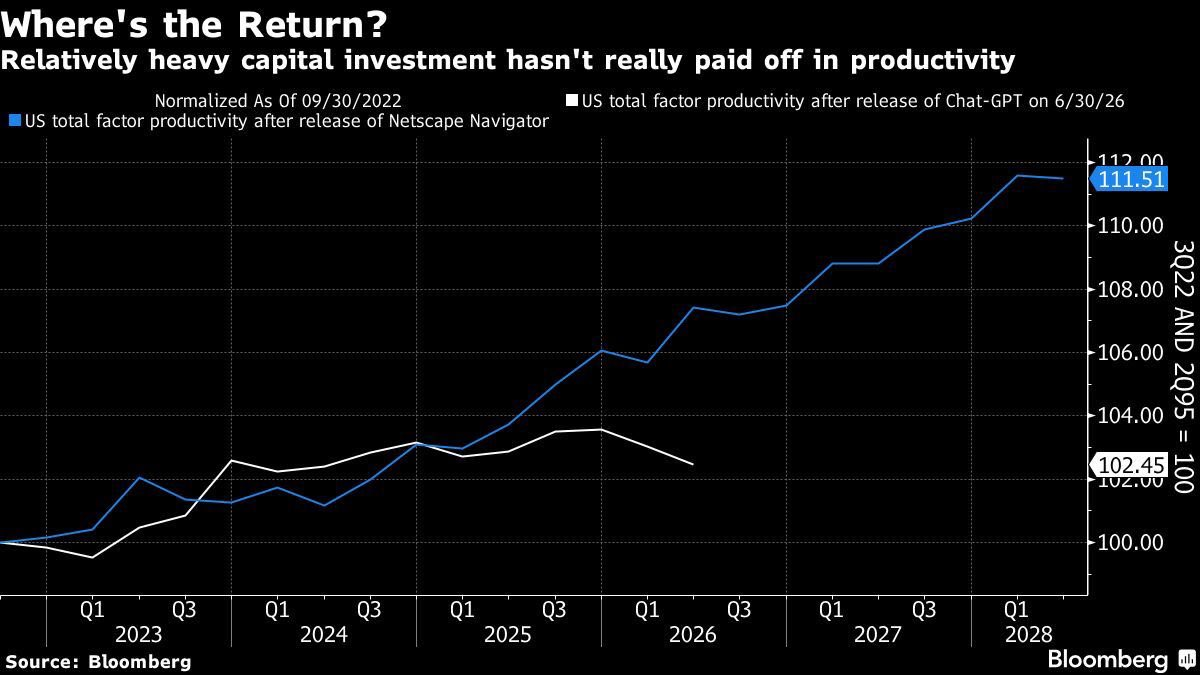
Somewhere, somebody is writing that this is “just like the Dot-Com Bubble,” and that everything will be fine.
If you liked this piece, you should subscribe to my premium newsletter. It’s $70 a year, $18 a quarter, or $7 a month, and in return you get a weekly newsletter that’s usually anywhere from 10,000 to 18,000 words and provides vast, detailed analyses of the biggest events and companies in the AI bubble.
If you want to get in touch — and especially if you have any juicy information about Anthropic, OpenAI, or any other companies in the AI bubble — hit me up on Signal at ezitron.76. I’m also on IB on The Terminal.