
If you liked this piece, you should subscribe to my premium newsletter.
It's $70 a year, $18 a quarter, or $7 a month, and in return you get a weekly newsletter that’s usually anywhere from 10,000 to 18,000 words, including vast, detailed analyses of NVIDIA, Anthropic and OpenAI’s finances, and the AI bubble writ large.
My Hater's Guides To the SaaSpocalypse, Private Credit and Private Equity are essential to understanding our current financial system, and my guide to how OpenAI Kills Oracle pairs nicely with my Hater's Guide To Oracle, as well as the Hater’s Guide To Oracle (Part 2). I've even done a two part Hater's Guide to NVIDIA.
Subscribing to premium is both great value and makes it possible to write these large, deeply-researched free pieces every week. To subscribe, use one of the following links: $70 a year, $18 a quarter, or $7 a month.
If you want to get in touch — and especially if you have any juicy information about Anthropic, OpenAI, or any other companies in the AI bubble — hit me up on Signal at ezitron.76. I’m also on IB on The Terminal.
Soundtrack: Tool - Forty Six & 2
The question I want to ask anyone reading this who might have invested in or in some way backed the hyperscalers and the greater AI industry:
What is it you think you’ve gotten yourself into? Because I think you’re being sold a lie.
Last week’s tech earnings saw outlet after outlet claim that Amazon, Google, and Microsoft’s AI bets were “paying off” as their respective cloud segments reported record revenue growth, casually ignoring that none of them have broken out their AI revenues. To add insult to injury, Microsoft decided, after sharing that it had a $37 billion AI run rate (about $3.08 billion a month) in Q3 FY2026, that it simply didn’t have to share anything about its actual AI payoff in Q4, realizing that its overall numbers would beguile reporters and analysts — especially those with little interest in what was actually going on as long as the topline stuff looked good.
To be clear, all three of these companies’ cloud platforms have many other customers paying for many other things other than generative AI services or AI GPUs, and they’ve all engaged in a combination of multiple outright price increases and changing their core subscriptions to force AI features on them as a means of boosting revenues and conning the street into believing that “AI is paying off” every time they non-consensually thrust it on their customers, framing higher prices as “better value” in a way that fucks the user to appease Wall Street.
Yet the biggest con of all is that a vast majority of this revenue growth comes from the compute spend of Anthropic and OpenAI, both of whom account for the vast majority of AI revenues and overall cloud growth we’ve seen in the last few years.
Every publication you read right now will tell you that AWS and Azure and Google Cloud are growing like wildfire as a result of the hundreds of billions of dollars they’ve invested in AI GPUs and data centers, when the truth is far simpler: their revenues are being buoyed by two unprofitable, unsustainable AI labs that cannot exist without being funneled tens of billions of dollars each year.
And a decent chunk of that money is coming from the hyperscalers themselves. In the last seven months alone, Google has sunk $10 billion (and up to $30 billion more) into Anthropic, with Amazon funnelling $5 billion to Anthropic within a week of that investment and a total of $50 billion into OpenAI. For all the concern about circular financing in the AI world, it’s astonishing that so much attention has (rightly, to be clear) centered on NVIDIA’s backstopping and funding of neoclouds, and less on the fact that hyperscalers are propping up their now biggest customers, giving them cash that will eventually migrate back to the hyperscaler.
I’d also argue that the vast majority of their capex exists to support these two load-bearing failsons. A few months ago, a Microsoft executive told the judge during the Musk-Altman trial that its OpenAI relationship had cost it “over $100 billion,” including both the $13 billion it sunk into the company and the associated infrastructure.
Microsoft has dedicated its Fairwater data centers (however much actually exists) entirely to OpenAI, much like Amazon has for Anthropic with however much of its massive Indiana-based Project Rainier has actually been turned on, and much like Google is in talks to backstop a $15 billion data center project for Anthropic, along with data centers with Cipher Mining and TeraWulf and a $35 billion private credit-funded Broadcom-backstopped deal where Google will sell Anthropic its TPU AI chips, put them in a Google-built data center, and rent them back to Anthropic.
I want to spell this out: when you remove Anthropic and OpenAI’s compute spend, I am not confident that Google, Microsoft and Amazon have much of an AI business.
While many people believe — largely because the big three refuse to break out their actual AI revenues or disclose their customer concentration — that they have AI revenues coming from a diverse set of different customers, the reality is that their largest cloud customers, let alone AI customers, are two companies that can literally not afford to pay them without a near-infinite flow of venture capital or debt.
Analysts Estimate That More Than 70% of Amazon, Microsoft and Google’s AI Revenues Come From OpenAI and Anthropic
Per Ross Sandler of Barclays, Anthropic and OpenAI are estimated to make up 73% of all of Amazon’s AI revenues in both 2026 and 2027 and 75% of AI revenues in 2028, with Anthropic spending $14.1 billion in 2026, $25.3 billion in 2027, and $35.8 billion in 2028, and OpenAI spending $9 billion in 2026, $15 billion in 2027, and $20 billion in 2028.
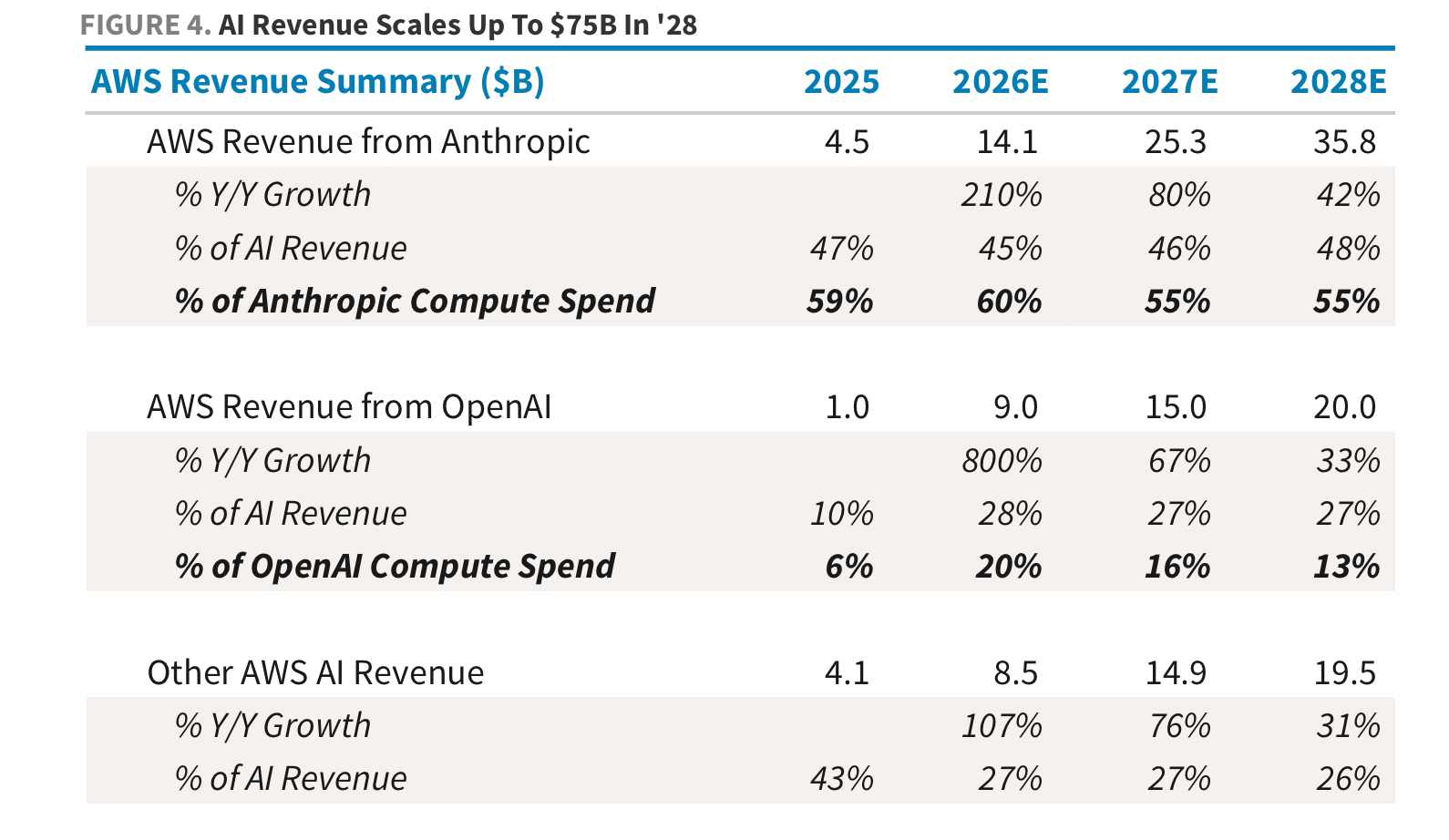
Amazon plans to spend $220 billion in capital expenditures in 2026 and even more in 2027, and appears to be doing so almost-exclusively to provide compute for a company that had to raise $95 billion in funding in the space of six months, with $5 billion of that coming from Amazon itself.
Editor’s Note: Just before I headed to press on this piece, I found another note from Stephen Ju (who you’re just about to learn about for the first time) about AWS revenues, with the numbers a little different. He has estimated total AI revenues at around $30.9 billion for 2026, with OpenAI and Anthropic’s compute spend sitting at 59% of those revenues ($18.3 billion) and the remaining $12.6 billion coming from Bedrock, the platform from which Amazon sells access to both TPUs and AI models from Anthropic and (more recently) OpenAI. This revenue concentration improves to 55% in the 2027 estimates.
Anyway, the rest of this piece focuses on Sandler’s numbers, as I did not get a ton of time to dig over these. These numbers, while different, do not meaningfully change my perspective.
As I’ll argue about Vertex, making money by proxy of having monopoly permission to sell OpenAI and Anthropic’s models absolutely counts as revenue related to Anthropic and OpenAI to me. A chunk of both labs’ revenue comes from the resale of these models, easy money that also becomes another way in which hyperscalers feed their revenues back into the AI labs so that the AI labs can spend the money on compute. I will add that Microsoft no longer pays a revenue share to OpenAI.
In any case, the viability, efficacy, and attractiveness of these models are still a product of Anthropic and OpenAI’s ongoing work.
Google is in a similar-position. Per Stephen Ju of UBS, “...Anthropic, OpenAI and Meta will account for 21%, 7% and 1% of 2026 Google Cloud revenues, respectively, and 44%, 5% and 1% of 2027 revenues,” or, put another way, 28% of all 2026 and more than 48% of all 2027 Google Cloud revenues are from Anthropic and OpenAI.
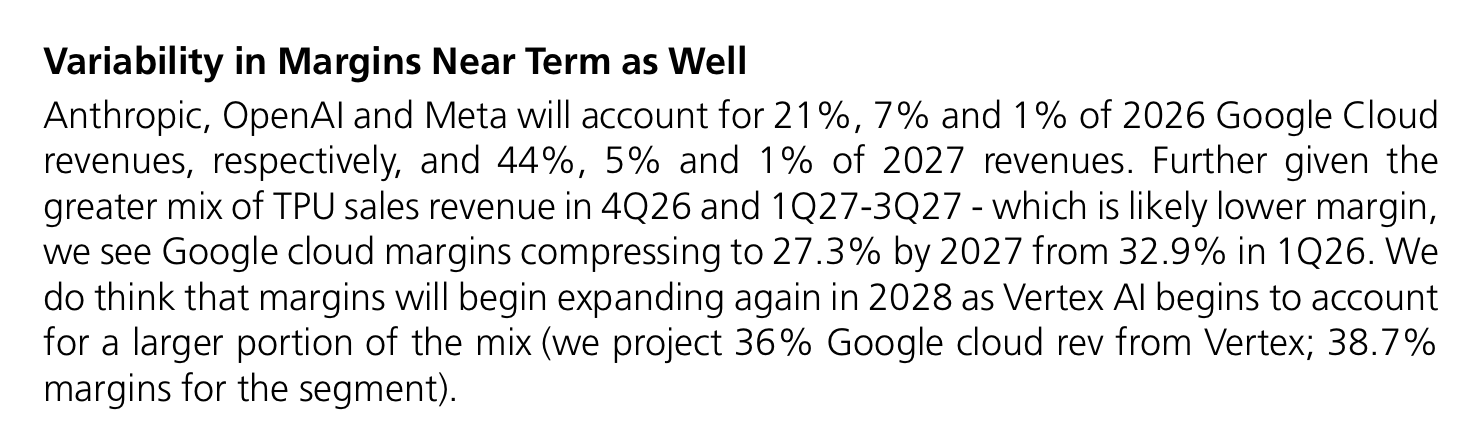
Ju also estimates Meta will make up a whopping 1% of Google Cloud revenues in each year, and does not mention a single other customer, which heavily-suggests that there aren’t really any large ones.
Based on Bloomberg Intelligence’s consensus estimates for Google Cloud’s revenues in 2026 ($105.9) and 2027 ($173.8), OpenAI and Anthropic represent $29.4 billion ($7.4bn/$22bn) in 2026 and $84.69 billion ($8.69bn/$76bn) in 2027. To be explicit here, this is all Google Cloud revenues. It is reasonable to believe that this represents at least 75% of Google’s AI revenue, if not more.
What’s crazy is that these numbers are actually lower than UBS’ estimates. As the chart below demonstrates, OpenAI and Anthropic’s spend is estimated to sit at over $35 billion in 2026, larger than both its entire Google Cloud core non-AI business and Vertex AI model rental business that is largely boosted by Google’s ability to sell Anthropic’s models.
Sidenote: Ju and Sandler appear to disagree on how much of Anthropic’s compute spend that Amazon and Google get, which is fair, because both Google and Amazon separately claim to be Anthropic’s primary provider.
Eagle-eyed readers will also see that Google’s non-AI cloud business is estimated to be effectively flat in 2026, 2027, and 2028.
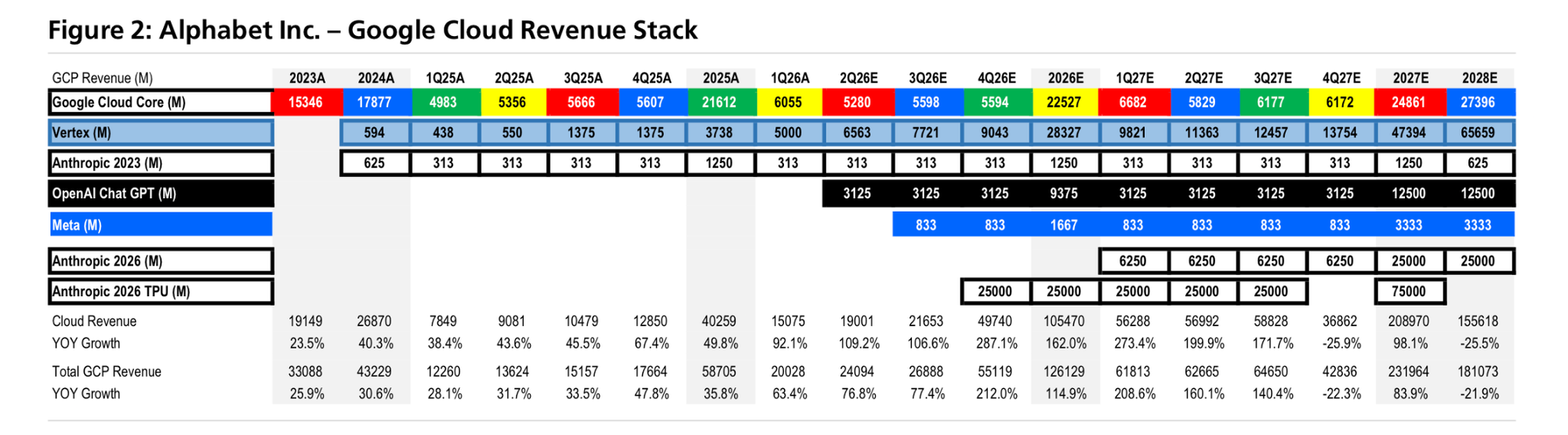
I also don’t think it’s common knowledge that OpenAI is such a large customer of either Google Cloud or Amazon Web Services, spending at least an estimated $52.5 billion in 2026 and at least an estimated $125 billion in 2027.
In the Musk-Altman trial, OpenAI estimated it would spend $50 billion on compute in 2026, and based on those estimates, that gives us about $16.4 billion across Amazon and Google, leaving a likely $33.6 billion in spend left for Microsoft Azure, though I’ll add that OpenAI continually underestimates its own compute spend and losses.
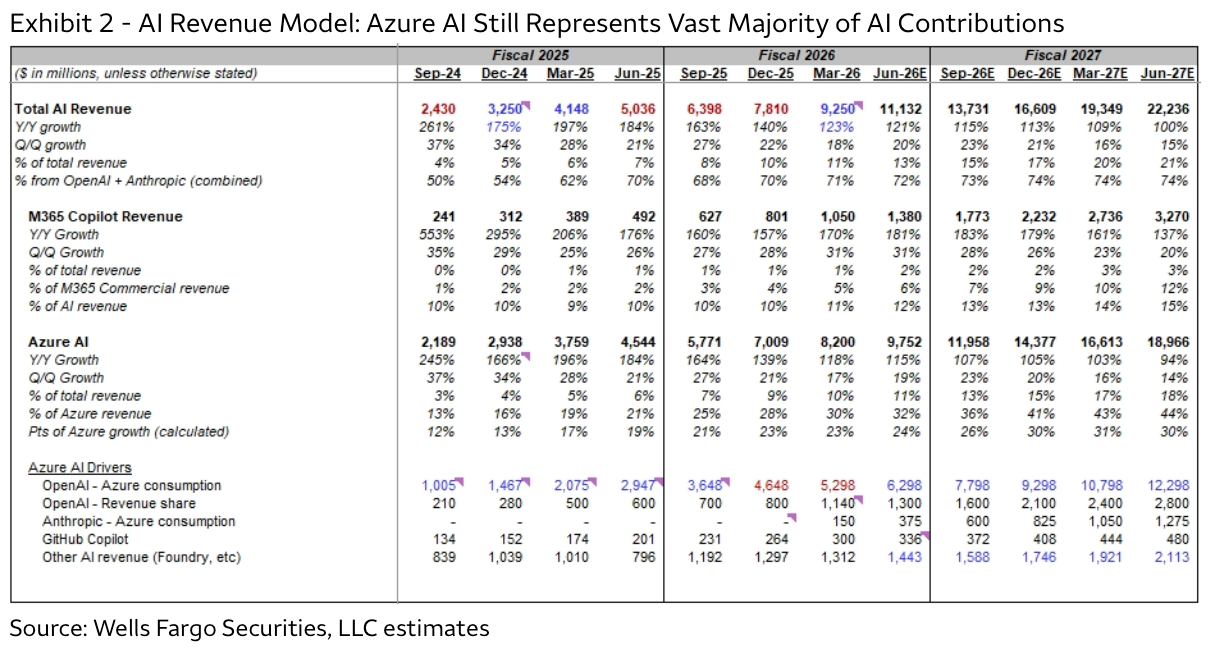
And based on a note from Michael Turrin of Wells Fargo from May 31 2026, things are just as bad for Microsoft, with 70% or more of its AI revenues coming from Anthropic and OpenAI. While Turrin “expects investments at software & models layers [to] pay off in meaningful adoption over time,” it’s difficult to argue that Microsoft has any meaningful AI strategy outside of OpenAI and Anthropic’s compute spend.
To make matters worse, based on Wells Fargo’s estimates, it appears that Microsoft 365’s AI revenues are barely — and I mean barely — beating the revenue share Microsoft gets from OpenAI’s sales.
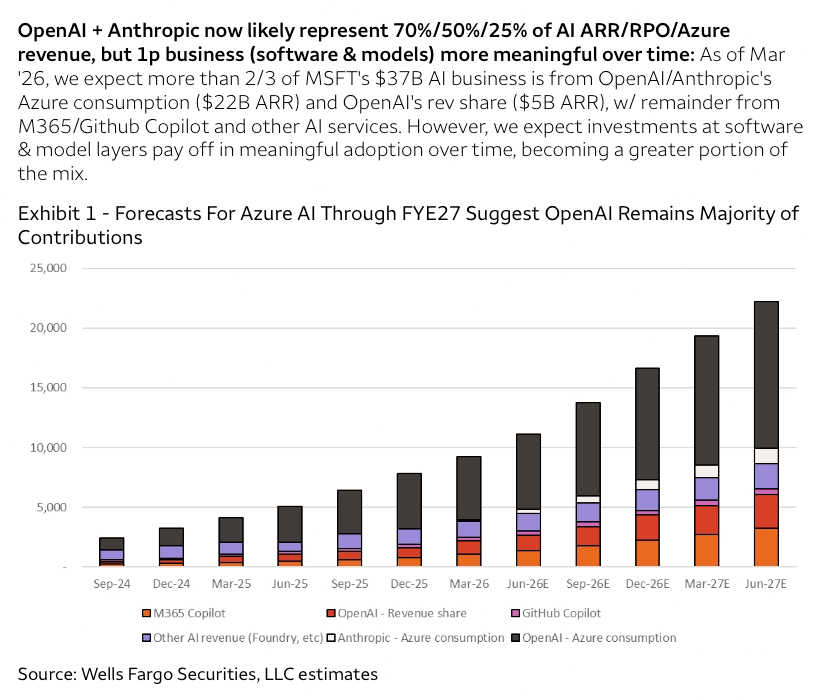
Wells Fargo also includes a helpful cheat sheet of its estimates for AI contributions, estimating that even at the very end of FY2027 (which began on July 1 2026), OpenAI and Anthropic’s spend will represent a dramatic 74% of all AI revenues. Wells Fargo also estimates that the two AI labs represented 23% of Azure revenue in FY2026, growing to 35% in FY27.
Considering Azure grew 41% year-over-year, this means that 40% or more of Microsoft Azure’s growth came from them — and remember, Azure sells far more than just AI services.
This is an absolute fucking scandal.
The vast majority of Microsoft, Google and Amazon’s AI revenues and revenue growth in their representative cloud platforms are from Anthropic and OpenAI, and they are blatantly, unashamedly misleading investors by not disclosing that this is the case. We’re talking 73% of AWS’ AI revenues, 74% of Microsoft’s, and likely 70%+ of Google Cloud’s considering that just Anthropic and OpenAI’s AI spend is expected to be more than 48% of all cloud revenues.
This is not me being a hater, a skeptic, or a doomer, but the product of actually investigating what’s happening in the real world rather than just looking at whatever numbers the hyperscalers fart out and assuming it’s “all from AI,” and that “AI” means something more than just the two main model labs.
Investors in Amazon, Google and Microsoft have been led to believe that the $994 billion spent on AI GPUs and data centers exists to boost their existing businesses and build what amounts to the next industrial revolution. In fact, this is the line that just about any AI bull will give you about NVIDIA’s GPU sales — that all compute will be used because there’s endless, insatiable demand.
Well, other than the fact there isn’t.
What hyperscalers have actually done is demolish their free cash flow and purchased hundreds of billions of dollars’ worth of GPUs, TPUs, and XPUs to support a customer base dominated by two customers that are now accounting for the vast majority of their revenue growth and quite literally cannot afford to pay their bills without a near-infinite flow of venture capital investments.
Based on these estimates, these analysts also don’t seem to believe that any other large customers are going to emerge, bringing into question both the rationale of their capital expenditures and those of basically anyone building any data center anywhere in the world.
This is all very important, so I want to spell it out really simply for you:
- If 73% of Amazon, Microsoft and Google’s AI revenues are from OpenAI and Anthropic, and analysts believe that this concentration will only grow in the next few years, that means there is not really that much demand for AI, and what demand it has is from two companies that they have sunk a combined $77 billion in funding into — far outpacing the actual revenue contribution that these companies provide, let alone the capex spending of the hyperscalers.
- This revenue also represents a meaningful slice of Google Cloud, Microsoft Azure and Amazon Web Services’ revenue, suggesting that leading cloud platforms are not growing as fast as investors have been led to believe.
- If 27% of all of 2026 and 48% of all of 2027 Google Cloud revenues are from Anthropic and OpenAI, that means that Google Cloud’s growth has or will potentially stall in the next year when you remove their compute spend.
- If there were real, meaningful demand for AI compute or AI services, we’d see it in these estimates, much like we’d see if there were other companies spending massive amounts on AI.
Remember: Microsoft Azure, Google Cloud and Amazon Web Services represent a large chunk of all global cloud spend and AI compute, and thus are a representative sample of all AI compute…and if diverse, “insatiable” demand existed, it would be represented in these estimates.
Sidenote: For the sake of clarity and transparency, Microsoft’s Amy Hood noted in the most recent earnings call that 90% of all cloud spending came from outside the two main frontier AI labs.
The problem is that "cloud revenue," in this case, encompasses a lot of things, including (but not being limited to) "Microsoft 365 Commercial cloud, Azure and other cloud services, the commercial portion of LinkedIn, and Dynamics 365."
With that being said, the fact that frontier spending is just 10% of cloud revenue doesn’t tell us anything — and is arguably a way of obfuscating how dependent Azure is on the two main AI model labs.
This is the single-worst capital misallocation in the history of business. Every single story you’ve read about the “incredible growth” of these cloud platforms is an embarrassing misread of three companies that are misleading investors that will more than likely be forced in the next year or two to have to restate revenues, cut remaining performance obligations, and admit that they’ve drastically overbuilt capacity.
The counterargument to my warnings is always that “this is useful infrastructure that will be used in the future,” or that we’re in an OpenAI Bubble not an AI bubble (which, I argue, is basically the same thing), but when you remove Anthropic and OpenAI, Amazon Web Services and Google Cloud go from exciting growth-engines to chernobyls of capital expenditure.
Without these two “startups,” AI revenues are catastrophically small — for example, Sandler estimates that Amazon Web Services will make a pathetic $8.5 billion in AI revenues in 2026, or roughly 25 times less than the $220 billion Amazon intends to spend this year. While Ju estimates that Google Vertex AI model platform (which is one of the main ways that large enterprises integrate Anthropic’s models) will pull in $28.3 billion in 2026, that’s still a little under $10 billion less than the $35.6 billion that Anthropic and OpenAI will spend on compute.
This needs repeating. Investors and the general public are being lied to. When you remove OpenAI and Anthropic, Amazon, Google and Microsoft’s capex has likely accounted for very little revenue growth, which means that if either or both of them die, the majority of capital expenditures and debt raised as part of the AI bubble have been a waste.
There Isn’t Really An AI Industry Without OpenAI and Anthropic
So, let’s go look at the non-Anthropic/OpenAI part of that Barclays note, with each column representing 2025, 2026, 2027 and 2028, with the last three being estimates.

For some context, in the year 2025, Amazon spent $131.8 billion in capex, or roughly 32 times Barclays’ estimates for non-OpenAI/Anthropic revenue — a number that barely improves with the full total ($9.6 billion) to 14 times.
If Amazon has its druthers and invests $220 billion in total capex in 2026, the (pathetic) $8.5bn in non-OpenAI/Anthropic revenue will be roughly 26 times smaller, or 7 times smaller when you use the full $31.6 billion in projected AI revenue for 2026.
If your counterargument here is that “the gap is getting smaller each year,” you are a mark. $31.6 billion is $22.6 billion less than Amazon spent on capital expenditures in its last quarter, or roughly $18.4 billion less than it invested in OpenAI this year. Barclays’ estimates for 2028 have Amazon’s AI revenues — 75% of which are from OpenAI and Anthropic’s compute spend — at around $75 billion, four god damn years into the AI bubble.
Amazon will have, by 2028, likely sunk over $650 billion in capital expenditures into AI, all to earn (and this assumes OpenAI and Anthropic exist and can pay) a little over $171 billion in AI revenue, with the vast majority of it contingent on two entirely venture-backed startups.
Similarly, even if UBS’ estimates come true, Google will have spent roughly $408.5 billion (including consensus estimates of $120.5 billion for the rest of the year) in capital expenditures to create an AI business that makes about $80 billion a year, with most of that coming from either selling Anthropic’s compute or access to its models via Vertex.
Microsoft is in the same position. Wells Fargo’s estimates have its AI revenues for FY2026 (which just ended) at around $34.5 billion, in a year where it spent $115.9 billion in capex, with $41 billion of that in the last quarter, or roughly $6.5 billion more than its entire estimated AI revenues for the god damn fiscal year.
I realize I’m being a little repetitive, but I need you to see that without OpenAI and Anthropic, Microsoft, Google, and Amazon’s AI revenues are absolutely pathetic, and are thus entirely-dependent on their compute spend.
This Just Isn’t Good Enough
Let’s be serious, and take the absolute kindest read of UBS’ estimates, saying that Google’s Vertex AI platform will make approximately $22.5 billion in annual revenue, and assume, wrongheadedly, that it’s not near-entirely made up of demand for Anthropic’s models…
…
Sundar Pichai, did you spend $288 billion god damn dollars to make an annual business that makes less revenue than YouTube? We haven’t even talked about margins or costs or whether any of this is actually profitable, largely because it’s immaterial, as there is absolutely no way to read this situation as anything other than a historic failure!
Andy Jassy, is that you? Get your country ass over here! You did NOT just go out there and spent $429.5 billion god damn dollars to stand up data centers for a pair of companies you have to literally hand the money to them to pay you, did you? I’m gonna tell momma Jassy what you’ve been up to! She’s gonna paint your back porch red!
Wait, what’s that?
You just gave OpenAI $35 billion dollars? Wasn’t that dependent on it going public or reaching AGI? Are you kidding me man? It’s almost as if you realize that the only way your largest customers are gonna pay y’all is by giving them the money to do so!
Okay, all jokes aside, there’s very clearly a problem here with AI demand, in the sense that it doesn’t really exist without hyperscalers paying themselves to do so.
When you look at these numbers, you see a brutal story of unproductive capex. Looking at Wells Fargo’s estimates, it doesn’t appear that Microsoft 365 Copilot is a meaningful business, hitting a meager estimated $3.859 billion for the entire fiscal year 2026 for a product that allegedly has 30 million paid seats, suggesting massive discounts and questionable value.
Wells Fargo estimates it’ll grow to an unremarkable $10 billion in annual revenue in FY2027 — barely more than OpenAI is estimated to spend in Q1FY2027.
Very Blunt Sidenote: if Microsoft is struggling to sell AI-powered software attached to the literally-most-used enterprise software in the world with a sales team of tens of thousands of people and tens of thousand more resellers, how do you think that the rest of the AI software world is going to do long term?
To be explicit: the demand for AI-powered software is not there, and neither is the demand for selling AI-powered add-ons to other software.
This is an embarrassing accident of an industry with two ticking time bombs underneath it.
There’re really two scenarios:
- Anthropic and OpenAI, who represent the near-totality of AI demand and revenue both as a vendor and a supplier, are perpetually held up by the venture capital industry and hyperscalers, at whatever cost that is and to what lengths it requires complete financial fealty, to degrees of circularity unseen in history,
- One day, one or both of Anthropic and OpenAI die, which leads to half or more of the demand for AI compute and actual industry production evaporating, and any further ability for Google, Amazon and Microsoft to further feed themselves money.
And, to be explicit, the last part of that sentence is exactly what’s going on. Microsoft, Google and Amazon are have spent over a trillion dollars in capex and equity investments specifically so they can create growth engines that are entirely-dependent on Anthropic and OpenAI, who are entirely-dependent on Microsoft, Google and Amazon to either (or both) feed them money or continually build them more infrastructure.
Sidenote: I haven’t even mentioned how Google’s $99 billion and Amazon’s $53.4 billion in profits were inflated by their stakes in Anthropic (and SpaceX, in Google’s case), because I could write an entire newsletter about how deceptive and ridiculous it is that GAAP allows companies to do this. We need new regulations, and we need them urgently, as investors are being misled.
However you feel about what I’m saying, these estimates also require OpenAI and Anthropic to keep growing at the rate necessary to keep up with expectations for Amazon Web Services, Microsoft Azure and Google Cloud.
The most important question is which part of the machine breaks first.
The wind cannot fall out of the sails OpenAI and Anthropic, as both of them have to keep pace to be able to pay for all this data center capacity, which would mean they would, across Amazon and Google alone, have to produce over $125 billion in 2027, which would require both the actual demand (from customers for inference and for training) to use that much compute and the means to pay for it (from venture capital and the hyperscalers themselves).
Sidenote: To give you some context about how large that amount of money is, Microsoft just announced that its entire fiscal year 2026 revenue for Azure was $100 billion.
For this to be possible, both the demand for access to OpenAI and Anthropic’s models and the money to pay for the inference to serve it must be there to realize these revenues and to keep Google Cloud, Microsoft Azure and Amazon Web Services growing at historical rates.
To even have a shot at doing that, compute capacity must come online fast enough, which is an open question in and of itself. As I covered a few months ago, AI data centers are some of the single-most ambitious construction projects in history, requiring massive amounts of capital, specialist talent, and materials, and execution that includes building decades’ worth of power infrastructure in a few short years, making them take anywhere from 18 to 36 months to complete. If capacity doesn’t come on fast enough, OpenAI and Anthropic can’t pay for it.
It seems very possible that the only reason growth hasn’t stumbled for Microsoft, Google, and Amazon is OpenAI and Anthropic’s compute spend and the ability to sell access to their models, which means that they may see their capital expenditures as existential.
It kind of makes sense. If they fail to build more and more data centers and continue to sink money into Anthropic and OpenAI, growth will slow across both their cloud platforms and associated services, as the two AI labs are the only real aggressive purchasers of AI compute, which makes up the vast majority of hyperscaler AI revenues.
It’s a dangerous game. Without OpenAI and Anthropic, it’s clear that the underlying businesses of the big three hyperscalers are deteriorating, and that their AI plays are a catastrophic failure, because the sheer amount of cash they’ve required to date (and the even greater pile of cash they’ll need in the months and years ahead) demands an outsized return for years to come.
Apparently things are so dire that the only way to patch over slowing growth was to fund two giant startups beholden to massive compute contracts that feed venture capital dollars to hyperscalers in a circular motion that mostly equates to eating poisoned cardboard.
Things look great right now, as long as you avoid thinking too hard about what it means that so much of this revenue growth is coming from Anthropic and OpenAI, and that their other AI plays are producing the lowest end of double digit billions of revenue for something that has cost them over a trillion dollars, their free cash flow, and burdened them with hundreds of billions of dollars of debt, along with off-balance sheet liabilities now totalling over $1.35 trillion (including Meta).
I can already hear the counter-argument that “Anthropic and OpenAI are the fastest-growing companies in history,” and I certainly hope you’re right, because there does not appear to be anyone else who wants to buy compute at their scale other than hyperscalers selling it to them and whatever weird also-ran bullshit Mustafa Suleyman, Demis Hassabis, and Alexandr Wang will be allowed to do until one of the CEOs tries to make them the fall guy.
I really need to be as clear as possible: the current consensus view on AI is entirely divorced from reality. Based on what I’ve shared with you today, it is ridiculous to suggest that hyperscalers are building data centers under the belief that they will make a lot of money or that demand exists. They may believe — or hope — that’s the case, but that doesn’t make it true.
Outside of OpenAI and Anthropic, there appears to be less than $30 billion dollars of non-AI lab compute demand across Amazon, Google and Microsoft. I need to also be clear that this is almost certainly an overestimate, because it includes revenues from Azure Foundry, Amazon Bedrock, and Google Vertex, which includes both compute and API spend on Anthropic and OpenAI’s models.
This means that we are likely overbuilding data center capacity at the scale of hundreds of billions of dollars. As the largest providers of AI compute with the most experience and the biggest brand recognition, it’s hard to argue that there’s pent-up AI demand waiting elsewhere that hyperscalers haven’t realized. If anything, it suggests that everybody else is completely and utterly fucked.
Perhaps you’ll argue that the analyst was wrong or that my analysis is wrong or that demand will magically appear, and you’re welcome to if you want to continue burying your head in the sand.
Let me spell it out for you: if Anthropic and OpenAI each had a run rate of $100 billion, they would still not have the scale to generate the compute demand to cover what their commitments are to Microsoft, Google, Amazon, and, of course, Oracle.
And CoreWeave. And Cerebras. And Cipher Mining and TeraWulf. And IREN. And Nebius. And Broadcom. And AMD. And SpaceX. And maybe Meta, SB Energy, and whoever might build a $30 billion data center in Georgia. While some of these — like Cipher, IREN, Nebius and TeraWulf — will flow revenue directly to Google Cloud or Microsoft Azure, there’s still tens of billions of dollars’ worth of compute revenue that needs to get paid somehow above and beyond OpenAI and Anthropic’s spend on the major platforms.
This is not sustainable. In fact, it’s pretty fucking awful.
Analysts Estimate Anthropic and OpenAI Represent More than 70% of All AI Revenues, And We Are Building Hundreds Of Billions Of Dollars Of Data Centers For Nobody
Let’s also be blunt about something: neither OpenAI nor Anthropic have worked out their business models. You can fart around claiming that Anthropic was profitable (it wasn’t) for a single quarter or repeat theoretical mantras about “positive gross margins” or say “they can just stop training” all you want. These companies lose tens of billions of dollars, they are horrendously unprofitable, an[d at this time do not have an actual answer to “how do these businesses function without infinite resources?”
Even if they were somehow profitable — which they are not! — they would still need to grow at an impossible rate. Putting aside all of the estimates from this piece, OpenAI projects to spend $750 billion in compute in the next three-and-a-half years, which either means it will need to grow its revenue to hundreds of billions a year very soon or raise half a trillion dollars or more over the next few years, at a time when even hyperscalers are having trouble raising that much money.
And based on both these estimates and the massive amounts hyperscalers are spending on capex, I think they’re well aware that there isn’t diverse demand, and that the only path forward is to continue building capacity specifically for OpenAI and Anthropic, funding them in whatever way possible — either through backstopping the compute costs or helping organize massive private credit deals — to make sure that revenue growth never slows.
This is a doomed mission.
These estimates show that Microsoft, Google and Amazon do not have meaningful AI business outside of the ones they’ve incubated, at least not ones that will pay off their capital expenditures. Consensus estimates for Microsoft’s FY2027 capex are around $186 billion in a year where its non-OpenAI/Anthropic AI revenue is expected to be $18.7 billion, meaning that even if these services had 100% net profit margins (IE: zero costs), it would take a decade of those revenues to pay back the capex.
While you might argue this is unfair — especially as OpenAI and Anthropic are unlikely to die before the fiscal year ends — it is time to start seriously discussing what happens to hyperscaler revenues once they do so.
Put another way, investing in Microsoft, Google, and Amazon as part of the AI trade is an investment in Anthropic and OpenAI’s ability to both survive and grow to become companies of comparative size and revenue growth as their hyperscaler progenitors.
It is clear based on the estimates I’ve shown today that the vast majority of growth in AWS, Google Cloud and Microsoft Azure comes from two companies that can literally not afford to pay their bills.
This Is A Huge Problem Even If You Don’t Want To Think About It
Jensen Huang has said that he has visibility into $1 trillion in GPU sales through the end of 2027, or, as I estimated, about 40GW of compute capacity requiring $435 billion in annual revenue. Though these estimates do not specifically break out compute demand from Bedrock, Foundry or Vertex, the combined AI revenues — including Anthropic and OpenAI’s compute spend, all API spend run through the platforms, and Microsoft 365 Copilot — for their fiscal years 2027 sits at around $304 billion, with the vast majority of that (around $197 billion) coming from AI lab compute spend.
There is not enough demand. We are overbuilding data centers. If compute demand existed to justify the amount of data center capacity being built — or even close! — then analyst estimates for AI revenues would be both significantly higher and meaningfully diverse rather than centralized around two unprofitable, unsustainable companies.
To be specific, for any of this to “make sense” we’d need to see multiple different companies or groups of companies spending comparable amounts to OpenAI and Anthropic, dramatic amounts of revenue generation from Google Workspace and Microsoft 365, and revenue diversity driven by multiple customers spending billions or tens of billions of dollars at the very least in estimates for 2028.
It’s also likely much worse than I’m explaining because of how the big three bundle every single imaginable AI service inside Foundry, Bedrock, and Vertex, all of which blend direct GPU rentals with API spend on models from Anthropic and OpenAI, which I believe generates a large majority majority of revenue on these platforms rather than diverse interest in renting AI chips or other models.
Microsoft, Google, and Amazon are selling their investors a lie about their AI strategies, and in a properly-regulated market would be forced to file investor disclosures that document the heavy revenue concentration of Anthropic and OpenAI’s compute spend.
In not doing so, they continue to mislead investors and the general public into believing that hyperscalers are funding the next great growth engine in tech, when what they’ve actually done is spend a trillion dollars in capex and investments to make tens of billions of dollars of revenue, much of which came from their own equity investments.
And in doing so, these hyperscalers have mangled their balance sheets, tripling their PP&E, encumbering themselves with over $500 billion in data centers and GPUs that exist mostly to support two companies that can’t afford to pay their bills long term. At the end of this hype cycle, Microsoft, Google and Amazon (and, I guess, Meta) will have left themselves in a much-worse condition than before, with revenue expectations that are overwhelmingly inflated by two unsustainable companies.
As I wrote in the Rot-Com Bubble two years ago, these companies are fundamentally out of hypergrowth ideas, and these analyst estimates confirm my absolute worst fears about the condition of these companies.
AI is not working. A $10 billion or $30 billion-a-year business is not sufficient to justify either the massive capital expenditures or scars on hyperscaler balance sheets. In fact, it’s kind of hard to imagine what that might actually be at this point, because Google, Microsoft and Amazon continue to spend somewhere between $170 billion and $230 billion a year in capital expenditures, and each time they do so, they increase the size of the payback necessary.
Sidenote: I’ve seen a note floating around Twitter from Bank of America that claims there’s $2.3 trillion in backlog across “the top 4 CSPs,” referring to Amazon, Google, Microsoft and Oracle.
Before anyone makes any vivid assumptions about these numbers, know that they refer to literally every dollar of incoming revenue for these companies, including long-standing compute deals, Oracle’s database contracts, and at least (per The Information) $1 trillion in commitments from OpenAI and Anthropic, though remember that we do not actually get a breakdown of RPOs based on segment, company, or related terms around cancellation or amendment.When companies tell you their RPOs, they do so so you’ll believe the revenue is diversified and, ideally, about whatever hype cycle they’re currently focused on (like AI!), which is exactly what’s happening with basically anyone covering them.
Let’s break down when they’ll be realized!
Microsoft: 30% — around $203 billion — will be realized in the next 12 months, for a company with over $300 billion a year in revenue.
Oracle: 12% — around $76.6 billion — will be realized in the next 12 months, for a company with around $62 billion in annual revenue.
Google: 22% or so within the next 24 months, or around $115 billion for a company with over $400 billion in annual revenue.
Amazon: Amazon doesn’t disclose, but it has a backlog of $496 billion, with at least $238 billion of that from OpenAI and Anthropic, and annual revenues of over $700 billion.
At this point, AI would need to become — and this is without OpenAI and Anthropic — a business at the scale of Amazon Web Services ($170 billion, though this number is inflated by OpenAI and Anthropic’s compute spend), Google Search ($200 billion), or at the very least Azure ($100 billion, again inflated by both AI labs’ compute spend) to make sense, and even then, for this to make sense, hyperscalers would have to stop spending money on capex.
Put another way, AI bets cannot “pay off” if hyperscalers continue to funnel three or more times their AI revenues every single year into capital expenditures.
Sidenote: If I had to guess the rationale at this point, it’s that OpenAI and Anthropic have signed up for massive amounts of compute capacity that has yet to be built or invested in, putting hyperscalers in a vicious circle where they must spend more capex to earn revenue from companies that they also must keep alive through either backstops or outright equity investments.
I haven’t even gotten into the other vicious cycle — that the more of these data centers hyperscalers build, the more expensive they become thanks (at least, in part) to the skyrocketing costs of memory that continue to increase primarily because hyperscalers keep buying servers for their AI data centers. As discussed last week, this only increases the amount of debt they’ll need at a time when the market is getting increasingly nervous about AI data center debt.
Yet as we speak, the market is ripping, because hyperscalers have swindled investors, the media, and even the analysts themselves. Article after article after article claims that AI bets have “paid off” because these companies are glazed any time they inflate their earnings using the compute spend of two unstable and unsustainable companies, in part because hyperscalers both refuse to and face no pressure to share their AI revenues, knowing that they’ll get credit as long as the topline numbers look good.
I want to be clear that the air is coming out of these companies, no matter how good these earnings may look.
Everybody is taking the growth of their existing businesses and two AI labs’ compute spend as proof that all this capex is paying off, even though there is now consistent proof that the direct opposite is happening, and that their businesses are becoming increasingly-dependent on that compute spend.
I understand that nobody really wants to think about the logical endpoints of what I’m arguing, so I’m going to do it for them.
- Based on everything I’ve said today, Microsoft, Google, and Amazon’s cloud businesses are clearly incapable of delivering the kind of high growth that Wall Street analysts like, and they’re using both Anthropic and OpenAI’s compute spend and selling their AI models as a means of covering that up.
- This is a tangible sign that these companies are approaching their golden years, turning from hypergrowth vehicles into boring, slow-growth mainstays.
- The problem with this is that they’ve raised debt and spent capex at a level that requires their businesses to grow at dramatic rates, and said growth was only made possible by inflating revenues using equity investments and two AI labs incubated by the hyperscalers themselves.
- Without these two companies — and, to be clear, without these two companies becoming much, much larger — hyperscalers do not have meaningful AI revenues in comparison to their capital expenditures, making a payoff near-impossible based on every estimate I’ve read.
- This means that without these AI labs, they have very little to impress Wall Street with, and without AI itself, their businesses are increasingly-stagnant and dependent on a pro-monopoly regulatory environment and the ability to continually increase prices.
- All of this is to say that I believe hyperscalers are on the decline.
- There is not enough demand for AI compute, which means that we’re in an incredibly-large overbuild of AI data centers that are predominantly funded by project financing that can only pay investors back if the data centers actually receive revenue.
- This means that the vast majority of data centers will go unpaid, and those that do — and man, I am not confident there’s more than a few billion dollars of non-AI lab demand — are likely dependent on unprofitable AI startups or hyperscalers that don’t have much demand outside of the largest AI labs.
- Though some might challenge me about the scale of the problem, there are hundreds of billions of dollars’ worth of AI data center loans, and I believe the vast majority of them will go unpaid. This will hit bank balance sheets and private credit funds to indeterminate levels.
- This means that investments in CoreWeave, IREN, Nebius, Cipher Mining, and any other neocloud are effectively bets on Anthropic and OpenAI, or on hyperscalers’ continued interests in backing them.
- As there is not enough significant non-OpenAI/Anthropic demand for AI compute, this means that earnings for NVIDIA, Broadcom, and effectively any other semiconductor company are inflated by what amounts to speculative purchases of assets, which could eventually lead to impairments or restatements of earnings, and will certainly lead to a drop in growth once the cat is out of the bag.
- This is why NVIDIA continues to do such blatantly-circular deals, especially with OpenAI, and why neoclouds continue to sign deals with hyperscalers and OpenAI/Anthropic. Without them, demand doesn’t exist at a scale that would justify their existence.
- OpenAI and Anthropic are both separately load-bearing companies. If either or both of them die, 40% to 73% of all AI revenue and compute demand evaporates.
- While they would likely still exist as shell entities — and hyperscalers would continue to sell access to models — their deaths would kill the ability for Microsoft, Google and Amazon to monetize their ever-expanding compute infrastructure, and would immediately begin ripping giant holes in their gross margins.
- The value of Anthropic and OpenAI to Amazon, Google and Microsoft is that they can continue to sign big compute deals without ever exposing hyperscalers to their actual underlying economics. This makes any kind of merger or acquisition somewhat useless.
- As Nik Suresh argued, a great deal of demand for AI services or subscriptions comes from peer pressure and a near-religious attachment to theoretical productivity benefits, most of which would be hard to justify if either of these companies died. This would leave very little to recover post-bubble.
- While they would likely still exist as shell entities — and hyperscalers would continue to sell access to models — their deaths would kill the ability for Microsoft, Google and Amazon to monetize their ever-expanding compute infrastructure, and would immediately begin ripping giant holes in their gross margins.
To put things really simply, Anthropic and OpenAI are a way that hyperscalers can feed their revenue to themselves by spending money on capex, backstopping compute contracts, or doing direct equity investments.
Their continued existence allows the AI bubble to continue inflating, but this can only continue as long as venture capital and hyperscalers are capable or willing to invest. There is simply not the demand — not from open source, not from other AI labs, not from self-hosting, not from anywhere — to justify the capex or the massive data center buildout.
And for those arguing that there would be a dot-com bubble recovery story, I must be clear that if there isn’t demand today, it won’t magically appear tomorrow. AI GPUs will cost just as much to run in five years as they do today, as will unfinished data centers cost just as much to finish, as will electricity remain expensive, and all this will be happening after it’s easy to raise venture capital to actually buy the compute.
To quote my buddy Kasey, every major cloud compute provider is solely standing on OpenAI and Anthropic.
OpenAI and Anthropic are time bombs, and when either of them explodes, everybody will ask why we didn’t see the brutality that follows coming.
The truth is that nobody wanted to look.
To stare at these numbers and reconcile with their meaning is to acknowledge that the current state of the tech industry is based on mania, deceit, circular financing, and outright cons, and that the ascent of NVIDIA was primarily driven by three companies building compute capacity for two unsustainable companies that became existential to their growth, inspiring hundreds of billions of dollars of waste by obfuscating how little real demand existed.
I realize it’s difficult to think about scary things, and how easy it is to dismiss me as a doomer or a catastrophist, but mine is a logical and rational argument in an era poisoned by hype and grifting at a scale unseen in history.
The greatest lie of this era is that the tech industry is building the next industrial revolution, when what they’re actually building is a monument to everything that’s wrong with modern capitalism — wasteful expenditures disconnected from any real benefits generated as a means of pursuing growth at all costs, setting up a collapse that will tear a hole in the tech industry and the markets, and leave the world full of half-built monoliths sold to local communities as job creators.
The fact we’re talking about compute futures is a joke. The fact we’re talking about AI factories is a joke. Almost every aspect of the AI bubble is a joke, and in the end, investors and the general public will be the punchline. The rich will have gotten richer, the banks will have harvested fees, the hedge funds will have traded and taken profits, the private credit funds will have gotten their fees, and anyone who didn’t have an active inside track will be fucked.
All of this could’ve been avoided, but the world has a cult-like obsession with the wealthy, believing that the CEOs of the largest companies in the world could never make a bad decision, and that any executive is automatically smart by virtue of being rich and powerful.
And oh, how silly that’ll look in retrospect.
If you liked this piece, you should subscribe to my premium newsletter. It’s $70 a year, or $7 a month, and in return you get a weekly newsletter that’s usually anywhere from 10,000 to 18,000 words, including vast, detailed analyses of the biggest events and companies in the AI bubble.