
If you liked this piece, you should subscribe to my premium newsletter, and you can subscribe on the following links: $70 a year, $18 a quarter, or $7 a month.
In return you get a weekly premium newsletter including vast, detailed analyses of NVIDIA, Anthropic and OpenAI’s finances, and the AI bubble writ large. It's a great way to support my free work, and you'll get full access to my massive archive of premium analyses of the tech and finance industry. I just did a two part Hater's Guide To AI Debt that's essential reading given the current climate around AI data center loans.
On Friday, I’ll interrogate generative AI’s effect on the economy to date — the dubious claims about productivity, the consequences of hyperscaler spending on treasury yields, how it’s driving inflation, and what could happen when the bubble finally pops.
If you want to get in touch — and especially if you have any juicy information about Anthropic, OpenAI, or any other companies in the AI bubble — hit me up on Signal at ezitron.76. I’m also on IB on your Bloomberg Terminal.
Soundtrack: Flobots - Mayday!!!
Last week, Fidelity Director of Global Macro Jurien Timmer said that “the [AI trade] has been dead money for more than three months,” citing that both token expenditures and GPU lease rates were all “flat to down,” citing specifically rental rates for H100 and A100 GPUs. While the counterargument might be that Blackwell GPU rental rates aren’t included, as I discussed last week, it’s questionable how many B200, B300, or other Blackwell chips are actually available for rent, as it appears that anywhere from $200 billion to $300 billion of NVIDIA’s sales since 2022 are sitting in warehouses or unplugged in data centers waiting for power.
The Financial Times’ Bryce Elder took the ball and ran with it, and found research that backed up what I’d been saying, emphasis mine:
Morgan Stanley measured the gap earlier this week by estimating the shortfall in available power, concluding that more than half of the GPU servers sold between 2026 and 2028 might not have anywhere to be plugged in.
Yet Elder makes the point, based on research from Jefferies, that there’re far more problems than simply not having enough power:
In the longer term, power availability is still the bottleneck — along with labour. And transformers. And cooling equipment. And backup generation. As Jefferies says: “The gap between planned capacity and physical execution remains the central issue.”
In other words, the talking point that NVIDIA’s GPU sales are proof of actual demand for AI services or, indeed, that hyperscaler growth is a result of all those capital expenditures is a complete lie. In reality, at least half of all those chip sales — and I’d add in Broadcom’s TPU sales too (see my Hater’s guide for more) — are being made years before anything actually happens with the chips, making the trillion-plus dollars spent on capex so far seem somewhere between optimistic and utterly incoherent.
Microsoft, Google, Amazon, Meta, Oracle, and far too many other companies have been hoarding hundreds of billions of dollars of AI chips that they either (to quote Microsoft CEO Satya Nadella) can’t plug in or simply want to have in supply for reasons that I find tough to imagine.
Even the argument that they’re in reserve for the (eventual) day when they’ll be installed in a data center, and that by purchasing well in advance, they’re not bottlenecked by NVIDIA’s ability to ship AI chips, doesn’t feel credible given the extent of the hyperscaler GPU spending spree. Especially considering that much of NVIDIA’s backlog exists because hyperscalers and neoclouds are stockpiling its GPUs.
Trevor Noren of Sage Road Research noted that he’d heard from a venture capitalist that “...some companies are hoarding colossal amounts in case they come to a point at which they don’t have enough chips to provide the computing capacity,” as if there’s been any shortage of NVIDIA chips, outside of the illusory one created by hyperscalers buying them years in advance.
So, we’ve got a situation where Microsoft, Google, Amazon, Meta, SpaceX, CoreWeave, and every imaginable neocloud is sitting on hundreds of billions of uninstalled GPUs (and increasingly TPUs). Whenever more capacity comes online, it’s immediately sold to OpenAI or Anthropic, who make up anywhere from 70% to 80% of all AI revenues and compute demand, creating the illusion that revenue growth is “coming from demand for AI compute” rather than said demand coming from two companies that have been fed over $217 billion in the last nine months, with the vast majority of it coming from Google, Amazon, Microsoft, and NVIDIA themselves.
As I discussed last week, If “demand is outstripping supply” because of millions of customers begging for AI compute, that’s very different to “demand outstripping supply” because two or three (including Meta) customers are taking up most or all of the capacity. Not to repeat myself, but…
Similarly, if “demand is outstripping supply” because lots of capacity is coming online and a diverse subset of customers is buying it, that’s vastly different to if capacity is coming on slowly, and the vast majority of it is being given straight to OpenAI, Anthropic, or Meta.
And that’s absolutely what’s happening, suggesting that the “AI boom” is more like five or six large companies (hyperscalers) feeding money to two companies (NVIDIA and Broadcom) so that they can feed money to two companies (Anthropic and OpenAI) who then feed that money back to them whenever capacity comes online. I estimate that there’s around $22 billion of global, non-Anthropic/OpenAI compute demand, and an indeterminately-large chunk of that is coming from AI startups that can only afford to pay for the compute as long as venture capital continues to fund them…
…which is also the problem that Anthropic and OpenAI themselves face, as 80% of their enterprise revenues come from 1% of their customer base, with the vast majority of that being unprofitable AI startups that allow users to spend hundreds of dollars (or more) of tokens for $20 to $60 a month, meaning that the AI labs’ demand is, much like hyperscalers’ compute demand, dependent on venture capital’s ability to keep funding it.
Right now, at least to the outside world, hyperscalers’ AI capex seems premature, when my argument is far simpler: it’s been a catastrophic waste, as there exists no fundamental demand for AI compute at anything approaching the scale of data center capex or construction, and what demand does exist is an illusion created by speculative investments.
In fact, I’d argue that the last year and a half’s worth of AI capex is fundamentally speculative, because there has never been any proof — even with Anthropic and OpenAI’s compute spend — that spending a trillion or more dollars on GPUs and data centers would ever pay off.
And now the rest of the world has caught up to what I’ve been saying since October 2025 — that hyperscalers need at least $2 trillion in annual AI revenue by 2030 or they’ve wasted their capex.
Too little too late.
Hyperscalers Need $2 Trillion to $3 Trillion Of Annual AI Revenue In Perpetuity To Justify AI Capex
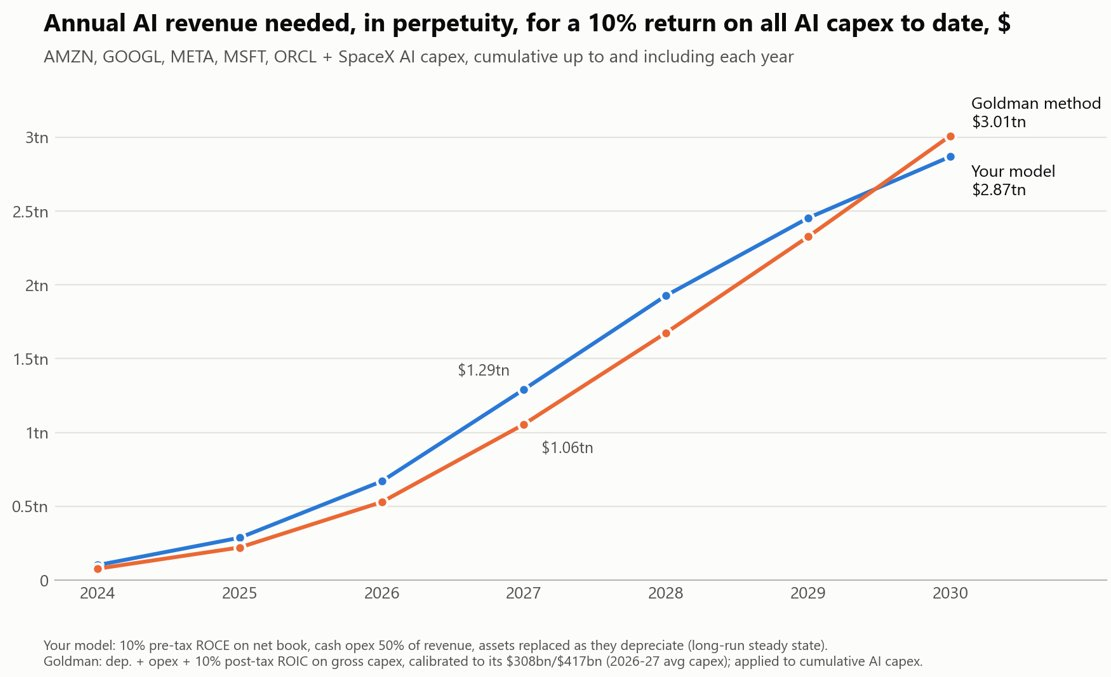
I’ll admit it’s vindicating to see so many people suddenly jump on the “how much money do hyperscalers need to justify their capex?” train, even if not a single one of them bothers to give me credit. Per Callum Williams of The Economist, Google, Amazon, Meta, Microsoft, Oracle, and SpaceX will need somewhere in the region of $1.29 trillion in annual AI revenue to get a 10% return on invested capital for their capex through the end of 2027, with the amount rising to $2.87 trillion if this farce continues through 2030.
Google, Microsoft, Amazon, Oracle, and SpaceX Have Approximately $183 Billion In Annual AI Revenues, Of Which At Least 64% ($118.2 Billion) Comes From Anthropic and OpenAI
To put that in perspective, Microsoft had around $34.4 billion in AI revenue in fiscal year 2026, of which 70% was OpenAI’s compute spend. Per Barclays estimates, Amazon will have $31.6 billion in total AI revenue in 2026, 73% of which will come from OpenAI and Anthropic, and per UBS estimates, 54.3% of Google’s AI compute sales come from them too, with an undefined amount of Vertex AI model sales coming from Anthropic on top, for a total of around $65 billion in AI revenue, which sounds a little high.
Adding all those together gets us to around $131 billion in AI revenues for Google, Microsoft and Amazon, of which $82.2 billion (62.7%) are from Anthropic and OpenAI.
Sidenote: The revenue concentration is also lower based on UBS’ inflated estimate of Google Vertex revenue. UBS also estimated that 28% of all Google Cloud revenues in 2026 are from Anthropic and OpenAI, so do with that what you will.
As of its latest quarter, SpaceX had (when you strip out Twitter’s ad revenues) around $2.194 billion in AI revenue, or $8.7 billion on an annualized basis, but I’ll bump that up to $25 billion on the year to include its full $1.25 billion a month from Anthropic and $920 million a month from Google, though I’ll add that both have 90 day outs. If we assume that Anthropic’s discounted compute for that quarter meant that it accounted for only $500 million of SpaceX’s AI revenue, this puts us at approximately $32.8 billion in AI revenue for SpaceX, with (as I believe Google will rent the compute directly to Anthropic) 79.3% of that coming from Anthropic.
While we don’t know Oracle’s actual AI revenues, it disclosed in its last quarter that its CPU and GPU revenues were at $6.5 billion for the quarter, or around $26 billion a year in revenue. Because I’m feeling nice, I’m going to say that Oracle has approximately $20 billion in annual AI revenue, but due to a lack of information it’s tough to say how much of that is OpenAI, though I’d imagine we’re looking at at least $8 billion or more given the progress of Stargate Abilene and the (as confirmed with sources) H100 and H200 GPUs currently rented to the AI lab. As a result, I think it’s fair to say at least 50% of Oracle’s AI revenues are from OpenAI.
This puts us at $183 billion in annual AI revenue for Google, Microsoft, Amazon, Oracle and SpaceX, with $118.2 billion, or at least 64.3%, coming from Anthropic and OpenAI.
Sidenote: I have been extremely generous with this analysis in anticipation of screeches of “bias” from the peanut gallery. In truth, I think there’s a world where AI revenues are much lower ($150 billion or less) and Anthropic and OpenAI’s share is more like 70% to 80%, especially in the case of Oracle.
And as you’re about to find out, $183 billion just ain’t gonna cut it.
Hyperscalers Need $308 Billion In Annual AI Revenues To Break Even On Their Capex From 2026 and 2027 — And They’re $125 Billion To $243 Billion Short
Last week, Goldman Sachs’ Ryan Hammond got a little more specific, noting that hyperscaler capex estimates were now over $1.1 trillion in 2027.
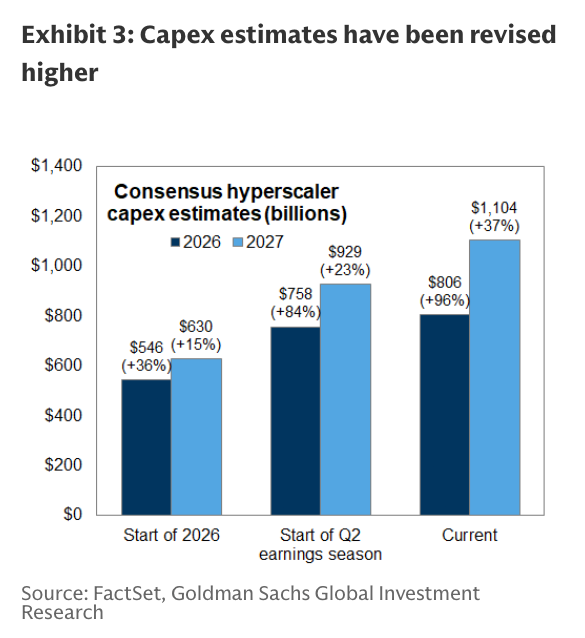
These revised capex plans also came with a new and deeply-worrying analysis, taking the average of estimated AI capex for 2026 and 2027, and calculating how much annual AI revenue hyperscalers would need to break even on their capital expenditures for just those two years.
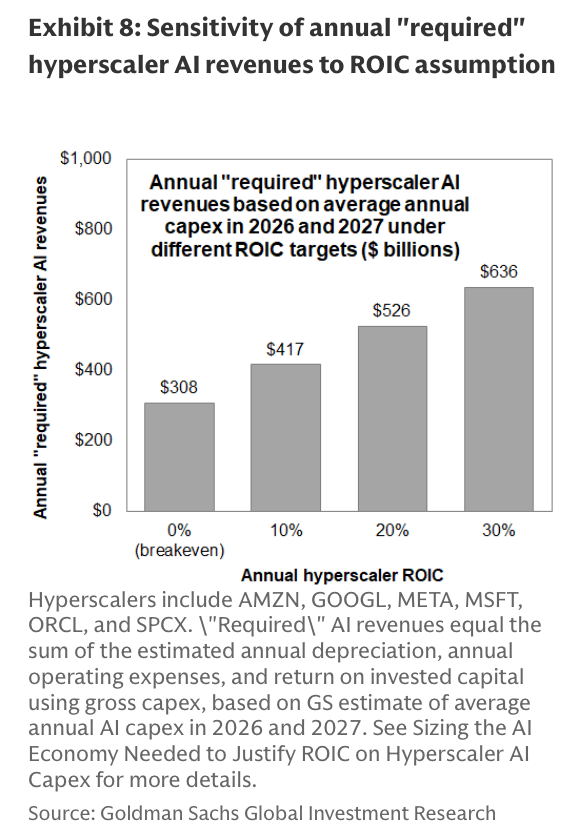
To just break even, hyperscalers need $308 billion in annual AI-specific revenues, and for a 10% Return On Invested Capital (calculated based on estimates of depreciation and operating expenses), they’d need $417 billion.
As discussed above, they are — including Anthropic and OpenAI — currently $124.2 billion short of break-even, or $243 billion short of break-even without their revenues, or $233.2 billion to $351 billion short for a measly 10% ROIC.
Now, keep in mind that A) the 2027 capex has yet to be spent and B) that, at least in theory, Anthropic and OpenAI will spend more next year…if hyperscalers are able to build the capacity necessary for them to do so, and they’re able to raise the money to pay them.
Goldman aggressively clears it throat by adding that “revenues are growing quickly and revenue backlogs are sizable”, but that’s far from a foregone conclusion considering (as I’ve mentioned) the fact that hyperscalers appear to be warehousing hundreds of billions of dollars of GPUs, with Microsoft sitting at around 2GW of AI capacity, and Oracle’s delays to its “Project Jupiter” data center in New Mexico becoming so severe that it had to issue a “force majeure” notice with the project developer, though as the Financial Times notes, it’ll have to pay regardless of whether the data center actually has power, otherwise known as a “Hell or High Water” contract.
AI Companies Would Need Around $400 Billion In Annual Revenues Just For Hyperscalers To Break Even On Their 2026 and 2027 Capex (And Are At Least $260 Billion Short)
Yet the part that really worries me is about the so-called “application layer” — the companies paying the hyperscalers for AI compute — and how much revenue they’d need in totality to be able to justify that hyperscaler capex.
The answers are extremely grim. For hyperscalers to break even on their capex through 2027, their AI customers would have to make around $425 billion in annual revenue, and that’s if they had an operating margin of 10%, a number that includes training costs for OpenAI and Anthropic.
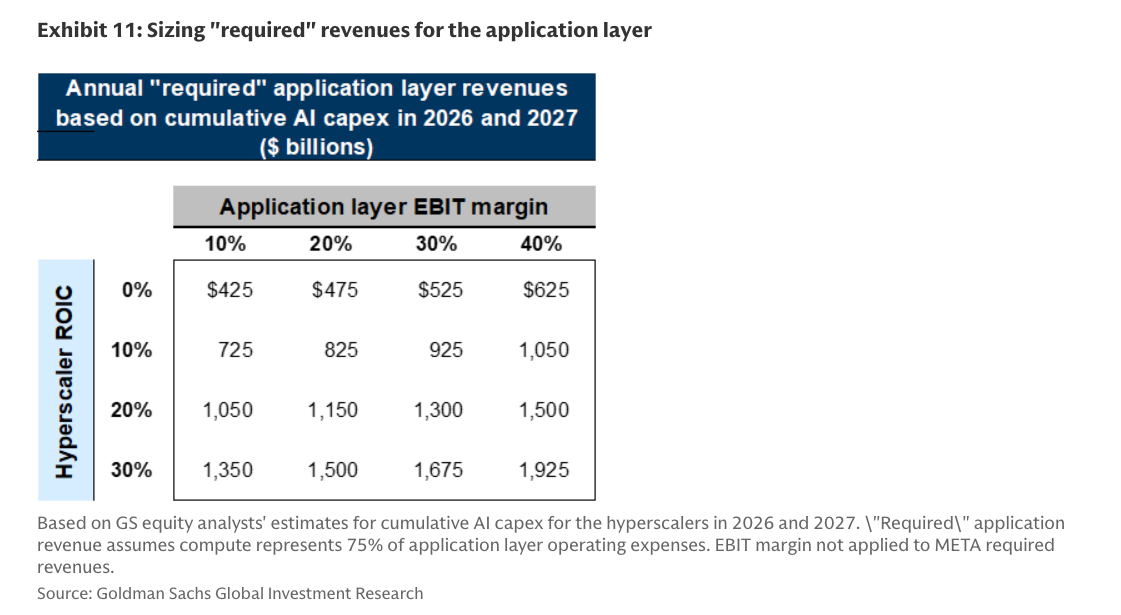
To be explicit, this chart measures how much revenue AI companies would need to have specific operating margins and for hyperscalers to have a specific ROIC. In other words, AI companies would have to make $725 billion in annual revenue to have both 10% margins and for hyperscalers to have a 10% ROIC.
Sidenote: things don’t change much when you account for negative operating margins, other than the removal of (theoretical) profits and shifting the responsibility of who’s paying for some of the hyperscalers’ costs from the companies’ revenues to their investors.
For some context about how far we are from these numbers:
- OpenAI estimates it will have $36 billion in revenue in 2026.
- Through the first half of 2026, Anthropic had around $16.3 billion in revenue, and if we assume that it’s growing faster than OpenAI, that puts its annual revenue around $40 billion for 2026.
- Cursor allegedly hit $4 billion in annualized revenue ahead of its acquisition by SpaceX, but that most decidedly does not mean $4 billion in revenue.
- Perplexity is allegedly sitting at around $750 million in annualized revenue, but was at $250 million at the start of the year, making its annual revenues likely somewhere in the $350 million range.
- Cognition recently hit $1 billion in annualized revenue ($83 million a month) as of September 25, 2026, but never defined what that meant. Considering that The Information had it at around $900 million a month beforehand, I think it’s likely that its revenues sit at around $300 million to $400 million.
- The Information also notes that Cognition expects to burn $800 million this year.
- Per The Information, OpenAI and Anthropic represent 89% of all AI startup revenues.
Even if Anthropic and OpenAI doubled their revenues and every single one of these “annualized” figures represented the true annual revenue of the companies, we’d be sitting at an embarrassing $157 billion, or roughly $268 billion short.
The further we get, the more ludicrous the expectations become, with Bain claiming that AI services (across both the consumer and enterprise realms) would need to generate $6tn in annual revenue by 2031 to justify the current and near-future levels of expenditure.
It’s remarkable, four years and hundreds of billions of venture capital dollars into the AI bubble, that we basically have zero meaningful revenue-generating AI companies outside of Anthropic and OpenAI. We aren’t even in the same universe of scale that would be necessary to justify the capital expenditures made by hyperscalers. I don’t even know how to put into words how far away we are, because it’s all so unfathomably stupid.
Goldman’s response is laughable:
The “required” application layer revenues that would justify current capex are large but potentially achievable. For example, estimates of global advertising and software spending each equal roughly $1.5 trillion in 2026. Our economists estimate that total annual AI US labor productivity gains that will potentially accrue to capital total roughly $1.8 trillion.
That link goes to a year-old report saying that “The AI Spending Boom Is Not Too Big” that does not, at any point, describe AI US labor productivity gains, other than this paragraph:
Productivity: Based on our AI productivity estimates, we assume a baseline gross 15% uplift to US labor productivity and GDP following full adoption, equivalent to $4½tn in economic value creation in today's dollars. In alternative scenarios we consider our previous estimates of a “less powerful” AI scenario based on more pessimistic assumptions regarding AI’s ability to automate work tasks (implying an 8% productivity uplift) and a “more powerful” scenario where the productivity gains reach 27%.
Those AI productivity estimates come from an analyst note from March 2023, around two weeks after GPT-4 came out. In other words, Goldman’s way of reassuring boosters and investors is to vaguely cite numbers from three and a half years ago, numbers that it has, for whatever reason, chosen not to update.
To quote Peter B. Parker from Spiderman: Into The Spider-verse, “don’t watch the mouth, watch the hands.” There’s a reason that Goldman hasn’t sought to measure the actual productivity or economic benefits of AI for three-and-a-half years, I assume because doing so would make it blatantly obvious how large the gulf is between the massive investments in AI GPUs and data centers and, well, this chart:
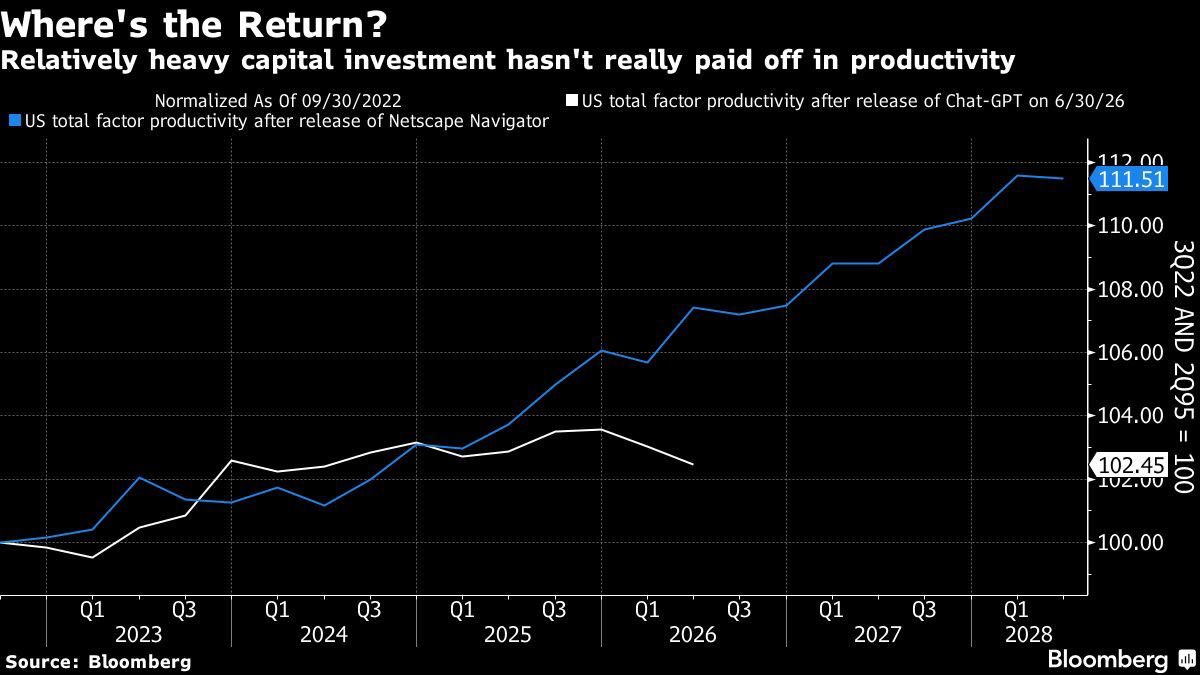
Alternatively, they’re avoiding saying what Timmer said: that investments in AI are dead money.
And things are only going to get worse from here.
AI Data Centers and Hyperscalers Need Over $930 Billion In Debt — And The Cost Of Borrowing Is Becoming Untenable For The Majority of AI Data Centers
Per Morgan Stanley, AI-related debt issuance should be around $570 billion in 2026, with around $250 billion of that coming from hyperscalers, and the rest various different forms of high-yield debt shoved into either asset-backed securities or dodgy SPVs for AI data centers.
Things are only set to increase next year. Per Goldman Sachs, hyperscalers will fund more than a third of their AI investments with debt in 2027 — around $400 billion — with Jeff Pu of GF Securities putting the number a little higher at $419 billion, against estimated capital expenditures of around $1.14 trillion, specifically referring to Meta, Google, Amazon, Microsoft, and Oracle.
If we assume that other AI-related debt stays flat on the year, that puts us at $739 billion in AI data center debt in 2027, and if we assume growth matches hyperscaler debt issuance growth (around 67.6%), the number grows to around $939 billion in debt.
That’s an astonishing number, and one that’s going to run headfirst into the growing price of US Treasuries, which I covered a few weeks ago in part one of the Hater’s Guide To AI Debt:
So, for the most part, interest rates on debt are set based on the value of government bonds because you, as a potential borrower, are incentivizing the lender based on how much more you’ll pay than the government’s competing treasuries. As it’s a government, it’s effectively risk free, unless you don’t believe the government will be able to pay its debt, which is an entirely-different newsletter.
For example, when Google raised multiple tranches of debt in August 2020, one of the tranches was for $1 billion, dated seven years in the future (maturing on August 15, 2027) at an interest rate of 0.8%, as seven-year-dated US Treasuries (IE: the rate that you’d get lending to the government, which is effectively risk-free) were a mere 0.463% at the time. Once that bond comes due in August of next year, Google will have to either pay it off (requiring it to hand over $1 billion) or refinance it.
While August 2027 is a little under a year away, interest rates are vastly different to 2020, with the expected yield on seven-year-dated treasuries (IE: what the market is currently paying for them) sits at around 4.92%.
To be clear, I published that article on September 18. As of writing this sentence, 10-year-dated US Treasuries are now sitting at around 5.24%.
The combined force of the wars in Iran and Ukraine, inflation, and spiralling government debt have pushed interest rates up aggressively over the last few months, in a way that is set to add billions of dollars in interest payments to an already-staggering debt load across the tech and AI industry.
A Bond-Related Sidenote: The “price” of a bond is usually $100 or $1000 depending on what you’re investing in, which is why you usually see the measure of a bond as either its yield (read: percentage interest rate) or “spread” — how many basis points (each one being 0.001) above a comparable US Treasury it would be.
Yield and bond prices move in opposite directions, and so when a bond “sells off,” its effective yield increases, because said yield is calculated based on the price of the bond plus the interest rate it pays, and if you’re paying less for the bond, you’re getting a higher yield for your dollar.
So when the market begins to worry about whether a company will actually be able to pay its bills, it will begin selling off their debt, lowering the price of the bond while raising the effective yield price.
And when that company goes out to raise more debt, it’s priced based on both the current price of comparably-dated US Treasuries and the effective yield (IE: how the market is currently pricing) of its debt. To be specific, new debt would be priced above the current going rate for its debt.
This is about to become important.
Let me give you a few examples.
Oracle’s November 2025 Bonds Would be 41.5% More-Expensive If Raised Today, With Half The Debt Pricing at Over 8% Yield, Adding $6.89 Billion In Extra Interest
A few months later in November 2025, Oracle would issue $18 billion in bonds, with maturities ranging from 4.45% on the five-year-dated notes to 6.1% on the forty-year-dated. Back then, Oracle was the belle of the ball, with analysts a month previously saying they were “all a bit in shock” by its massive new revenue backlog, most of which came from OpenAI and would require building 7.1GW of data center capacity that, as I’ve established, would take years. In the month preceding, OpenAI had announced a flurry of multi-gigawatt deals, most of which didn’t exist, but the market was extremely excited to fund whatever crap was put in front of it as long as it had “AI” on the side.
By December 2025, the spreads (explained here) on Oracle’s debt were trading “like junk,” meaning that investors were buying and selling them at a price that said that if it were to issue more, it would have to be at the high yields associated with the junk bond market.
Since then, Treasury bonds have sold off and interest rates have been hiked with another due by the end of the year. Two months ago, Oracle’s credit rating was downgraded to BBB — one level above junk — by S&P Global, and the debt associated with the SPV behind its New Mexico data center for OpenAI has moved into “distressed” territory, meaning that it’s trading somewhere between 89 cents and 91 cents on the dollar, with the “Force Majeure” notice arriving less than a week later.
All of this is to say that Oracle faces a much, much harsher lending climate today than it did back in November.
When we reprice based on today’s Treasury prices and current going rates for Oracle’s debt, things get…a little nasty.
Across the board, Oracle’s spreads between US Treasuries have effectively doubled, and its new yields range from a bad-yet-manageable 6.73% and 6.91% on its five and seven-year-dated bonds to astonishingly high 8%+ yield across anything longer than 10 years.
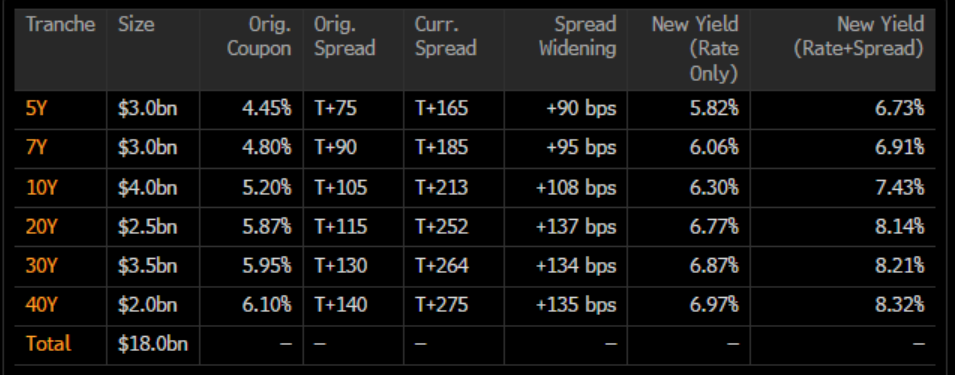
On a strictly cash basis, this means that Oracle’s debt would, if issued today, cost it another $6.89 billion in interest.
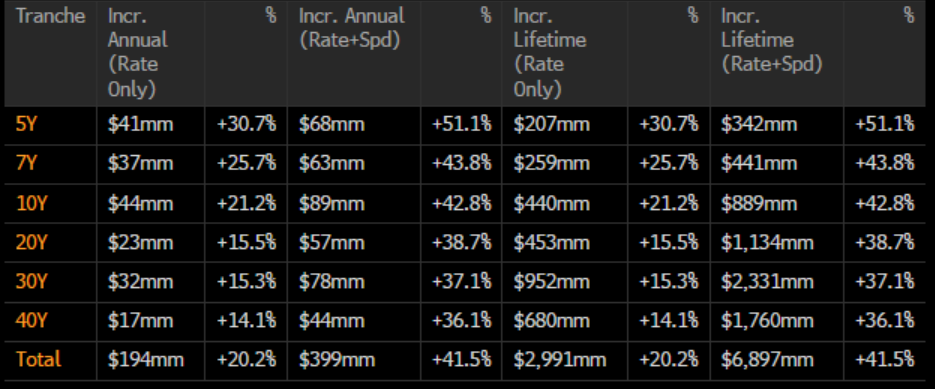
I should also be clear that these numbers are based on a completely flat calculation related to today’s Treasuries and going prices for Oracle’s bonds. As Oracle sits exactly one rung above junk — and its debt trades at junk rates (meaning that the markets buy and sell it as if the yields were junk (an average of 7.8%) — it would likely see its debt priced at around 25-50bps more than what we’ve seen here.
And if Oracle raises more debt, it runs the risk that two ratings agencies could downgrade it to “junk,” immediately forcing investment funds and indices that cannot hold junk debt to dump it, turning it into a “fallen angel” (as I covered a few months ago).
Oracle isn’t even the worst of them.
CoreWeave’s 2025 Five and Six-Year-Dated Bonds Would Be 35.8% More Expensive If Issued Today, Adding $1.2 Billion In Interest, With Yields Of 11% to 13% In The Best Case Scenario
Wretched, debt-ridden neocloud CoreWeave issued around $7.75 billion in bonds in 2025 and 2026, and faces a double-whammy of problems — the increasing yield on Treasury bills combined with the overall souring of debt markets toward both its business and the overall idea of AI data center debt.
Last year, CoreWeave was already borrowing at ridiculously-high coupons of over 9%, but if that debt was repriced today, it would be paying at the very best rates between 11% and 13.22% — the kind of numbers you’d associate with a personal loan.
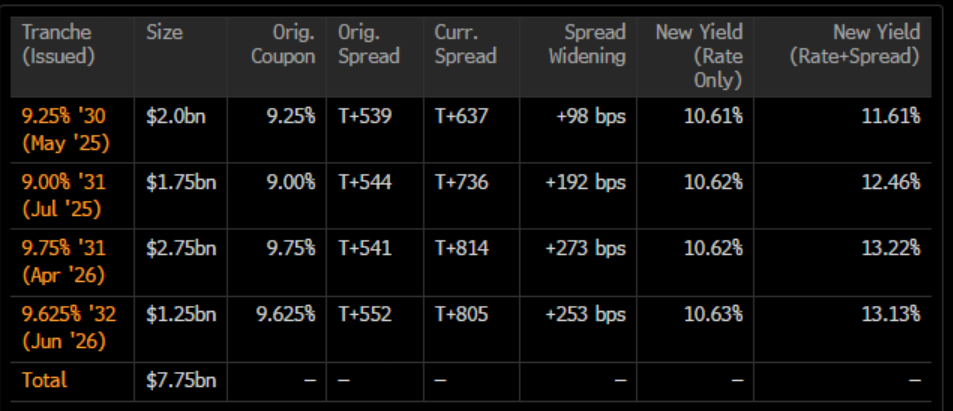
As you can see, repricing CoreWeave at today’s rates would increase its costs by 35.8%, adding $1.2 billion to the lifetime cost of the bonds for a company that already pays $640 billion a quarter in interest.
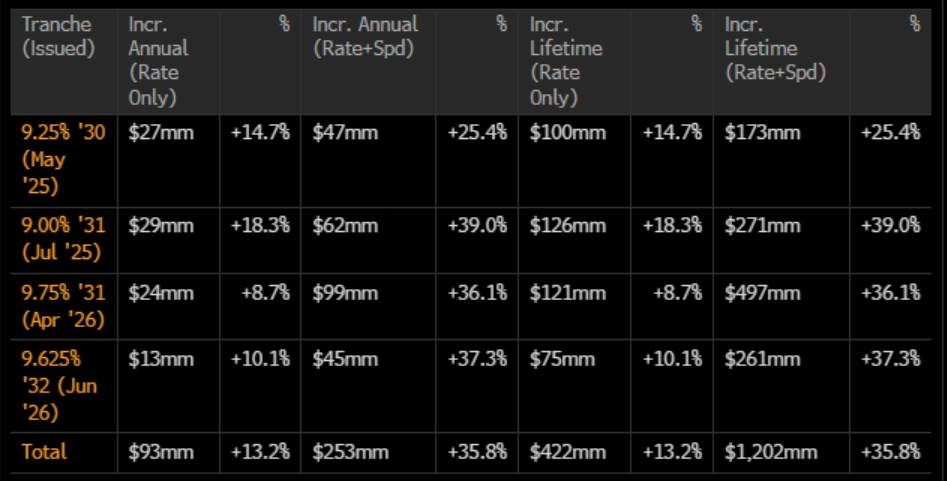
Make no mistake, CoreWeave needs to raise more debt to build its data centers. Bloomberg consensus estimates have it borrowing more than $33 billion in 2027, at a time when interest rates are likely to stay elevated and jitters around AI data center debt are becoming full-blown convulsions. UBS’ Karl Keirstead estimates that it will need $102 billion in extra financing between 2027 and 2030, but that makes the broad assumption that CoreWeave will still exist in a few years.
In any case, CoreWeave and Oracle’s debt exist as a kind of barometer of the data center industry’s debt position — two junk-or-near-junk firms raising endless debt to build out the so-called next industrial revolution at an agonizing price.
And if the price of their debt is crashing — and the expected yield on the future debt is skyrocketing as a result — then their problems are everyone’s problems.
The AI Data Center Doom Loop
As I discussed back in July, the sheer scale of AI capital expenditures has inflated the price of every imaginable piece of gear that goes inside a data center, a problem that compounds with every new dollar of capex:
As I wrote in the Hater’s Guide To The Memory Crisis, the sheer scale of Microsoft, Google, Meta and Amazon’s spend on AI data centers has led to a massive supply chain crisis and price-gouging from the triopoly of Micron, SK Hynix and Samsung, with Micron alone bumping prices for DRAM by 60% in its last quarter, shooting up the price of every single kind of RAM possible, at a rate increased by the amount of GPUs and servers that hyperscalers buy.
This naturally creates a vicious cycle. The more AI servers that hyperscalers buy, the more demand they create for RAM and high-bandwidth memory, which increases the price of RAM and HBM, which makes the AI servers more expensive, which means hyperscalers need more money, and because AI has yet to provide meaningful improvements in revenue or cashflow, they’re forced to raise more debt.
The more they raise that debt, the more expensive that debt becomes, and the more of that debt they use, the more of it they need, because the more they spend, the more the stuff they’re buying costs, which means they need more debt.
I published that newsletter on July 28 2026, back when ten-year-dated US Treasuries were a mere 4.6%, and concerns around Oracle’s data center debt had yet to truly erupt.
And a little under a month later, NVIDIA would bump its prices by more than 15%, partly as a result of memory costs, and partly because it has the entire tech industry by the balls.
So, as more AI data center debt gets issued, said debt becomes more expensive, because the larger the amount of debt any one thing takes up, the more competition it faces, and the more risk an investor carries by holding it. Once the debt is issued, it immediately flows into buying GPUs and associated hardware, slowly growing the cost of memory and hardware, all while increasing the competition for the specialist labor and materials needed to build data centers, such as spiking the cost of Copper, increasing the cost of construction by billions in the process.
In other words, the more you buy, the more you lose. The more money you raise, the more money you need. The more money you need, the more expensive that money becomes. And once you spend that money, everything you spent it on becomes more expensive, including raising more money in the future.
The other problem is, as I discussed last week, that these things are simply not getting built, either because the power isn’t there or construction is taking longer than expected, which is in turn putting pressure on effectively any data center-related debt, with even the $27 billion in bonds underlying Meta’s Hyperion data center in Louisiana (known as “Beignet Investor LLC”) aggressively selling off over the last two months.
As I’ve said, a bond “selling off” means that anyone raising more debt that resembles it will have to pay investors more for the privilege.
And when even the debt associated with the largest companies in the world begins to sell off, that becomes everyone’s problem.
Oracle’s Data Center Debt Doubts Are Everybody’s Problem
Sidenote: While a data center SPV “connected” to a company is connected to the credit rating of the company in question, it is not technically “owned” by the company like a traditional bond because it’s not technically on their balance sheet, and the debt/assets are held by a separate special purpose vehicle.
This is why connected SPVs can trade so much lower than the company’s debt.
I also want to be clear about something: every single AI data center SPV is funded by customer payments which will only arrive if the data center actually gets completed.
So, let’s talk about the $18 billion in debt behind Oracle’s New Mexico-based Project Jupiter data center, starting with ZeroHedge’s diagram of the structure:
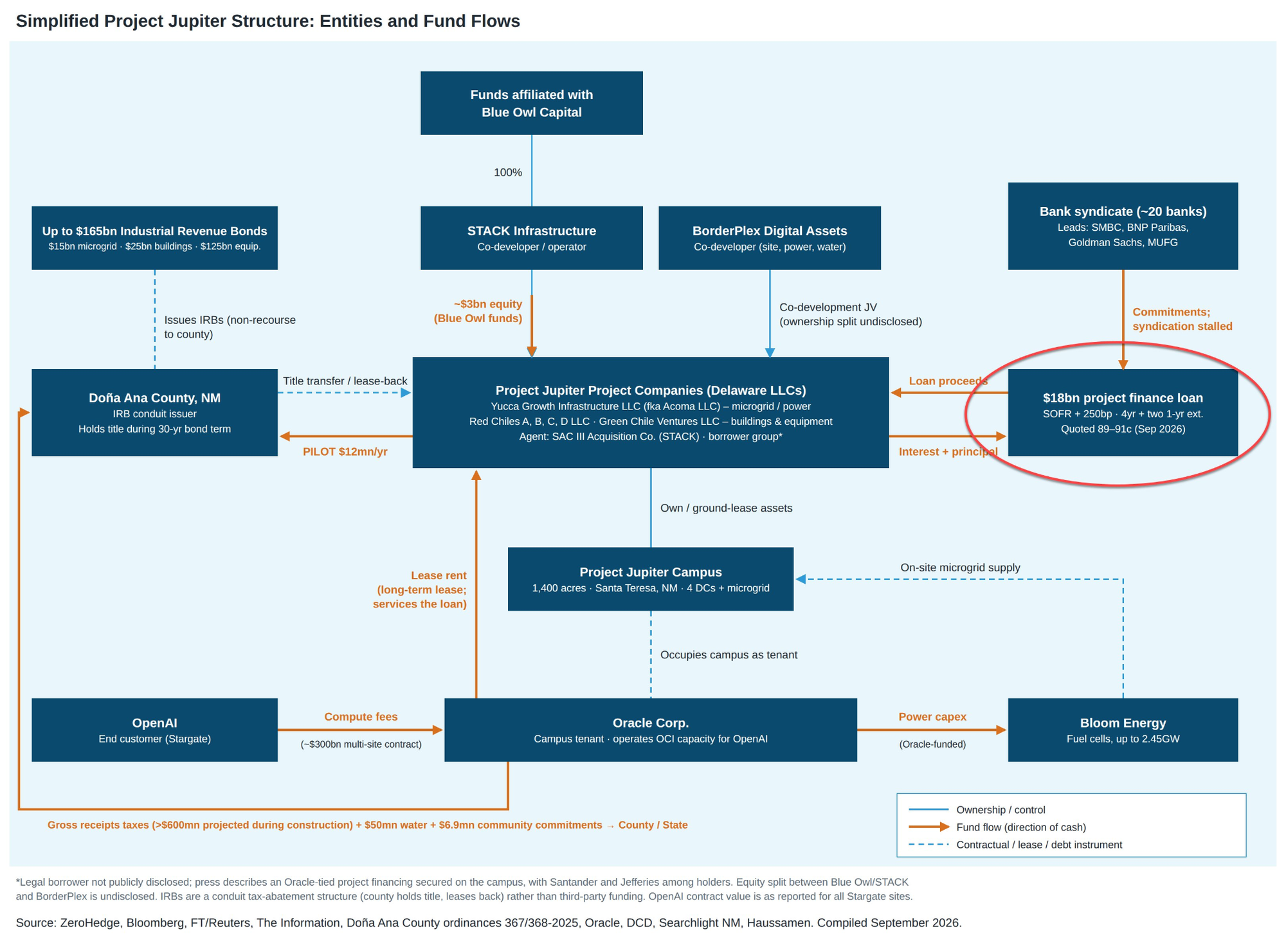
Oracle borrowed $18 billion from a syndicate of financial institutions including BNP Paribas, Goldman Sachs, and two Japanese banks — MUFG and SMBC — that have been in effectively every major AI data center deal, including multiple CoreWeave debt facilities, every Stargate/OpenAI/Oracle data center, and even SoftBank’s bridge loan that it used to fund OpenAI’s 2025 funding round. Additionally, funds related to Blue Owl (who is also invested in multiple different Stargate and CoreWeave facilities) kicked in $3 billion in equity to make sure the debt actually got raised.
This kind of labyrinthine structure is how basically every off-balance-sheet and SPV-based data center debt deal is capitalized — a few billion dollars of equity investment, usually from one of a few private credit funds (EG: Blue Owl, Blackstone, BlackRock) that then raise debt from many of the same investors, something I covered at length in my Enshittifinancial Crisis piece from the end of last year. I also went into detail about the SPV structures a few months ago here.
The reason I bring all of this up is that this kind of SPV is the template for data center debt, and the associated investors are a large chunk of the capital funding it, which means that their ability to continue feeding the beast of AI data center debt is what’s holding up this industry.
And now one of their largest data center debt deals, as mentioned, has entered “distressed” status, which means that any further SPVs they’re involved in will price based on the current state of Project Jupiter, which will be priced both based on the project’s health and the current state of Oracle, which is being dragged down by the questionable health of its many, many data center debt deals, all of which are contingent on OpenAI’s ability to pay it $300 billion over five years.
This means that the price of any debt associated with AI data centers is now skyrocketing, at a time when the price of the goods that debt is buying are skyrocketing, at a time when the underlying construction needed to pay back that debt is taking forever.
This is the Doom Loop: the more data center debt that gets raised, the more expensive both the data centers and the debt become, and the only way of fixing the problem is to stop financing new data center debt, except once that happens, everybody will ask whether the data center buildout has stalled, which will in turn create pressure on all of the debt that’s already been issued.
In simple terms, it’s going to be difficult to impossible to raise AI data center debt below 8%, with even the $2.27 billion in bonds issued to CleanSpark for a Meta-connected data center in Georgia pricing at 8.25% on September 18.
AI Data Centers Are Dead Money
As I went into in last week’s premium (and per my Bastard data center model), a 100MW data center costs around $4 billion to $5 billion, with gross margins of 28% at $17.7 million a megawatt…with negative gross margins below $12.10 a megawatt. But only if you have a customer the entire time, and you don’t have any debt.
Those customers are, for the most part, either OpenAI, Anthropic, or a company like Microsoft or Amazon renting out compute to resell to them. Otherwise, they’re unprofitable AI startups like Cognition, which expects to burn $800 million in 2026, with (per The Information) “hundreds of millions” of dollars of those costs coming from renting NVIDIA GPUs.
This means that the underlying customer base for effectively every AI data center is either a hyperscaler or somebody that can, by definition, not actually afford to pay for their compute without somebody else giving them the money, with “somebody” often meaning “a hyperscaler.”
AI data centers are some of the most-expensive and ambitious infrastructure projects in the history of mankind, funded with some of the most-expensive debt ever raised, with said debt only payable in the event that the project A) gets completed and B) has customers that can pay once that happens. Said customers are brittle, unprofitable and unsustainable, with the very real risk that they simply won’t exist by the time construction is complete.
Even if everything goes to plan, the incredible cost of AI data centers means that they’ll take anywhere from three to five years to pay off, and that’s being extremely generous about the terms of the debt and the willingness of the customer to pay top dollar.
Long Term GPU Rates Are Much Lower Than You Think, Making Payoff Near-Impossible For Most AI Data Centers
One counter-argument to my skepticism has been that the per-hour price of GPU compute has gone up based on SiliconData’s various indices, but I have serious questions about the validity of this data, as I believe it measures spot rates — as in the amount you’d pay to rent right now versus on a longer-term basis — which creates an illusion of success that doesn’t connect to reality.
For example, SiliconData has NVIDIA’s B200 GPU pricing at around $5.78 an hour, but a contract I found between neocloud Kidz AI (which rents capacity from a company called Limestone, or, more-specifically, its subsidiary Catalyst Compute) and AI inference company Canopy Wave priced 256 B300 GPUs at $4.30 an hour (per GPU) for the first three years and $3.50 an hour for the last two of the five-year-long contract for a more-advanced chip than the B200. Another contract I found between Australian neocloud Sharon AI signed a deal with a dodgy-sounding company in Dubai priced 8208 B300 GPUs at $3.30 an hour for five years.
To be explicit, the B300 is NVIDIA’s latest-generation GPU, and its long-term rental prices are less than half of SiliconData’s hyperscale pricing for the years-old H100.
If we assume that an 8-pod of B300 GPUs retails around $550,000, and the capex is a comparable amount, that puts the cost of the data center that Sharon AI is renting out at somewhere in the region of $1.1 billion, for a contract that will, over the course of five years, pay a total of $1.264 billion, assuming that the client in question pays.
In the case of Catalyst Compute, the 32 8-pods of B300s cost roughly $17.6 million, for a rough total of $35 million for the full capex. Over the course of five years, the contract will pay around $44.6 million, and I should note that the customer (Canopy Wave) only moved into reselling inference compute as of November 2025.
In both of these cases, capital expenditures are barely paid off in five years, and only if you don’t include a single dollar of operating expenses or associated debt.
And that’s if everything goes to plan, and the customers actually pay.
Even then, at the end of the five year period, we’ll theoretically have multiple new generations of NVIDIA GPUs (Vera Rubin and Feynman), which will further suppress the ongoing rates that your data center earns, all as ongoing opex (and debt) stays at the same level, assuming, of course, you were paid consistently throughout.
Let’s review:
- AI data centers are extremely expensive.
- AI data center debt is now extremely expensive.
- AI data centers take years to build.
- AI data center customers are brittle, unprofitable and dependent on near-perpetual funding.
- For there to be any real chance of a payoff, the average customer — you know, the brittle, unprofitable one I just mentioned — will need to survive until the data center is built, and then be able to afford ongoing fixed annual costs, all while competing with multiple other data centers with identical chips.
AI data centers — and their associated costs and debt — are priced for a level of perfection that no other industry has ever rivaled. Their customers must be well-capitalized, prompt in their payments, and have revenues that allow them to spend tens or hundreds of millions of dollars a year on operating expenses on an ongoing basis, something that only really matters if the underlying construction happens.
For whatever reason, everything I read about AI data centers considers it a foregone conclusion that everything will go to plan, and in fact that each data center will generate tens of billions of dollars a gigawatt in revenue, with no real thoughts or feelings about where those billions might come from or whether anyone will be able to afford them.
Everybody is either egregiously ignorant or hopelessly optimistic in a way that will make this situation so much worse when it collapses. I do not think the majority of these AI data center debt deals ever get paid. I do not think CoreWeave makes good on its debts.
Shit, I don’t think Oracle makes good on its debts.
The AI Industry Is Near-Entirely Dead Money
I estimate that since 2023, there’s been around $800 billion in global venture capital investment in AI companies, with at least $266 billion of that going to Anthropic and OpenAI.
Of those investments, I expect at least $300 billion of that equity to be dead money, because, for the most part, AI companies are wrappers or layers built on top of Anthropic and OpenAI’s models, holding very little IP of their own and being burdened with ever-growing opex that mostly flows to the two AI labs that constantly want to compete with their customers. These businesses are fundamentally built on reselling tokens from the large AI labs at a loss, which is why companies like Harvey and Perplexity have to raise hundreds of millions of dollars every few months.
These startups’ continued existence is entirely a function of venture capital, as all of them are deeply unprofitable. This means that before the bubble bursts, these companies will continue to sap the venture capital world of billions more dollars, all with little chance of an acquisition and a near-zero chance of an IPO considering their ugly economics. These economics are also load-bearing for OpenAI and Anthropic, representing around 80% of their revenues, meaning that once they die, the AI labs’ underlying revenues begin to decay.
This also means that these AI startups are, in general, not actually renting AI GPUs, choosing instead to rent them by proxy by using Anthropic and OpenAI’s models. Though some of them talk a big game about building or training their own models, doing so is enormously expensive with little chance of a payoff, especially given the massive advantage in compute, capital and talent held by the labs.
There really is no clean “out” for any AI startup not named Anthropic or OpenAI. Cognition, valued at $48 billion in its latest funding round, is allegedly worth nearly as much as Ford ($59 billion market cap), yet generates a mere $1 billion in ‘annualized run rate,’ which could mean anything, all while losing $800 million. Ford, by comparison, had $187.2 billion in revenue in 2025, with a net loss of $8 billion attributable in part to a massive writedown of its electric vehicle portfolio ($12.5 billion in Q4 2025 alone).
In 2025, Ford sold around 2.2 million vehicles. Cognition, by comparison, makes yet another AI coding agent.
What, exactly, does Cognition do from here? Who buys Cognition? Does it go public? How? It loses tons of money and has a commoditized product!
Nobody wants to answer these questions, because the answer is pretty simple: one day, Cognition, like many AI startups, simply runs out of money and dies, or becomes a much, much smaller company. The same goes for Harvey, Perplexity, Replit, and basically every other major AI startup, though I’d argue they’re all hoping to get swept up by a hyperscaler.
As I discussed at the end of last year, AI startups are a devil’s deal for all venture capital. Because they’re so capital-intensive, there’re tons of opportunities to invest, and every time you do so, the underlying valuation (and assets under management of the VC fund) skyrockets, making everything look good on paper.
The problem is that these valuations are entirely disconnected from reality to the point that, for the most part, all of these companies either go to zero or are picked up in nebulous “acquihires” for embarrassing fractions of their previous prices.
Without these companies, Anthropic and OpenAI lose somewhere in the region of 60% to 80% of their enterprise revenues, which makes them even less likely to be able to pay for all their $1.3 trillion in compute commitments.
And outside of those two companies, I estimate there’s roughly $22 billion of demand for AI compute.
How The Doom Loop Breaks Everything
Every single day — even on the weekends — someone asks me either how or when all of this breaks, and my answer is simple: when the money runs out.
Eventually, AI data center debt is going to become untenable for those raising it, because 11%+ rates on already-meager margins makes the maths a little impossible. Once this happens, there will be a fundamental reevaluation of the value of all AI data center debt, which may lead to a sell-off of the underlying bonds and associated debt, which will make any investor deeply entrenched in the GPU credit business extremely nervous and, in some cases, unable to exit their positions in anything short of an embarrassing fashion.
This isn’t likely to happen due to moral or ethical reasons, but as a result of creditors realizing that they’ve got way too much risk tied up in projects that regularly make the news for not getting built. At some point these projects become too risky for even the most mold-poisoned private credit fund or brainless Japanese bank to stomach, and the timeline will accelerate based on either Treasury rates or further data center developments facing cashflow or construction problems.
On the venture capital side, it’s unclear how much dry powder actually remains, how much of it could be deployed into AI startups, and whether it’ll be a case of ‘running out of money’ so much as a moment where everybody gets spooked about AI and stops investing entirely. This would be accelerated by any cashflow issues across any major AI startups, any downrounds (IE: raising at a lower valuation), or failed acquisitions, such as when Anthropic walked away from buying Decart for $6 billion earlier in September.
And really, the biggest sign is the most obvious one — the deceleration of Anthropic and OpenAI. If they aren’t going to pay those $1.3 trillion in compute bills, the jig is up for AI data center demand.
The signs are already there that something is up.
Per Irrational Analysis, Anthropic’s record-breaking “$65 billion in annualized revenue run rate” from July 2026 may have been calculated in the single-most-deceptive way I’ve ever heard a startup do so:
Last month, there was a whole kerfuffel in AI/semis/finance circles on Anthropic July ARR. Two numbers were going around. I don’t remember the numbers and frankly it does not matter. You will see.
One ARR number was the traditional “trailing 28 days * 13” number. Personally I hate this venture-capital clown metric but whatever a lot of people use this.
The traditional ARR number was bad and implied deceleration in growth. So the people massively long Anthropic came up with a new ARR number that was July 31st * 365 days.
That’s right folks. If Irrational Analysis is right, Anthropic’s revenue on July 31, 2026 was $178 million, and because the other calculation — 28 days times 13 — created a lower number, the company chose to go with something that should, at a minimum, have investors hiring lawyers and demanding real, tangible answers about how run rate is calculated. Every single reporter with any Anthropic source that can speak to run rates should be screaming at them for clarity, because this is some sub-Enron bullshit.
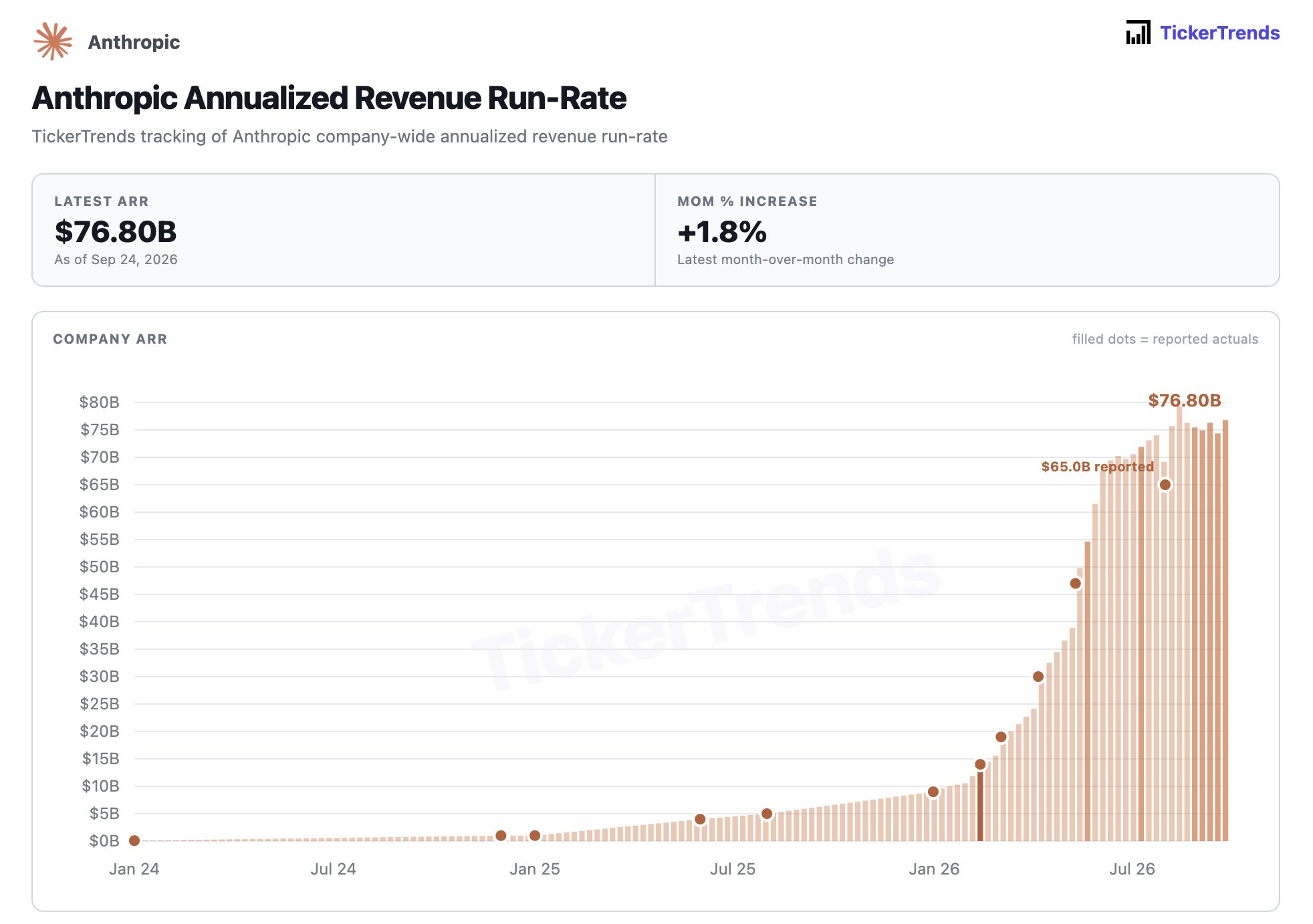
Even if you don’t trust that analysis, another from TickerTrends surfaced by Callum Williams of The Economist shows Anthropic’s annualized run rate plateauing since, it seems, the beginning of June, and as Williams said, if this is even broadly correct, it’s really, really bad.
Williams also another TickerTrends chart showing OpenAI’s revenue growth had continued to climb…but was showing the initial signs of a slowdown.
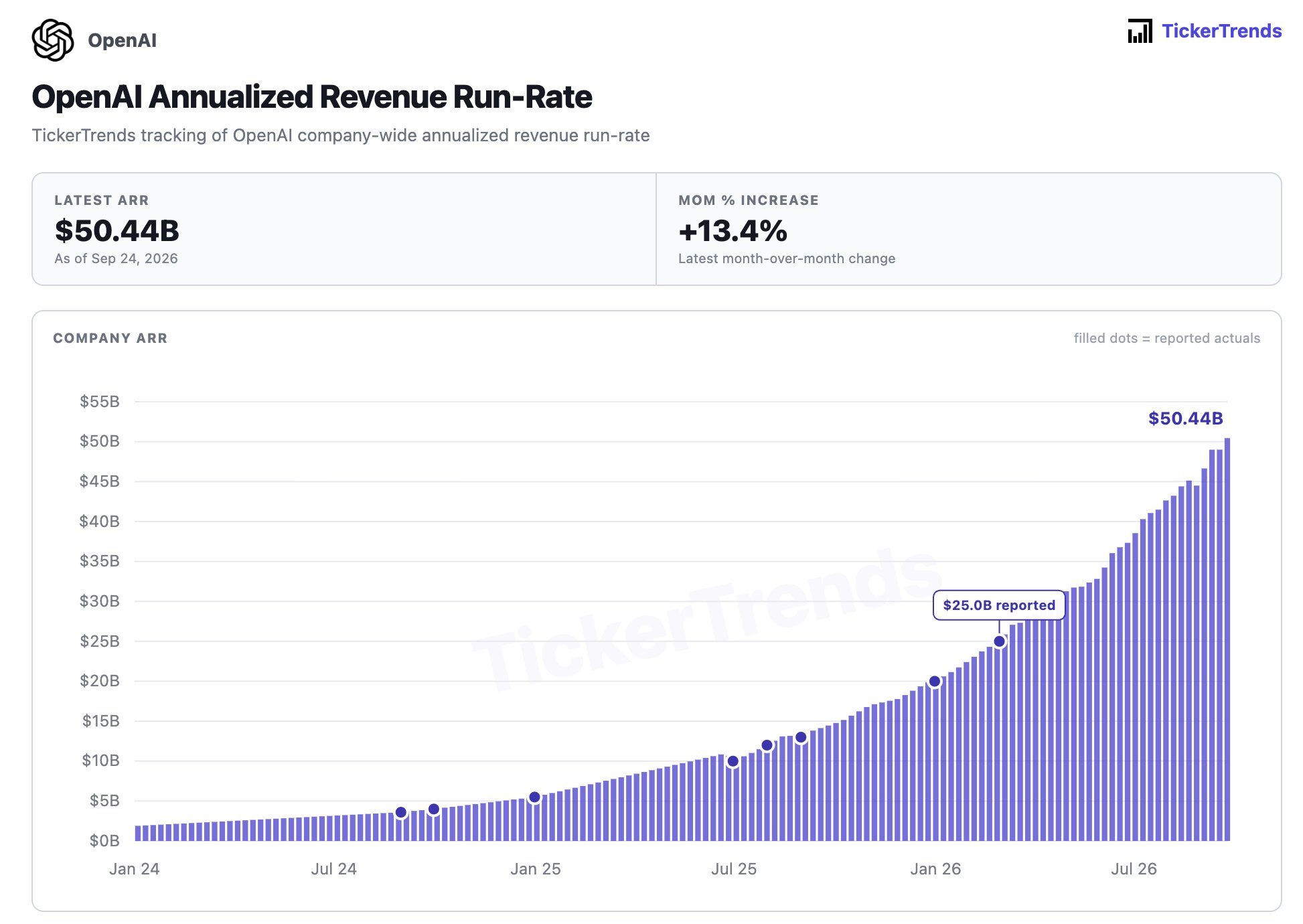
Neither of these companies can afford to slow down, in part because of their massive compute obligations, and in part because their massive valuations are based on them being able to pull in, at least in Anthropic’s case, between $190 billion and $200 billion in annual revenue within the next two years.
If they fail to do so, everybody suffers. Hyperscalers miss revenue estimates. AI data center debt goes unpaid. Venture capitalists find their holdings washed out.
When that happens, everybody will act as if it was a huge surprise, rather than something that was blatantly obvious to anybody who bothered to look.
Anthropic’s S-1 Shows That It Was A Worse Business Than OpenAI In 2025, Spending $2.75 To Make $1 (OpenAI Spent $2.60 To Make $1)
That was originally where this newsletter ended, but the night before this was due to go out, parts of Anthropic’s S-1 leaked to Reuters, showing the shocking financial condition of the company as of the end of last year.
In 2025, Anthropic lost over $8 billion on $4.6 billion in revenue. 25% of its 2025 revenue came from two customers, and its compute costs were $7.33 billion for the year. It technically had a net loss of $42 billion, but that was stock-related and was not a cash loss.
Reuters did not report on Anthropic’s 2026 numbers, and while in theory its economics could have improved in the last three quarters, there are reasons to believe that things have gotten worse, such as the fact that it has resorted to using adjusted margins as a means of faking a “profit” in Q3 2026. In any case, I find it strange that Reuters reported on only a section of the S-1, and if it turns out anything was held in reserve for some reason I will be deeply disappointed. I will be fair and assume it was a limited slice of the prospectus, and that Reuters will diligently report anything it finds, and it is an incredible exclusive.
So, let’s talk about how terrible of a company Anthropic was in 2025.
It spent $12.65 billion in operating expenses to make $4.6 billion of revenue, otherwise known as spending $2.75 to make a dollar.
This, shockingly, means that Anthropic was a worse business than OpenAI in 2025, when it spent $34 billion to make $13.07 billion (per my own exclusive reporting of its audited financials), or $2.60 to make $1.
While things could change in 2026, it’s important to note how many people said that Anthropic was “a better business” that would “be profitable faster than OpenAI,” which is, until we are able to see both of their audited 2026 financials, somewhere between a myth and an outright lie.
So many people told me that Anthropic was more-profitable! So many people assured me that this company had worked it all out, when in fact Dario Amodei’s horrid son was just as obese as Altman’s, a rotten, unprofitable carcass.
Boosters are already boiling their copium kegs, angrily oinking that 2026 “will be better” and that “Anthropic has been more profitable.” At this point I have less than zero interest in anything that hasn’t gone through an auditor, because it’s very clear that, through either misinforming investors or the media, Anthropic has intentionally obfuscated the full horrors of its economics.
Perhaps 2026 will be better! But right now, the evidence is that Anthropic’s economics have decayed for the last two years, and its business was, at least in 2025, somehow more toxic than OpenAI’s, regardless of what you may have read in the press. If things have improved, it will have required a fundamental turnaround of a business in a way that does not appear to have happened in any way for OpenAI, despite both companies being in the same business and selling the very same thing. The only difference I can imagine is that Anthropic’s infrastructure is more TPU and Trainium/Inferentia-heavy, but we’ll eventually find out, I guess.
If you have the full S-1, I implore you — bring it to me. My signal is ezitron.76. I will protect your identity. I will do this document justice. It’s time we had complete clarity into what this business truly looks like. We should not be made to wait for November, we should see it now, so that investors (and any economic counterparty) may fully understand the state of Anthropic.
In any case, these numbers are as bad as I’ve always thought they’d be, if not a little worse. I don’t see how this company becomes one that can afford its $518 billion in compute commitments, nor do I see how it magically works its way out of the economic equivalent of septic tank.
This company will, if allowed to go public, likely lean on the very same junk-grade/high-yield debt that AI data centers and neoclouds like CoreWeave currently need, and it will do so at volumes of somewhere between $50 billion and $100 billion a year for a company with few assets, endless losses and a CEO with the grace of a drunk elephant.
Anthropic is not the future of technology, nor is it the next Google, nor is it the next Microsoft, nor is it, to quote Reuters, capable of “[transforming] the global economy more profoundly than industrialization, electricity and the internet.”
Anthropic is a cloud software company with volatile products and economics, sold in a fundamentally insincere and deceptive manner, pushed upon society with threats of death and destruction by aggressive zealots and members of the media bereft of shame. Its culture is fundamentally unhealthy, as is the culture of the fandom it has curated over the last few years. Dario Amodei is a manipulative and deceptive person influenced by a cadre of cultists, and Anthropic CFO Krishna Rao should feel ashamed of himself for allowing a single run-rate story to go out.
It is impossible to rationally argue that the economics of OpenAI and Anthropic make any real sense. To claim that this is “just like Uber” or “just like Amazon Web Services” or “just like the Dot Com Bubble” is to bury one’s head in the sand or, on some level, want to know less about the world. This is serious, dangerous, and should not be seen as “business as usual.”
We must treat OpenAI and Anthropic as what they are: economic disasters waiting to happen.
To do anything less is to directly invite danger to the door of every investor that’s allowed to believe that they’re funding the next industrial revolution.
If you liked this piece, you should subscribe to my premium newsletter. It’s $70 a year, $18 a quarter, or $7 a month, and in return you get a weekly newsletter that’s usually anywhere from 10,000 to 18,000 words and provides vast, detailed analyses of the biggest events and companies in the AI bubble.
If you want to get in touch — and especially if you have any juicy information about Anthropic, OpenAI, or any other companies in the AI bubble — hit me up on Signal at ezitron.76. I’m also on IB on The Terminal.