
If you liked this piece, you should subscribe to my premium newsletter. It’s $70 a year, or $7 a month, and in return you get a weekly newsletter that’s usually anywhere from 5,000 to 18,000 words, including vast, detailed analyses of NVIDIA, Anthropic and OpenAI’s finances, and the AI bubble writ large (updated to version 3.0 last week). My Hater's Guides To the SaaSpocalypse, Private Credit and Private Equity are essential to understanding our current financial system, and my guide to how OpenAI Kills Oracle pairs nicely with my Hater's Guide To Oracle.
Over a three week period in May, I published an exhaustive three-part guide to how the AI bubble might collapse, the events that might trigger it, and the consequences. For something lighter, check out last week’s premium, where I re-introduce you to the antagonists of the AI bubble (and their fatal weaknesses) in caustic, slightly sweary terms.
Subscribing to premium is both great value and makes it possible to write these large, deeply-researched free pieces every week.
Last week I went on Bloomberg and discussed the state of the AI bubble with a clarity that rattled even the sweatiest boosters, mostly because I spoke with clarity about an investment frenzy whipped up through hype, deceit and mythology. Some were equal parts frustrated and angry that I don’t have money in the market, or, as they’d put it, “skin in the game.”
I get it! When your entire worldview is dictated by what a series of venture capitalists and psuedo-journalists on Twitter want you to believe, it must be difficult to imagine someone having “morals” or “beliefs” or that one might hold a position that wasn’t entirely based on greed or tribalism. It must be confusing — upsetting, even! — to hear that somebody is willing to accurately and vociferously tear into a tech industry largely controlled by people with no regard for their users or workers, who are willing to bathe their products in mediocrity all because it’s the thing that everybody else is doing.
This is a hysterical era perpetuated by liars, cowards, imbeciles, craven boosters and the easily-fooled. Those excited about generative AI are either the victim or the perpetrator of a con centered around a technology to ingratiate at the highest cost possible.
AI Cannot Afford To Slow Down — It Needs $3 Trillion Or More In Revenue By End Of 2030 To Sustain Its Existence
I also think that everybody is a little flippant about what has to happen for me to be wrong.
- If we take Sightline Climate’s data from February at face value, there are 190GW of data centers planned. If we take NVIDIA CEO Jensen Huang’s statement that data centers will cost $80 billion to $100 billion a gigawatt at face value, this means that said data centers will cost anywhere from $9.5 trillion to $15 trillion. Bloomberg incorrectly states that this is a “$3 trillion” buildout.
- This money will have to come from somewhere. The Financial Times reported in May that banks are concerned they might “choke” on data center debt when I estimate there’s barely $250 billion a year being issued. They will, to actually make these data centers happen, have to start issuing anywhere from $500 billion to a trillion a year.
- Jensen Huang has also said that NVIDIA projects a trillion dollars worth of revenue through the end of 2027. 54% of NVIDIA’s revenue comes from three clients, which means that NVIDIA’s future largely depends on three unnamed companies — likely Taiwanese ODMs building servers for Microsoft, Google and Meta — and their counterparties’ ability to raise debt on a near-perpetual basis, as the number of firms that can afford to buy thousands of $7.8 million racks of Vera Rubin GPUs is dwindling.
- Even then, every part of this puzzle requires more and more debt or at the market dumps like Google’s $85 billion equity sale or Meta’s planned multi-billion dollar dump.
- The fact that hyperscalers are doing equity sales is, as economist Paul Kedrosky raised in our conversation on my show last week, a sign that debt is becoming harder to acquire.
- Anthropic has made $330 billion in compute and chip commitments between Google, Amazon, and Microsoft, another $30 billion with CoreWeave and another $15 billion with SpaceX. To pay for this compute, Anthropic must meet its projected revenue of $174 billion a year by 2029.
- OpenAI has projected to burn at least $852 billion through the end of 2030, and has made over $770 billion in compute commitments across Microsoft, Amazon, CoreWeave, Cerebras, and Oracle. The $122 billion funding round from March will be insufficient to cover these costs, and it will require, at the very least, another $250 billion in funding by the end of the year.
Whatever obtuse fantasies you have about the current state of generative AI are irrelevant to a much larger problem: that the infrastructure being built and compute commitments being made are being done so at a level that demands that generative AI and AI compute generate over $2 trillion in annual revenue by 2030. When I say that, I mean it absolutely has to do that otherwise none of the data center capex makes sense, and neither Anthropic nor OpenAI can pay their commitments.
OpenAI expects to spend $50 billion on compute in 2026, and I wouldn’t be surprised if Anthropic spends anywhere from $30 billion to $50 billion. Between them, Anthropic and OpenAI represent the vast majority of all AI compute demand — at a minimum 70%, if not 80% to 90%.
Put another way, there’s barely a few billion dollars of demand outside of two companies that lose billions — or tens of billions — of dollars a year.
Let’s break down these numbers a little further:
- 190GW of data center capacity assuming a PUE of 1.35 suggests a critical IT load of around 140GW, which, charged at around $12.5 million per megawatt, works out to around $1.75 trillion in annual revenue.
- If we assume that half of that gets built, that’s still $875 billion in annual revenue that will be needed to keep these data centers from running out of money as their margins are atrocious and they’re all paid for with onerous debt.
- OpenAI and Anthropic project to make $184 billion and $174 billion in revenue in 2029, for a total of $358 billion in annual revenue. While Anthropic claims it will be profitable by then, I do not believe it will be, nor is it profitable at this point outside of financial engineering.
- At present, there are no other major purchasers of AI compute outside of NVIDIA, hyperscalers (who are selling it to Anthropic and OpenAI, or they’re Meta, which has no AI strategy), OpenAI, and Anthropic. None. I can’t find a single one outside of Jane Street spending more than a few hundred million. We need a few hundred billion.
- That’s already a huge problem, but the other problem is that we also need companies to spend dramatically more on AI services than they already do. While journalists are currently gooning over OpenAI and Anthropic making $6 billion or $10 billion in a given quarter, that’s just not enough! Both Anthropic and OpenAI need to be making $10 billion or more in monthly revenue by Q1 2028, or their growth rates aren’t going to support their compute commitments.
This is not hyperbole! Every single thing I have stated here precisely maps to the projections and promises of the AI industry. No matter how horny or flaccid you are for the potential of AI, it must grow at an astonishing, unstoppable rate from here until the end of time to be anything close to worthy of its costs.
Actually, sorry, let’s put judgments aside for a second, because this isn’t about judgment, but rather the promises that have been made by the software and hardware companies associated with AI. NVIDIA’s place atop the stock market and its ridiculous projections depend on both the continued flow of data center debt and the continued belief that AI services will have the revenue to back it up.
AI cannot, under any circumstances, slow down. In a year, Anthropic and OpenAI’s businesses have to be roughly twice the size they are today, and then double again basically every year until 2029 or 2030. In that time period, they must also both raise hundreds of billions of dollars or, alternatively, turn deeply unprofitable businesses into profitable ones while also doubling their revenues.
Alternatively, both must severely reduce their costs…except if they do that, they won’t have any need for all that compute capacity, which will deprive Oracle, Google, Microsoft, SpaceX, Cerebras, CoreWeave, TeraWulf, Cipher, and Hut8 of the $1.1 trillion in remaining performance obligations.
Also, if OpenAI can’t afford — or doesn’t want — its compute, Oracle will simply run out of money. It is spending anywhere from $340 billion to $700 billion (depending on whether you believe Jensen Huang in September 2025 or May 2026) on the 7.1GW of data centers it’s building for OpenAI. These, again, are not hyperbolic statements, but the actual costs associated with Oracle’s massive buildouts in Michigan, New Mexico, Wisconsin and Texas. I didn’t agree to do this! Larry Ellison did!
Sidenote: Larry Ellison has also got at least $21 billion in loans collateralized by his Oracle shares, and any doubts around Oracle’s ability to pay for its debts or OpenAI’s ability to pay Oracle for its compute will threaten massive margin calls. I wrote about this here. It’s really bad!
Whatever Everybody Is Spending On AI Right Now Is Insufficient, and We Need At Least Two Other OpenAIs To Justify The Compute Being Built
Apparently, Salesforce is planning to spend $300 million on Anthropic in 2026, to which I say “that’s not nearly enough”! Everybody has to be spending even more than that in the next few years, without fail, no ifs, ands, or buts. It is non-negotiable. Anthropic needs to be making over $100 billion in two years or it can’t afford its commitments, so you filthy token-hogs better slurp up your slop this instant, or Dario Amodei gets made part of the permanent underclass!
But seriously folks, the combined compute demand of every single AI company in the world doesn’t currently reach $100 billion — and it needs to be ten times that by 2030 or all those data centers got built for no reason!
And for that to happen, both Anthropic and OpenAI need to be making about $400 billion a year in annual revenue, which means there needs to actually be that much demand for AI services! Right now, Anthropic and OpenAI’s combined projected revenues for 2026 sit somewhere in the region of $60 billion — so, you know, they only need to grow by 496% by the end of 2029!
To make matters worse, it doesn’t seem like anyone else in the AI industry is going to help with the whole “demand for AI services or compute” thing. As The Information reported a few weeks ago, OpenAI and Anthropic make up 89% of all AI startup revenues.
We could include hyperscaler revenues, but that wouldn’t help very much. Microsoft’s $37 billion in AI annual run rate — these fucking cowards never share actual AI revenues! — is predominantly made up of OpenAI’s compute, with the rest of it (maybe $8 billion in annual revenue at best) from Microsoft harassing its permanently-abused customer base into installing Copilot.
Ah, shit, there’s another problem with Microsoft — Microsoft AI CEO Mustafa Suleyman just said that Anthropic’s models were too expensive, and he intended to reduce Microsoft’s use of them to zero! You can’t do that Mustafa! We need every cent of demand, otherwise everything falls apart!
Sidenote: Amazon and Meta barely have AI stories. Mark Zuckerberg just said he “thinks” Meta has a use for the vast amount of compute it’s bought or is developing, if you’re wondering how great things are going over there.
A source tells me Meta is working on a Tamagotchi-like pendant that uses OpenClaw, and when I heard that I felt exactly how I felt the first time I heard No Doubt’s Rock Steady — did I really used to like this dogshit when I was young?
Anyway, eager math-knowers among you might also notice that even if Anthropic and OpenAI spent $500 billion a year in annual compute — an amount that they can’t afford even if they combined both their unsustainable asses — we’d need at least another $250 billion or more in annual compute revenue to justify it.
In other words, they need everybody to be “doing agents” at such a scale that basically every third dipshit you run into on the street is sinking $50 or more a day into them.
I sure hope that’s happe-OH MY GOD!
AI Is Slowing Down Just As It Needs To Speed Up
As I discussed last week, you can’t measure the cost of a particular task with AI, nor can you measure its return on investment. The only reason that we’ve been “doing AI” with such ferocity and veracity is that most companies are beholden to Business Idiots disconnected from production who have no real understanding of their underlying firms’ outputs, and thus have very little way of measuring them.
These multi-millionaire midwits have been “doing AI” because everybody else is doing it, burning millions of dollars to turn their code into slop (see: Zillow) or have their engineers compete to see who can spend the most money (see: Meta and multiple other companies). In one case, a company spent $500 million on Anthropic’s models in a month because it didn’t set up spend controls. In Uber’s case, it burned through its entire annual token budget in a single quarter, which led to its COO saying it was harder to justify spending money on AI tokens because it couldn’t show a link between that spend and a meaningful increase in useful features on Uber. Now Uber has capped its employee spend at $1,500 a month per user, with T-Mobile temporarily following at $2,000 a month per user with the intent to move to a tiered system. Over at Brex, engineers are limited to $500 a week in tokens, with non-engineers getting an astonishingly-low $5 a week.
These are signs that AI’s revenue growth is slowing, and it’s likely going to slow further, because we currently live in an era where Anthropic and OpenAI are straight-up abusing its clients, providing limited-to-no visibility into spend, per the Wall Street Journal:
The shift to pricing based on usage, and measured by tokens—the basic unit of measurement for AI computing—is creating new challenges for even the most experienced finance teams. CFOs used to paying flat amounts for technology are finding costs more unpredictable and harder to model as they build agents and embark on ambitious AI investments.
Twenty-six percent of companies say they have a comprehensive view of their AI costs, while 50% have some visibility and 22% report no visibility or visibility after billing, according to an as-yet-unreleased survey from KPMG. “It’s a new resource that needs to be managed that didn’t exist quite that way, and we’re seeing exponential growth,” said Steve Chase, KPMG’s global head of AI.
How utterly ridiculous! Only in the frothiest, most-disconnected economy in history could we have companies spending millions (or tens or hundreds of millions) of dollars on a service without having any visibility into costs until after billing. This is not a sustainable revenue stream under any circumstances, and anybody who says that it is is either ignorant, a mark or a con artist. This is revenue made entirely by convincing your customers that something is true (AI is the most revolutionary thing ever!) and keeping them in the dark as long as humanly possible as they run up ridiculous bills, all in the hopes that you’ve brainwashed the executives/paypigs well enough that they’ll never stop.
And really, “paypig” is the accurate term for these cretins:
Russell Burke, Life360’s finance chief, said the company doesn’t yet have a real-time monitor of its token spending, but he hopes to have one soon. “We hope that’s right around the corner,” he said.
Russell, you may as well let Dario Amodei put a cigarette out on your forehead! This is pathetic! What a fucking loser! Oohhh, I sure hope that the company I pay all this money to lets me see how much I’m spending! I thought Silicon Valley was meant to be all about meritocracy!
Sidenote: I will say that it’s nice after two years of being called a crank and a doomer to read an outlet say exactly what I’ve been saying for years — that businesses will squeal when they are made to pay the true cost of AI.
Boosters will say that it’s “hard to measure productivity for any job outside of sales,” but that’s simply not true! If you let your engineers spend $1500 or more a month on a service, surely you must have some way of measuring how much actual new stuff went out — new features, customer tickets reduced, projects completed, I don’t know, I’m not the fuckwit spending $1,500 a month per person on this garbage! You’re the one that has to justify it!
But, fundamentally, these are all signs that AI is slowing down.
Remember: Anthropic and OpenAI only moved their customers to token-based billing in Q1 2026. It only took two or three months for us to get headline after headline of big, serious business publications saying “AI costs a lot of money and companies aren’t sure if there’s a return on investment.”
Sidenote: What do you think happens when regular people are forced to pay their token-based rates? Do you think they’ll spend more? If so, please read the many, many complaints from users of GitHub Copilot who have been on token-based billing for less than a week.
If things were going well, these stories would be inverted — companies would be boasting about their remarkable token spend and pointing to all the new, incredible things they were shipping. Their products would be spotless, their features sublime, their engineers sliding entire new stacks of impressive software out the door so fast that it would be changing the very nature of software. I mean…someone would be, right?
Let’s check out the chaAHHH!
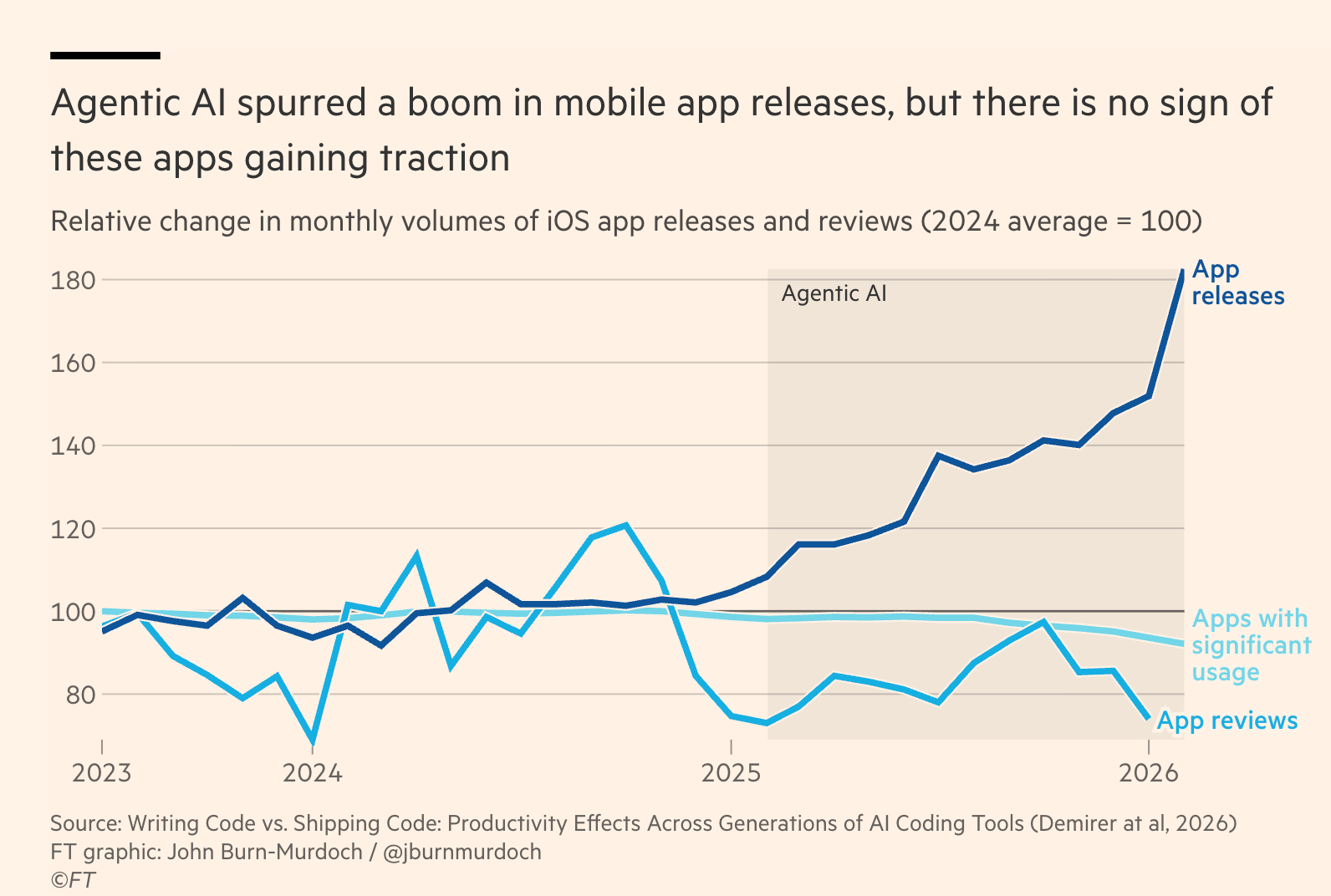
What’s actually happening is that these tools are — at a remarkable price — shoving a lot of stuff out the door. Is the stuff good? No. Do people like or use it? No. Does it make money? Also no. While we’ve discovered the shovelware, that’s all that LLMs have given us — “more” apps, with the vast majority being useless, insecure slopware.
This is meant to be the era of agentic coding! This is meant to be the era where any dickhead with a Codex or Claude Code account with $1,000 of free API credits should be able to create the next Salesforce or whatever it was that dimwit Citrini talked about a few months ago.
I’m sorry to be a little surly and dismissive, but the AI industry has burned over a trillion dollars and I’ve spent two years being told I’m a luddite and an ape for not celebrating it. I don’t care! I’m not impressed! I’m not coddling this mediocre, expensive crap!
Like I said earlier: isn’t the tech industry meant to be a glorious bastion of meritocracy? Isn’t this meant to be a cold, harsh community of rationalists?
If so, why are we coddling AI like it’s the kid from that episode of the Twilight Zone? Has Silicon Valley become so decidedly whipped by the forces of capitalism that it can’t see that none of this makes sense? Or was this always just a culture of lemmings drawn in whatever direction venture capital waved a dollar bill?
To make matters worse, both OpenAI and Anthropic are speeding as fast as they can toward IPO — which means that both will have to start looking like real companies, which means both will, inevitably, start charging their customers more and very likely moving the vast majority of them to token-based billing and either kill or vastly limit their subsidized subscriptions.
The AI Companies Are Going To Start Getting Desperate
In a mysterious confluence of events, both Claude Code chief Boris Cherny and OpenAI-owned OpenClaw televangelist Peter Steinberger have both said that their users need to be “designing loops for their agents,” meaning “creating ways to make their agents burn a bunch of tokens doing stuff,” I imagine as part of the ongoing campaign by both Anthropic and OpenAI to make people spend lots of money on tokens to keep their enterprises afloat.
I expect that “loops” will become the next thing that journalists pick up on and start oinking about. To be clear, “loops” already exist, in that you can make an LLM decide to keep taking actions whether or not a user prompts it for as long as you’d like. Whether the output works at the end isn’t Peter or Boris’ problem, as both of them are allowed to burn anywhere from $130,000 to $1.3 million a month in tokens. As I’ve argued before (though referring to subsidized subscriptions):
Think of it like this: if you’re using an AI subscription with rate limits but no actual costs, any mistakes a model makes — such as getting stuck in a loop or just doing the wrong thing — can be dismissed as the troubled nature of early-stage technology, because the “cost” was $20, $100, or $200 for the entire month. Anthropic, OpenAI and every other AI company deliberately obfuscated these costs because they knew that the second a user actually had to pay for the fuckups of an AI model they’d scream like they were being stung to death by bees.
To be clear, this is both OpenAI and Anthropic’s representative stooges actively suggesting that you “shouldn’t be prompting coding agents anymore,” instead letting LLMs that hallucinate the more they “reason” (IE: make plans for themselves, which is how agents work) do as much reasoning as possible without user input.
These men have complete contempt for their users and customers. They do not give a shit that their models break so often that Notion had to cut access to Anthropic’s for several hours or that the costs are so severe that CFOs are a few bad bills from a trip to Budd Dwyer’s Favorite Lunch Spot. You must burn more tokens, because otherwise you won’t be doing AI coding right, whatever that means.
And please, god, stop trying to convince me this shit is impressive. You all sound like you’re in an abusive relationship trying to explain why a guy who rifles through your pockets and half-asses everything he does at an incredible cost is actually super sweet behind closed doors.
I’m distinctly unimpressed!
AI, Explained Using The Giant Metal Spider From Wild Wild West
After hearing a particularly colourful story from Kevin Smith, I came up with the perfect way to explain the AI bubble. Okay, perfect might be a stretch, but I think this gets my point across, and hell, it’s a free newsletter, what’re you going to do? Kill me? Run me over with a truck? Good luck with that, I’m a huge homebody.
Anyway, imagine, if you will, a smaller version of the giant mechanical spider from Wild Wild West — a portable one that you sit in like a chair with big arms and big legs. The giant metal spider costs $1 million, and takes up about $40,000 of fuel every time you use it, but it can sometimes pick stuff up and make you dinner.
The problem, however, is that it’s a giant metal spider — sometimes it precisely grabs a diet coke from the fridge, and sometimes it punches a hole clean through it, requiring both a brand new fridge and for me to pay $40,000 regardless. The good news is that the companies that make the giant metal spider from Wild Wild West also subsidize the giant metal spiders at around $200 a month with free insurance, though businesses are forced to pay for its actual costs.
As I march it around my apartment, the giant metal spider leaves horrible scratch marks on my floor, it sometimes makes a terrible noise, but I, as the user, barely have to do anything — the spider does everything for me, even though whatever it “does” is incredibly costly, convoluted, and often takes far longer than it should.
Every update to the spider widens what it can allegedly do, but each time I use it it’s just as expensive. Can the spider make me a cup of coffee? Yes. It takes five minutes, which is longer than I’d take, and occasionally it throws the coffee in the air or simply fills the cup full of oil, but most of the time I get a cup of coffee. Isn’t that good? We love the giant metal spider.
When I turn on the news, I see a headline about how “THE GIANT METAL SPIDER FROM WILD WILD WEST WILL CHANGE EVERYTHING.” 30 different guys on Twitter write 800-word-long screeds about how we must redesign apartments and office buildings to cater to the spider, that “it’s inevitable that the metal spider from Wild Wild West will be how everybody does everything in the future,” and one guy even suggests that it’s alive because, after adding a $500,000 add-on, the giant metal spider can be scheduled to get up on its own and make the coffee. Sometimes it does so successfully. Sometimes it smashes the coffee maker up into tiny little pieces. Sometimes it mashes its legs through the kitchen island. Sometimes the spider opens up my Amazon packages with ease. Sometimes the spider rips them in two.
Thankfully, the companies behind the giant metal spiders subsidize them, so the average person only experiences the occasional act of destruction, but they also lose billions of dollars a year on training the spiders and the constant maintenance required to run them. There are some workplaces full of the giant metal spiders and they’re absolutely insufferable.
Everywhere I go, somebody is telling me the spider is the future. “The giant metal spider from Wild Wild West will eventually stop destroying stuff! Future innovations in giant metal spiders will make them cheaper and more-reliable! Look, we’ve done a study, and the giant metal spider’s ability to complete a task of a certain length 50% of the time has increased!”
Every time they add a new feature to the giant metal spider from Wild Wild West, it requires several hundred million dollars, and it isn’t always clear whether the giant metal spider learned anything new. It’s really good at opening Amazon packages, so they thought it might be able to make a bed, and spent $100 million training it to do so, only to find it kept karate chopping the bed in half approximately 20% of the time. Another time, the giant metal spider from Wild Wild West showed promise at playing Texas Hold ‘Em, successfully getting through an entire game 50% of the time. Unfortunately, the other 50% of the time it smashed the cards into the table. After another $100 million, they were able to reduce that number to 30%. A day later, The Atlantic ran a story: “Vegas Is Scared Of The Giant Metal Spider From Wild Wild West.”
Technically, the giant metal spider is productive, at least in some households where they give it significant room to maneuver and only give it tasks it’ll excel at. Across the world, private credit funnels billions into giant metal spider factories powered by NVIDIA chips, assuming that everybody will be paying to rent one of them. When you criticize the giant metal spiders, you’re told that you use them in the wrong scenarios, ones where they’re guaranteed to fail. Young graduates are encouraged to learn how to move the giant metal spider, and that if they fail to, they’ll be unable to explore the giant-sized future that will be built for them. Year after year, more people insist that the giant metal spider from Wild Wild West will get cheaper, but the costs only seem to increase along with the vast amounts of damage it causes.
It’s undeniable that the giant metal spider from Wild Wild West can do stuff. Sometimes it even does the stuff as well as a person. For some reason, it’s impossible to tell when it’ll get things wrong, and despite everybody saying that the giant metal spider from Wild Wild West is “smart,” it seems to occasionally do things the user didn’t ask for.
If you say that the giant metal spider from Wild Wild West isn’t going to be the future of anything due to its massive, unsustainable costs, or suggest that its inconsistencies make it unreliable in some way, you’re told you’re a doomer, a skeptic, a luddite and a rube.
One day, someone using one of the giant metal spiders from Wild Wild West steps on your car. Futurism writes an article laughing at you. You scream so loudly that one of your neighbors calls the police.
AI Needs To Keep Growing To Feed The Circular Economy, Except The Con Needed A Real Product At Some Point
No matter how much you dress up whatever AI service has gaslit you into believing it’s sentient, generative AI is inherently limited, impossibly expensive and economically unviable. Its services cost too much to run, its progenitors have no path to profitability, and no amount of rigged benchmarks and anecdotal examples of theoretical engineering teams that are “10x’d” can make up for the fact that you can’t measure the cost of an LLM-driven task or its return on investment.
Anyone claiming that you have to “measure AI’s ROI differently” is attempting to con either you or themselves. While it’s tough to measure the ROI of a particular worker or project, most workers and projects don’t increase your operating expenses by anywhere from 10% to 100% under the vaguest of promises that you might be “doing the future.” AI is calamitously expensive and, despite years of promises of it getting cheaper for both those running AI services and its customers, costs have only ever increased.
I think that’s by design. AI labs want their costs to be high so that they can continue growing at ridiculous rates, all so that they can keep feeding money to their hyperscaler compute partners who then invest that money right back into them, creating further reasons to keep buying NVIDIA GPUs, so that NVIDIA can then invest that money back into either AI compute providers (who OpenAI and Anthropic pay) or the AI labs themselves.
Concepts like “efficiency” or “cost reduction” run counter to the greater narrative of AI’s voracious sprawl of data center capex and still-theoretical AI revenue. If OpenAI or Anthropic were to seek profitability or sustainability (assuming these things were possible), that would create less demand for AI compute, which would mean less demand for Azure or Google Cloud or Amazon Web Services or CoreWeave or Oracle Cloud Infrastructure, which would in turn mean less demand for NVIDIA GPUs.
The problem with this marvelous plan is that at some point there had to be an honest transaction — real, honest, sustainable demand based on a reliable product that people liked paying for because they understood its value. Right now, AI revenues are either chaotically experimental or so thoroughly-subsidized that labs are giving away hundreds of dollars a user in the hopes that at some point said user might want to pay even more money for measurably less value, the kind of proposition you make when you think your customers are fucking idiots.
It only took a few months of token-based billing for the AI conversation to go from “our magical, beautiful agents” to “hmm, are we sure this is worth it?” and I believe it only gets worse from here. AI labs do not have some super secret trick up their sleeves — no, not even Mythos, that was bullshit I’m afraid — that will suddenly provide the kind of ROI that’s impossible to ignore, nor do they have some magical way to bring down their costs while also spending just as much on compute.
From here, we basically need to 10x every part of the AI stack based on the projections and commitments made by effectively every AI firm. Anthropic and OpenAI must grow faster than any company has ever grown before in the space of a few years, and suddenly become profitable, all while somehow raising hundreds of billions of dollars.
On top of that, we need at least another $250 billion in annual AI compute demand, which likely means at least two other OpenAI or Anthropic-scale companies. If this all sounds unreasonable, don’t blame me. I’m not the stupid fucker that agreed to build 100GW+ of data centers or mortgaged the future of Oracle on the off chance that Sam Altman and Dario Amodei, two craven manipulators, somehow work out how to create Google 2 and Amazon 2 in the space of four fucking years.
I Come Bearing Bad News For The AI Industry
I won’t tip my hand too much, but I have a story coming out in the next two weeks that will likely confirm the absolute worst fears of the AI industry. Many have been incredibly brazen about the potential losses of particular AI labs to the point that I made it my mission to talk to as many people in the tech industry as humanly possible, in part because some who have suggested that I “don’t speak to people who work in the tech industry.”
In truth, I speak with tech workers every single day of the week, and they’re in fucking agony.
If you are someone in the executive team of any major tech company, know that your employees are, for the most part, completely and utterly miserable. Your endless death march of “do as much AI as possible or we’ll fire you” and forcing them to use these tools day-in-day-out has radicalized them against you. Every day I hear from someone who is dealing with the wrath of a different Business Idiot who doesn't do anything other than demand more deliverables in a smaller timeframe with less people because you keep laying people off.
If you are a worker at a tech company, I fucking see you. I feel your pain. I hear your sadness. I am enraged and disgusted at the way you are being treated. Reach out to me at ezitron.76 on Signal with anything you’d like to share. I’ll protect your identity, listen to your stories, and if you share something with me that warrants publishing, I’ll make sure I do it justice by understanding the subject matter and reporting it in a way that it never gets back to you.
I’ve done this again and again, and will continue to do so, because I love my sources, I treat them with dignity, respect and empathy, and they, like me, find the current state of the tech industry wretched, its leaders worthless, its road maps directionless and its works mediocre.
Even if I don’t run with the story, I am here to listen, because I hate what you are going through. I feel your pain. So many of you truly love making good software and want to do good things in the world and feel impeded by the Business Idiots and mocked by the boosters who seem to care more about your bosses than anything to do with software or innovation. It sickens me what the industry has done to you and continues to do to you. You deserve better.
I write this newsletter because I deeply enjoy writing and I deeply hate what is being done to the computer. I hate that many people like me are suffering at the hands of the scumbags and freaks birthed from the guts of McKinsey and various MBA programs.
I don’t do this because of a short position. I don’t have one. I don’t hold any stocks, securities, or CFDs.
I do it because it’s my job and because I give a shit. If it’s impossible to comprehend why somebody would do something without a short position, you need to think long and hard about why you bother waking up every morning.
One of my sources has come forward and brought me a story that will possibly burst the AI bubble. The reason they brought this to me is that I’ve shown — and will continue to show — that I actually give a shit about this industry and the people in it.
If you’re wondering what the story is, know that it’s the information I’ve wanted for years, delivered as I have always wanted it, and I will treat it with the reverence it deserves. Imagine what the worst possible thing for me to get would be and you’re probably close.
I expect it to be out in the next two weeks, and you’ll know exactly when it runs. There’ll be a podcast and a newsletter, and very likely follow-on coverage elsewhere.
I can guarantee you it’ll be worth it, and you’ll be stunned by what I report.
If you liked this piece, you should subscribe to my premium newsletter. It’s $70 a year, or $7 a month, and in return you get a weekly newsletter that’s usually anywhere from 10,000 to 18,000 words, including vast, detailed analyses of the biggest events and companies in the AI bubble.
